
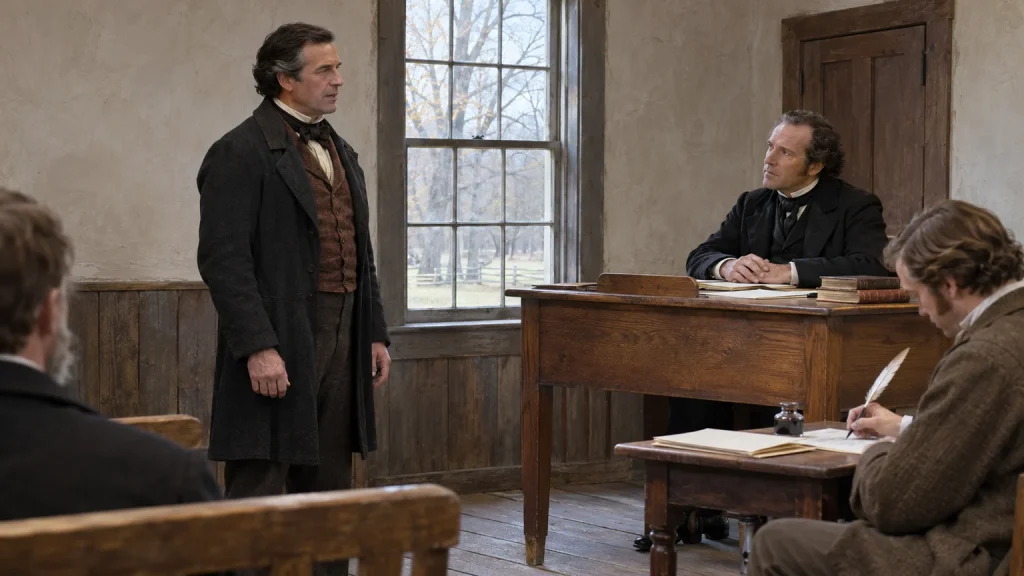
In August 1844, a poem honoring Joseph Smith appeared in the Nauvoo newspaper Times and Seasons. It ran under the title “Joseph Smith,” without an author’s name. Today we know it as “Praise to the Man.” The man who wrote it, William W. Phelps, had once testified against Joseph in a Missouri courtroom.
The letters they left behind show how close the two men had been, how badly they fell out, and what it took for them to call each other friends again.
What happened in the Missouri courtroom?
Phelps was a printer and a prominent leader in the early Church. In 1835, he and his twelve-year-old son lived with Joseph and Emma Smith in Kirtland while he worked on Church publications. When Phelps wrote home to his wife, Sally, Joseph added a note of his own, calling William her “most worthy Companion” and telling her how much he admired him.
In Missouri, Phelps clashed with other Church leaders over land and finances. He was excommunicated in March 1838 but was apparently back in fellowship by summer. That November, after months of armed conflict in Missouri, he testified for the state at a preliminary hearing in Richmond.
Phelps told the court that Sidney Rigdon had threatened to kill any sheriff who came to serve them with court orders. According to Phelps, Joseph then backed Rigdon and said that was what they intended to do. This was Phelps’s testimony, not a finding by the court. His testimony and that of other witnesses helped lead to Joseph’s detention in Liberty Jail while awaiting trial. In March 1839, Phelps was again excommunicated from the Church.
In April 1839, a flood damaged a mill dam in Missouri. Phelps wrote to John P. Greene offering to arrange a sale if he could get authorization from Joseph’s father and two other men. When Joseph learned of the offer, he wrote to Phelps on May 22 and told him to leave the family’s affairs alone. Just over a year later, Phelps wrote to Joseph directly. This time he wasn’t writing about property.
The letter that reopened the friendship
Writing from Dayton, Ohio, on June 29, 1840, Phelps compared himself to the prodigal son. He asked to return to fellowship with the Church. If that could not be granted, he asked for something more personal: peace and friendship.
Two apostles, Orson Hyde and John E. Page, added a note supporting his request. On July 19, Phelps’s letter was read to a congregation of Latter-day Saints, who voted unanimously to welcome him back into fellowship. Joseph wrote to him three days later.
In his reply, Joseph reached for the book of Obadiah, where a brother stands aside while strangers carry off his own people. The passage gave Joseph words for what had hurt: when trouble came in Missouri, someone he had once trusted had stood on the other side. His account of that hurt took up much of the letter.
Then Joseph took up Phelps’s own image from the parable of the prodigal son. He told Phelps that he believed his repentance was genuine and that he would be glad to welcome him back. To close, Joseph adapted a line from the Methodist hymnist Charles Wesley: “friends at first are friends again at last.”
From the letter to the hymn
By early 1844, Joseph was again trusting Phelps to write on his behalf. When Joseph ran for U.S. president, he asked Phelps to draft a pamphlet laying out his political views.
On June 29, 1844, two days after Joseph and Hyrum were killed at Carthage, Phelps was preaching at their funeral in Nauvoo as the hearse passed the meeting ground. The coffins in the procession held sandbags. Mourners feared the brothers’ bodies might be desecrated, so they buried them in secret. The man who had taken the stand against Joseph in Missouri was now speaking at his funeral.
On August 1, the Times and Seasons printed Phelps’s tribute to Joseph. In the original, Joseph’s blood would “Stain Illinois.” In today’s hymnbook, it would “Plead unto heaven.” The earlier wording still carries something of the anger that surrounded the funeral.
The name credited with that tribute in today’s hymnbook is the same one on the letter asking to come back.
Sources
- Joseph Smith Papers: Joseph Smith’s note to Sally Waterman Phelps, July 20, 1835
- Missouri State Archives: William W. Phelps’s testimony, November 1838 · Manuscript scan
- Joseph Smith Papers: Phelps’s letter to John P. Greene, April 23, 1839, and Joseph Smith’s reply to Phelps, May 22, 1839
- Joseph Smith Papers: William W. Phelps’s letter to Joseph Smith, June 29, 1840
- Joseph Smith Papers: Joseph Smith’s reply, July 22, 1840, with notes on the Missouri testimony · Closing lines of the letter
- Joseph Smith Papers: Joseph Smith’s 1844 campaign pamphlet and Phelps’s role in drafting it
- Richard S. Van Wagoner and Steven C. Walker, “The Joseph/Hyrum Smith Funeral Sermon,” BYU Studies
- “Joseph Smith,” Times and Seasons, August 1, 1844, p. 607
- “Remembering the Martyrdom,” Revelations in Context · “Praise to the Man,” hymn no. 27