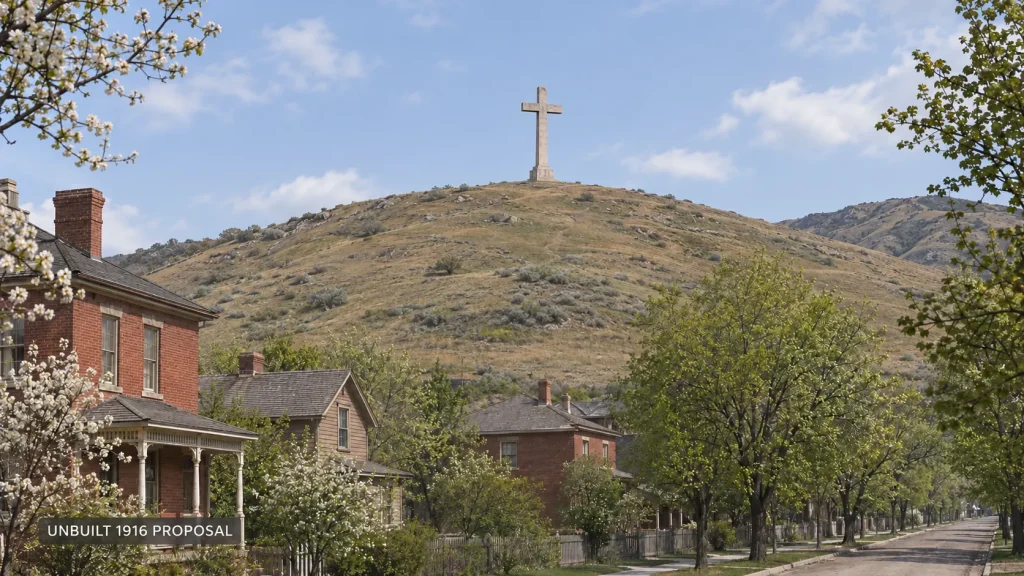
In 1916, Salt Lake City commissioners voted 4–1 to let The Church of Jesus Christ of Latter-day Saints build a large cross on Ensign Peak. It was meant to be visible across the city. The commissioners asked that the flagpole already on the summit be left standing if possible.
The cross was never built. And some of the people who opposed it were Latter-day Saints themselves.
Why Put a Cross on Ensign Peak?
Ensign Peak rises just north of downtown Salt Lake City. Brigham Young and several companions climbed it in July 1847, two days after Young entered the valley. By 1916, the summit was a natural place for a memorial to the pioneers. The question was what it should look like.
Charles W. Nibley, the Church’s Presiding Bishop, proposed a concrete and steel cross. In his petition, he called it “the symbol of Christianity.” In a letter later that month, he explained why visibility mattered: visitors came to Salt Lake City without knowing that Latter-day Saints believed in Jesus Christ. A cross on the peak, he thought, could tell them something about the faith of the pioneers.
Why Was the Cross Never Built?
Apostle Orson F. Whitney saw the symbol differently. He associated it with the Catholic Church and favored flying the American flag on Ensign Peak. He suggested placing a cross on Mount Timpanogos instead, in honor of the Franciscan explorer Silvestre Vélez de Escalante.
In a May 31 letter excerpted by historian Michael G. Reed, Nibley wrote that the cross brought to mind “the one who died upon the cross.” He connected that remembrance to what he did every Sunday when he took the sacrament. To him, the cross could speak for Christians of different traditions.
Rabbi Rice and Samuel Baskin raised a different objection: city-owned land should not carry the religious emblem of any one faith. They said they would object just as strongly to a Jewish symbol in the same spot.
The city’s approval did not settle the debate. As opposition grew both inside and outside the Church, Nibley dropped the plan.
In 1934, a separate pioneer memorial was unveiled on the summit: an eighteen-foot stone obelisk. That is the monument hikers see today.
Why Doesn’t the Church Display the Cross Today?
The Ensign Peak debate did not settle how Latter-day Saints would use the cross. Reed traces the shift away from the symbol into the 1950s, decades after the proposal was dropped.
Today, the Church does not display the cross on its buildings or in its chapels as a symbol of the faith. Its official emblem depicts the living, resurrected Jesus Christ. The Church’s explanation distinguishes that choice of emblem from its teachings: Christ’s death at Calvary is central to His Atonement, together with His suffering in Gethsemane and His Resurrection.
In his 2022 general conference address “Lifted Up upon the Cross,” Jeffrey R. Holland expressed respect for Christians who use the cross as an expression of faith. Nibley’s letter shows what the symbol meant to one Latter-day Saint leader a century earlier: it brought to mind the same sacrifice he remembered each Sunday at the sacrament.
Sources
- Michael G. Reed, The Development of the LDS Church’s Attitude Toward the Cross. Pages 76–89 include excerpts from the 1916 petition, the commission’s approval, and the Nibley–Whitney correspondence.
- Dennis A. Wright and Rebekah E. Westrup, “Ensign Peak: A Historical Review”, BYU Religious Studies Center.
- “Cross,” Topics and Questions, The Church of Jesus Christ of Latter-day Saints.
- Jeffrey R. Holland, “Lifted Up upon the Cross”, October 2022 general conference.