
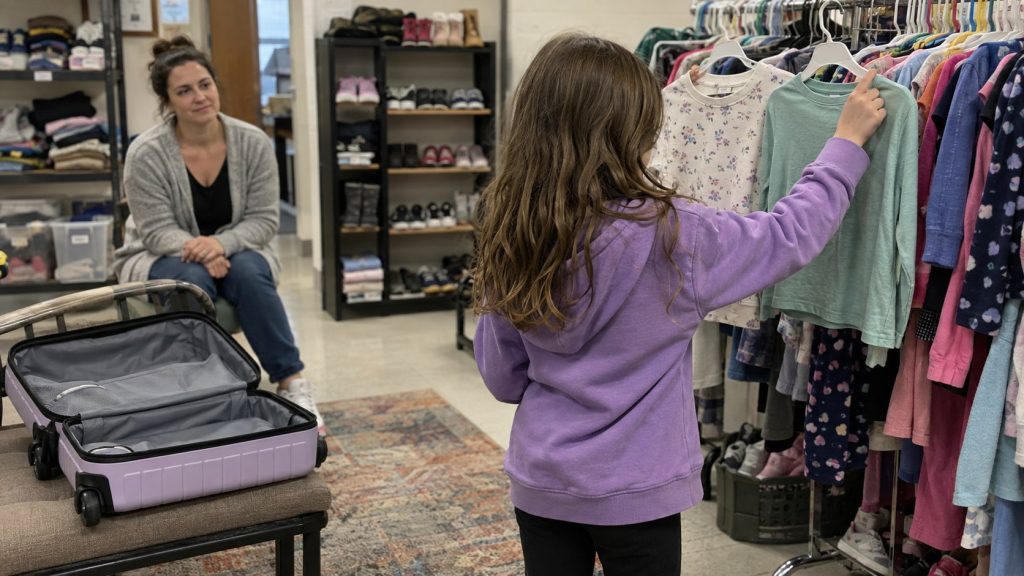
At one Idaho center, a suitcase, a rack of clothes and one simple question are being used to give a small piece of that control back.
A child entering foster care may not get to choose where they sleep that night. They may not know who will pick them up, how long they will stay, or when they will see their family again.
Sometimes the transition happens so quickly that everything they bring with them fits inside a garbage bag.
At The Village, a foster-care resource center in Blackfoot, Idaho, volunteers decided that at least one part of that experience should look different.
The child gets a suitcase.
Not because a suitcase can solve the larger crisis. It cannot. But because carrying your belongings in something that is actually yours can mean something at a moment when so much else suddenly feels temporary.
And even that is not the most important part.
The more important part is the question that comes next:
Which one do you want?
When Almost Every Decision Is Made for You
Inside The Village, children can choose clothing, shoes, hygiene products, toys, comfort items and other necessities free of charge.
The center is intentionally arranged more like a store than a traditional donation closet. Children can move through the space, look at what is available and decide for themselves what they want to take with them.
“When children enter care, many of their choices are taken away,” director Jacque Burt explained when the expanded facility opened earlier this year. “At The Village, they have a voice.”
That idea is not new.
When The Village opened its dedicated Blackfoot storefront in 2021, Burt described the purpose in almost the same terms. Allowing children to choose things for themselves, she said, “gives them their voice back.”
Five years later, that remains at the center of what the organization is trying to do.
Foster care exists to protect children when living at home is no longer safe or possible. But even when that intervention is necessary, entering care can bring an extraordinary loss of control.
Many of the biggest decisions in a child’s life may suddenly involve caseworkers, courts, caregivers and other adults — including where the child will live and what happens next.
The Village cannot change those decisions.
But it can avoid making one more decision for them.
Instead of simply handing a child whatever shirt or pair of shoes happens to be available, someone can ask:
Do you want this one — or that one?
It is a small question. But at that moment, small questions can carry unusual weight.
Childhood Does Not Stop During a Crisis
The Village opened its dedicated Blackfoot storefront in 2021 after its organizers had already been helping foster children through other local spaces. Since then, it has grown from a small foster-care closet into a much larger resource center serving families across 16 counties in southeastern Idaho.
According to the organization, it served 869 children in 2025. In March 2026 alone, another 87 children received help.
The expanded facility now includes private dressing rooms and formal clothing for teenagers who may need something to wear to prom or another special event. There is also a birthday room where foster parents, social workers and CASA volunteers can find gifts for children in care.
Those details change the story.
Foster care is not only about the night a child leaves home.
Children still grow out of their shoes. Winter still comes. Birthdays still happen. Teenagers still get invited to dances and special events.
A child experiencing family disruption does not stop being a child.
The Village allows children and foster families to return when needs change — after a growth spurt, when the seasons change or when another ordinary part of childhood creates a new need.
The goal is not merely to respond to an emergency.
It is also to preserve pieces of normal life inside an abnormal situation.
The Church Was Already Part of the Story
Long before Relief Society General President Camille N. Johnson visited The Village this September, The Church of Jesus Christ of Latter-day Saints had already become part of the effort to expand its work.
In 2025, the Church contributed $65,000 to the Idaho Foster & Adoptive Parent Association as the organization developed its larger Blackfoot facility.
That contribution mattered, but it was only one part of a broader community effort.
Local companies provided financial support. Contractors donated materials and labor. Volunteers gave their time. Other organizations stepped in as well.
Later, The Village was selected as one of the charities featured in the Church-sponsored Light the World Giving Machines in Idaho Falls.
When the final totals were announced, individual donors using those machines had contributed another $141,000 to The Village.
That money came from people who chose to support The Village through the Giving Machines, not directly from the Church. The Church sponsors the machines and covers their operating costs so donations can go to participating charitable organizations.
The distinction matters because it shows what the project actually became: not one institution arriving to solve a problem, but a network of people, businesses, volunteers and religious organizations responding to a very specific need.
The Church’s role was substantial.
But the story was larger than the Church alone.
Camille Johnson Came to See What That Help Had Built
On September 25, Relief Society General President Camille N. Johnson visited The Village during a ministry visit to southeastern Idaho.
For Latter-day Saints, her role is significant. As Relief Society General President, Johnson leads the Church’s worldwide women’s organization.
During the visit, Burt showed her what children experience when they come to the center and explained that some arrive carrying their belongings in garbage bags.
“These kids come to us with a garbage bag, and sometimes that’s all they have left,” Burt said.
The goal is different when they leave.
“We want them to walk out with a suitcase.”
Later that same day, more than 900 people gathered in Blackfoot to hear President Johnson speak.
Her message centered on a word that carries particular meaning inside Relief Society:
relief.
“Jesus Christ is relief,” President Johnson said. “He’s the source of all of our relief. And we’re members of the Relief Society, bringing His relief to all of God’s children.”
By itself, that phrase can sound broad.
Relief might bring to mind disaster zones, food shipments, emergency shelters or major financial donations.
But after walking through a place like The Village, the word becomes much more concrete.
Sometimes relief is large and institutional. Sometimes it requires tens of thousands of dollars, donated materials and years of community work.
And sometimes it looks like giving a child enough room to say:
No, I don’t want that shirt. I want this one.
A Suitcase Cannot Fix Foster Care
A suitcase cannot repair the crisis that brought a child into foster care.
New shoes cannot remove fear.
A birthday gift cannot answer the biggest questions about what happens next.
And The Village does not pretend otherwise.
That may be exactly why the smaller choices matter.
A child may not get to choose where they sleep that night. They may have little control over many of the decisions that shape what happens next or when life begins to feel normal again.
But someone can still make sure their belongings no longer travel in a garbage bag.
Someone can give them a suitcase that is theirs.
And someone can leave one decision in their hands:
Which one do you want?
For members of the Church, that small question gives President Johnson’s words about relief a remarkably practical meaning.
Relief does not always mean removing the whole burden.
Sometimes it means recognizing the part of that burden you actually can lift — and giving something back that a child should never have had to lose in the first place:
a voice.