We worship Jesus Christ, the Son of Mary, who was crucified at Calvary and rose from the dead.
We also do not accept the Nicene account of exactly how the Father and the Son are one.
Both statements are true of Latter-day Saint belief.
If someone believes the second automatically cancels the first, then that is the argument we should actually be having.
Because the phrase “different Jesus” can mean two very different things.
It can mean that Latter-day Saints direct their faith toward someone other than the Jesus of the New Testament.
Or it can mean that we identify Jesus correctly but believe such serious errors about Him that our confession no longer represents Him faithfully.
Those are different accusations.
Our scriptures give a clear answer to the first.
The second requires a theological argument.
The Book of Mormon Identifies Him by the Wounds of Calvary
The strongest Latter-day Saint answer is not simply, “We use the name Jesus too.”
It is much more specific.
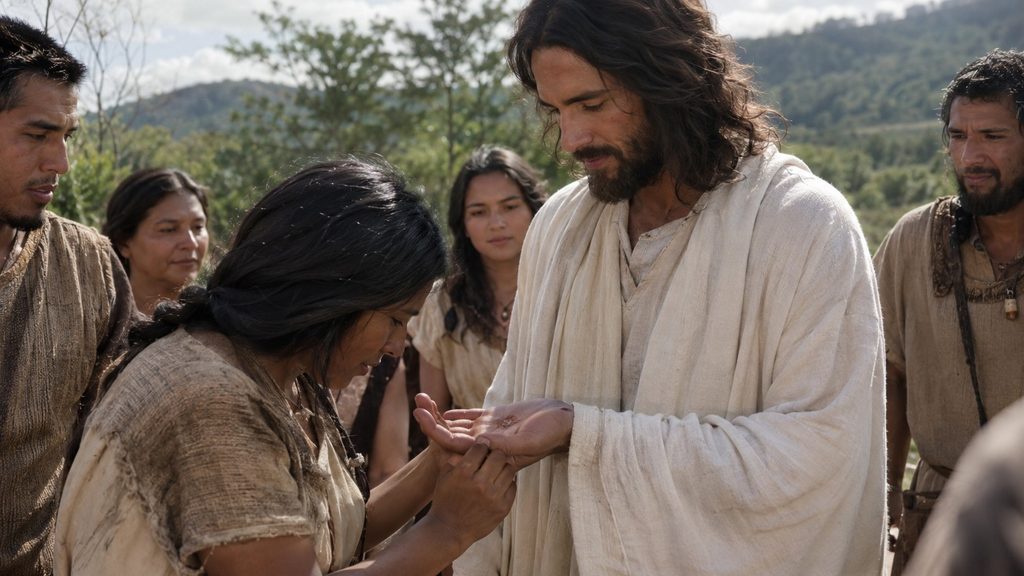
In 3 Nephi 11:10–17, the risen Lord declares:
“I am Jesus Christ.”
He then invites the people to feel His side and the nail prints in His hands and feet. In the same scene, He identifies Himself as the God of Israel and the God of the whole earth, and the people fall before Him in worship.
The Book of Mormon identifies its God by the wounds of the New Testament Jesus.
Mosiah 3:8–10 makes the connection another way. Christ is named Jesus. His mother is named Mary. He is called “the Creator of all things from the beginning.” The following verses describe His crucifixion and resurrection on the third day.
That is not merely a shared religious title.
It is a cumulative identity:
Mary.
Jesus Christ.
Crucifixion.
Third-day resurrection.
The wounds.
A person can reject the Book of Mormon as revelation. But it is difficult to claim honestly that the book itself intends its Christ to be some unrelated being who merely happens to share the name Jesus.
The real debate begins after that point.
Paul’s “Another Jesus” Warning Is a Serious Objection
Latter-day Saints should not dismiss the phrase “another Jesus” as nothing more than an anti-Mormon slogan.
Paul himself uses the expression in 2 Corinthians 11:4.
And an informed evangelical does not need to claim that we have confused two historical men.
The stronger objection is this:
You correctly point to Jesus of Nazareth, but you teach such fundamentally false things about Him that your message deserves Paul’s label “another Jesus.”
That argument deserves an answer.
An evangelical reading of the passage can make precisely this distinction: Paul’s opponents could refer to Jesus while still distorting the message about Him badly enough to warrant the warning. See, for example, The Gospel Coalition’s commentary on 2 Corinthians 11.
Our own scripture also prevents us from pretending doctrine does not matter.
Doctrine and Covenants 93:19 connects revealed teaching with the need to “know what you worship.”
We have no reason to argue that Christ’s nature is irrelevant.
But Paul’s warning does not automatically prove its application to Latter-day Saints.
The key question is not whether Paul used the word homoousios. He obviously did not. The question is whether the apostolic witness itself requires the Christological conclusion later articulated at Nicaea.
A Nicene Christian may argue that it does—that John 1, Colossians 1, Hebrews 1, and the wider New Testament place the Son eternally on the divine side of the Creator–creation distinction.
But that connection has to be demonstrated. It cannot simply be assumed by quoting “another Jesus.”
A critic still has to establish which apostolic teachings about Christ we deny, why our interpretation is wrong, and why those errors cross the line from misunderstanding Jesus to worshipping another Jesus.
That gives us one of the clearest principles in this entire debate:
“Another Jesus” can express the conclusion of a theological argument. It cannot do the work of the argument itself.
Simply repeating the phrase does not prove the case.
The Difference Between Latter-day Saint and Nicene Christology Is Real
We should not minimize it.
Nicene Christianity teaches that the Father and the Son are distinct Persons who fully possess the one divine essence. The Catechism of the Catholic Church, §§252–255 gives a clear modern expression of this understanding.
Latter-day Saints understand the Father and the Son as distinct beings, perfectly united in their divine work.
Those accounts are not two slightly different ways of saying the same thing.
They are fundamentally different understandings of God.
And the strongest Nicene case does not depend merely on the authority of a fourth-century council. It appeals directly to passages such as John 1:1–3, Colossians 1:15–17, and Hebrews 1:5–12.
So if a Catholic, Orthodox Christian, or Protestant says:
“Your Christology is different from ours.”
Yes.
It is.
But another step is required to get from there to:
“Therefore you worship a different Jesus.”
And Christian history itself helps show why.
Nicaea Shows Why These Are Two Different Questions
The controversy surrounding the Council of Nicaea concerned the eternal nature of the Son.
The competing sides were not arguing about two unrelated first-century men.
They were arguing about who the Son truly was.
What was His relationship to the Father? Was He eternally divine? How should Scripture’s language about Him be understood?
Eusebius’s account of the Council of Nicaea preserves both a confession of Jesus Christ and the council’s effort to draw boundaries around how His nature could properly be understood.
The council ultimately rejected competing teachings.
A Nicene Christian can therefore respond:
“Exactly. Some understandings of Jesus were judged outside orthodox Christianity.”
Correct.
We are not asking Nicene Christians to call Latter-day Saint theology orthodox.
That is not the claim.
The claim is narrower:
A dispute about the nature of Christ can be a dispute about the same Jesus—and still concern an error that one side considers fundamental.
Nicaea shows both things at once.
Christology matters enormously.
And people can still be arguing about the same Jesus while disagreeing radically about how He should be understood.
So saying “your doctrine about Christ is false” and saying “you have switched to another Jesus” are not identical statements.
That is the distinction we are asking critics to defend rather than assume.
Gordon B. Hinckley Did Acknowledge the Divide
Some of the most uncomfortable quotations in this debate come from President Gordon B. Hinckley himself.
Speaking at a member meeting in Paris, France, on June 4, 1998, he said:
“The traditional Christ of whom they speak is not the Christ of whom I speak. For the Christ of whom I speak has been revealed in this the Dispensation of the Fulness of Times. He together with His Father appeared to the boy Joseph Smith…”
That statement appears in the Church News report on President Hinckley’s 1998 European visit.
He did not hide the difference.
He located the difference in Restoration revelation and the nature of God.
And the broader record from that Paris meeting matters. President Hinckley also testified of Jesus Christ as the Redeemer who died at Calvary and rose on the third day. Church News later reproduced that testimony.
Then, in General Conference in 2002, Hinckley returned to the same criticism:
“There is some substance to what they say.”
He then contrasted dependence on ancient creeds with the testimony of a modern prophet who saw the Father and “His Beloved Son, the resurrected Lord Jesus Christ.”
The full address, “We Look to Christ,” can be read here.
So what did Hinckley acknowledge?
A profound disagreement about how Christ is defined, how the Father and Son relate, and where authoritative knowledge about Them comes from.
What did he not concede?
That Latter-day Saints had replaced Jesus of Nazareth—the crucified and resurrected Christ—with some unrelated figure.
That distinction is exactly the argument of this article.
“Latter-day Saints Don’t Believe Jesus Is God”
That claim does not survive contact with the Book of Mormon.
The Book of Mormon title page calls Jesus “the Christ, the Eternal God.”
Mosiah 3:8 identifies Mary’s Son as “the Creator of all things from the beginning.”
In 3 Nephi 9:15, Jesus says that He created the heavens and the earth.
And in 3 Nephi 11:14, the risen Jesus identifies Himself as the God of Israel and the God of the whole earth.
Those are direct affirmations of Christ’s divinity.
So the real disagreement is not:
Christians believe Jesus is God.
Latter-day Saints do not.
The real disagreement is:
What do Latter-day Saints mean when we call Jesus God?
That is a serious question.
It is also a much more accurate one.
Calling Jesus “God” establishes that Latter-day Saints confess Him as divine.
It does not establish that we mean exactly what Nicene Christianity means by divine.
That is where the actual argument belongs.
“But Your Jesus Was Created”
This objection points toward a genuine disagreement.
But the word created can obscure as much as it clarifies.
Latter-day Saints confess Christ as the Firstborn in premortality. Doctrine and Covenants 93:21, 29 also speaks of the Firstborn and of intelligence as something that “was not created or made.”
Latter-day Saint teaching therefore rejects creation out of absolute nothingness. The Church’s Gospel Topics essay “Becoming Like God” discusses this broader Latter-day Saint understanding of eternal existence.
Nicene Christianity, meanwhile, confesses the Son as eternally begotten, not made, and consubstantial with the Father.
Here is the important part:
We do not confess Nicene consubstantiality.
The disagreement is deeper than a label: Nicene theology and Latter-day Saint theology begin with different accounts of the basic relationship between God, intelligence, and creation.
That is a real difference.
So argue with that.
Simply saying “the Latter-day Saint Jesus is a created being” can hide the fact that the two theological systems are already using different concepts of creation, premortal existence, and divine sonship.
Church publications themselves sometimes use creation language for spirit children while distinguishing that idea from creation out of absolute nothingness. See, for example, this Liahona explanation.
We do not need to outlaw the word created.
We need to define what is meant by it.
We do not confess consubstantiality. Debate that—not the shortcut.
“Jesus and Satan Are Brothers”
In one specific Latter-day Saint sense, yes.
Christ, Lucifer, and humanity belong within the Father’s premortal family.
But that does not make Jesus and Satan two equal divine rivals.
Jesus is our divine Savior, Redeemer, and Jehovah.
Lucifer rebelled against God and became Satan.
The Church has addressed this claim directly in its Newsroom explanation about Jesus and Satan.
The shortest answer is also the strongest:
Premortal family relationship does not make Satan a second Jehovah.
The phrase “Jesus and Satan are brothers” becomes rhetorically explosive when it isolates those two figures and leaves out everyone else in the same premortal family.
It establishes relationship.
It does not establish equality.
A Nicene Christian may still reject the entire premortal framework.
That is a theological dispute.
But the slogan itself should not be allowed to imply something Latter-day Saints do not believe.
So What Is the Claim We Actually Have to Defend?

Eventually this argument reaches something deeper than terminology.
Authority.
A Nicene Christian can believe that Jesus Christ is alive and still reject Joseph Smith’s claim to have received revelation from Him.
So the final issue cannot simply be:
“Do you believe Jesus can still speak?”
The deeper question is:
Did the risen Jesus actually reveal Himself again—and does Restoration revelation have authority to correct inherited Christian definitions?
That is where the disagreement reaches its foundation.
An evangelical critique framed around this deeper question appears, for example, in Gerald McDermott’s contribution to the exchange “Is Mormonism Christian?”.
For Latter-day Saints, the question is whether the risen Lord actually revealed Himself through Joseph Smith and whether Restoration teaching faithfully tells us how Christ should be understood.
That is the Restoration’s claim.
And that is the claim we have to defend.
Same Jesus. Different Christology.
We worship Jesus Christ.
The Son of Mary.
The Lord who was crucified.
The Savior who rose from the dead.
The Christ who still bears the wounds of Calvary.
We also make claims about His relationship to the Father, premortal existence, revelation, and the nature of God that Nicene Christians reject.
We should not hide that.
But neither should the disagreement be rewritten before the argument even begins.
If the claim is:
“Latter-day Saints understand Jesus differently from Nicene Christianity.”
Yes.
We do.
If the claim is:
“Therefore Latter-day Saints worship a different Jesus.”
then we have moved from description to theological judgment.
And that judgment still has to be defended.
“Another Jesus” may be the conclusion of the argument. It cannot replace the argument.
The real Restoration claim is not that we discovered another Christ.
It is that the same risen Jesus Christ has spoken again.
And whether that claim is true is where the real disagreement begins.
Author’s Note: This article reflects the author’s personal perspective and interpretation. It is not an official statement of The Church of Jesus Christ of Latter-day Saints.