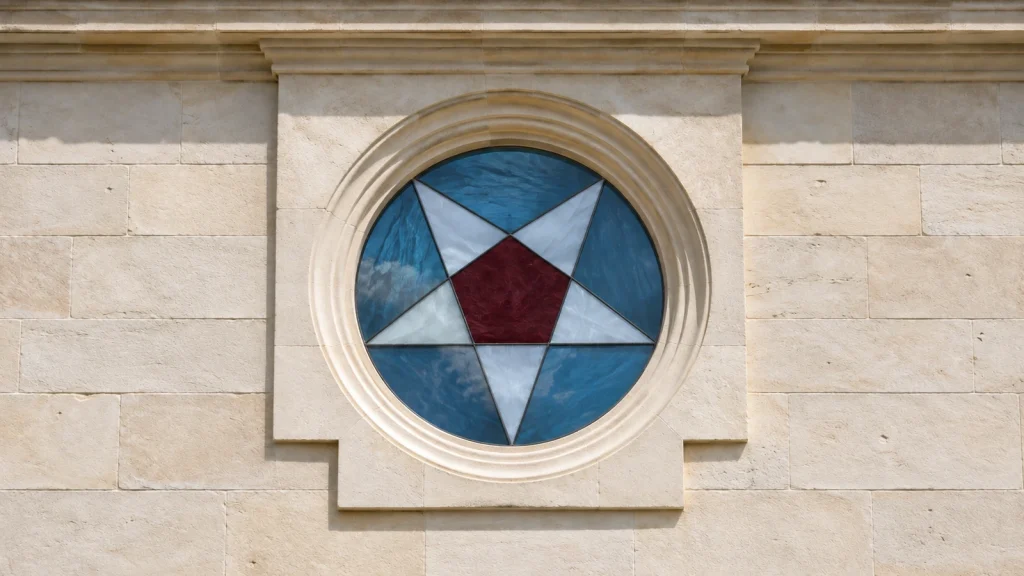
Look up at one of the round windows of the Nauvoo Illinois Temple and you’ll see a five-pointed star with one point aimed straight down. It’s easy to notice. It’s harder to guess what a Latter-day Saint in the 1840s might have seen in it.
Now look down the wall. Near the roofline are stars. Below them are stone faces surrounded by rays, and near the ground are crescent moons. You might recognize the sun, moon, and stars from the way Latter-day Saints talk about the degrees of heavenly glory. But if that were the whole explanation for Nauvoo, why would the stars sit above the sun?
A man who helped build the original temple left a clue. He pointed to a woman in the Book of Revelation.
Why is the star upside down?
Today, an upside-down star may bring occult imagery to mind, but that association doesn’t tell us what the star meant in Nauvoo.
The Nauvoo Temple Visitors’ Center exhibit on the star windows explains that a downward-pointing morning star was used in the nineteenth century as a symbol of Jesus Christ. In Revelation 22:16, Jesus calls Himself “the bright and morning star.”
There’s a useful piece of historical evidence behind that reading. In the Joseph Smith Papers podcast on the Nauvoo Temple, Church historian Matthew McBride points to a nineteenth-century Latter-day Saint source that calls a similar star on the Logan Tabernacle the morning star. That tells us how at least some Latter-day Saints of the period understood the shape. It’s evidence for the interpretation, though it’s not a written explanation from Nauvoo’s architect, William Weeks.
The motif wasn’t limited to glass. Architectural drawings and early photographs discussed by BYU’s Religious Studies Center show that the original temple also had carved stars near the roofline, with their bottom rays elongated. The window and the carving are two details worth looking for separately.
Read the Nauvoo Temple from the ground up
Start at the base of one of the shallow columns that project from the wall, called pilasters. There’s a crescent moon carved into the stone. At the top of the same pilaster is a sun with a human face emerging from clouds. Two hands holding trumpets appear above the rays. Look higher still and you reach the star.
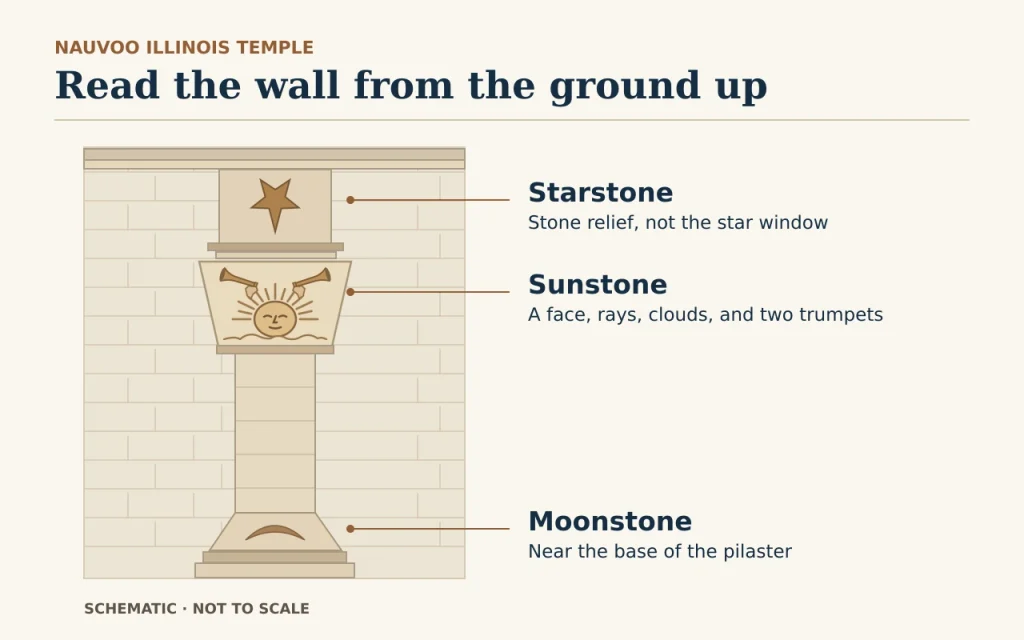
In his autobiography, Nauvoo Temple builder Wandle Mace recalled the woman in Revelation 12:1. She is clothed with the sun, has the moon under her feet, and wears a crown of twelve stars. Mace saw that biblical image in the carved stone of the temple. His recollection makes sense of a detail that a list of symbols would miss: what sits above what. The passage describes twelve stars in the crown; it isn’t a count of the stars on the building.
The sunstone also carries a meaning of its own. The Church History Museum explains that early Saints saw the sun breaking through clouds as the dawn of the Restoration, with the trumpets announcing the return of gospel light. That reading helps explain why the sun was carved as a scene, complete with clouds and trumpets, rather than as a simple disk.
What changes when you look at the Salt Lake Temple?
On the Salt Lake Temple, a Church history teaching manual identifies a different grouping: the sunstone represents the celestial kingdom, the moonstone the terrestrial kingdom, and the earthstone the telestial kingdom. The comparison to different kinds of heavenly brightness is familiar from 1 Corinthians 15:40–42 and Doctrine and Covenants 76. But on this particular building, in the manual’s explanation of the three kingdoms, it’s the earthstone that completes the set.
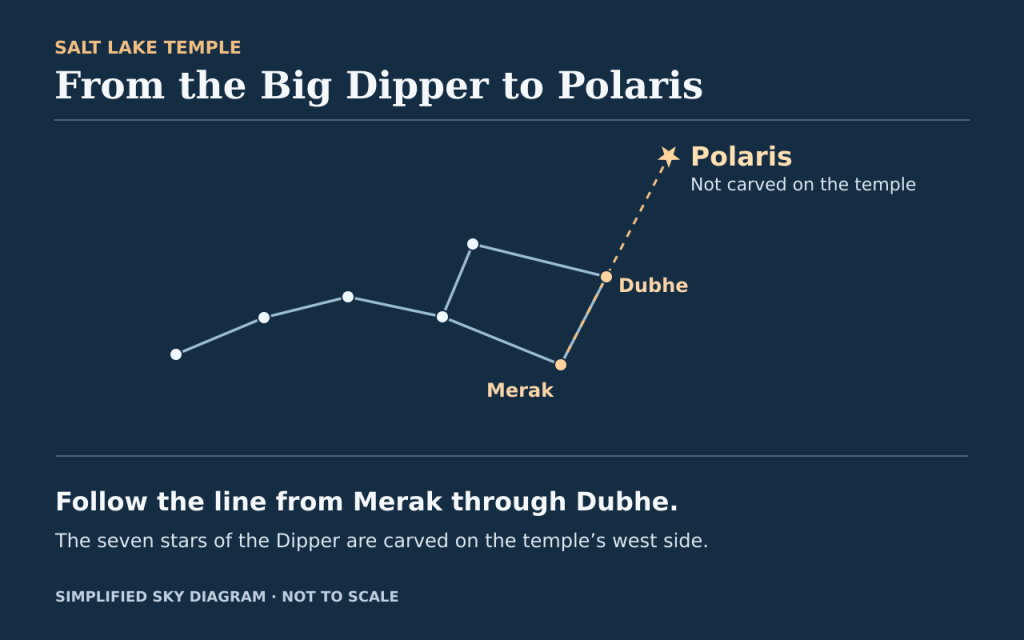
The stars offer a different clue. On the west side of the temple, seven stars are arranged as the Big Dipper. In the sky, the two stars on the outer edge of the Dipper’s bowl point toward Polaris, the North Star. The teaching manual uses that familiar way of finding north as an image of spiritual guidance: Church leaders help point people toward their Heavenly Father.
These symbols didn’t disappear after the nineteenth century. The Washington D.C. Temple, dedicated in 1974, has bronze medallions on its exterior doors depicting the sun, the moon, and the stars. Unlike the carving in Salt Lake City, the design here shows both the Big Dipper and the North Star.
So if you see a star on a temple, look at what’s around it before deciding what it means. In Nauvoo, a single downward-pointing star can recall a name Jesus gave Himself. The stars grouped above the sun and moon help tell another story. And in Salt Lake City, seven stars ask you to look beyond the stone altogether and think about where they point.