The sacrament hymn ends. One person kneels at the table to bless the bread, and everyone else stays seated. It’s a familiar scene in The Church of Jesus Christ of Latter-day Saints.
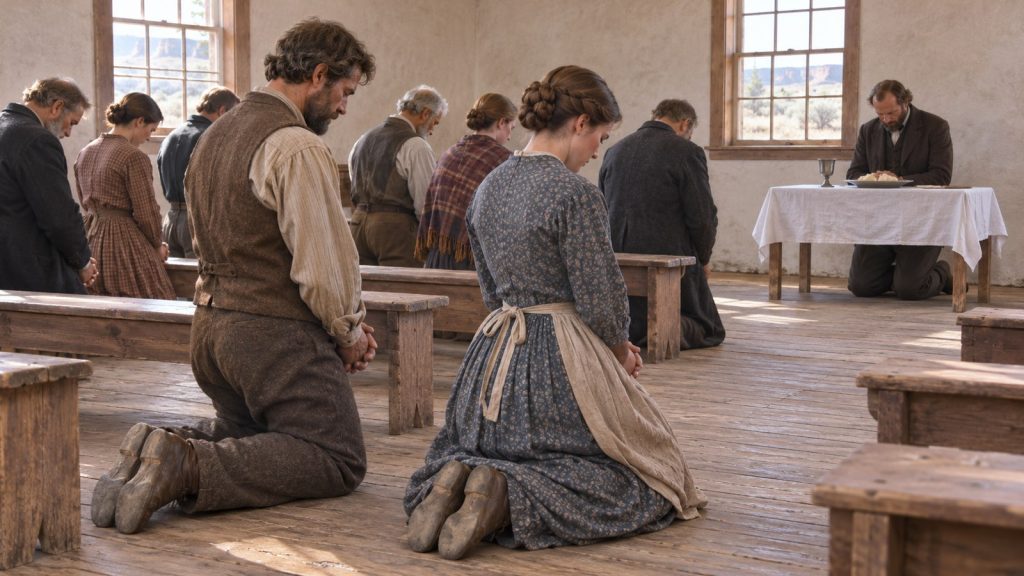
But just before the prayer for the bread, Doctrine and Covenants 20:76 says that the person offering it shall “kneel with the church.” In Kanab, Utah, one Sunday in 1879, those words meant exactly what they sound like: the congregation knelt, too.
The Sunday Kanab knelt
The phrase appears in the Church’s early Articles and Covenants, and similar wording appears in Moroni 4:2. Those texts tell us what was written. Records from the Church’s earliest years tell us much less about what people in the congregation actually did during the prayers.
By the 1860s, sitting appears to have been usual in Utah. That’s what makes L. John Nuttall’s diary so striking. In April 1879, the Kanab Stake president noticed people sitting during the sacrament prayers and urged them to kneel. A week later, he recorded what happened:
The Saints kneeled whilst blessing was being asked on bread and water.
This wasn’t a custom that Kanab had simply carried forward unchanged. The congregation had been sitting, and on that Sunday it knelt at Nuttall’s urging. Later accounts describe congregations kneeling elsewhere in Utah and even in Amsterdam, but the practice was never universal.
Why did the congregation stay seated?
At a stake conference in Ogden in 1893, Joseph F. Smith pointed to the size of congregations, the design of meetinghouses, and the noise of everyone kneeling and getting up again. He saw no similar obstacle for the person saying the prayer.
Two years later, Apostle Abraham H. Cannon recorded a revealing distinction: Smith believed the revelation had originally meant for the congregation to kneel, but thought the Church’s growth had made that impractical. By 1899, a Deseret Evening News answer offered another way to read the phrase: the person giving the blessing could kneel “in the presence of the Church” while everyone else remained seated.
On June 13, 1901, the First Presidency and apostles settled a narrower question: of the men administering the sacrament, only the one saying the prayer should kneel. That date tells us when leaders agreed on a uniform procedure for those at the table, not when the last congregation stopped kneeling. A 1902 Improvement Era answer still described congregational kneeling as acceptable, even as it recalled it as a custom from the days of smaller congregations.
What does the Handbook say today?
Section 18.9.4 of the current General Handbook directs the person blessing the bread or water to kneel. It gives no instruction for the congregation to kneel.
The next time the sacrament hymn ends, listen for the words “we ask thee.” In Kanab in 1879, the congregation knelt together during the prayer. Today we hear it from our seats. One person speaks, but the prayer still says “we.”
Related: Why do Latter-day Saints take the sacrament with their right hand?
Sources
- Doctrine and Covenants 20:76–77, Moroni 4:2, and the early manuscript copy of the Articles and Covenants.
- David W. Grua and Jonathan A. Stapley, “The Letter and the Spirit: The Lord’s Supper and Set Forms in Two Restoration Churches”, The John Whitmer Historical Association Journal 43, no. 1 (Spring/Summer 2023): 218–231. See pp. 227–230 for congregational posture, Nuttall’s diary, and the 1899 newspaper answer. Author-posted copy.
- Justin R. Bray, “The Sabbath, the Sacrament, and the Latter-day Saints”, on what Nuttall observed in Kanab.
- Church History Library, “Did congregations used to kneel during sacrament prayers?”, citing Joseph F. Smith’s 1893 discourse and the April 1902 Improvement Era answer.
- Abraham H. Cannon’s diary, September 26, 1895, and Marriner Wood Merrill’s and Rudger Clawson’s diaries, June 13, 1901, transcribed in the University of Virginia’s Mormon Studies archive.
- General Handbook, Section 18.9.4, “Instructions”.