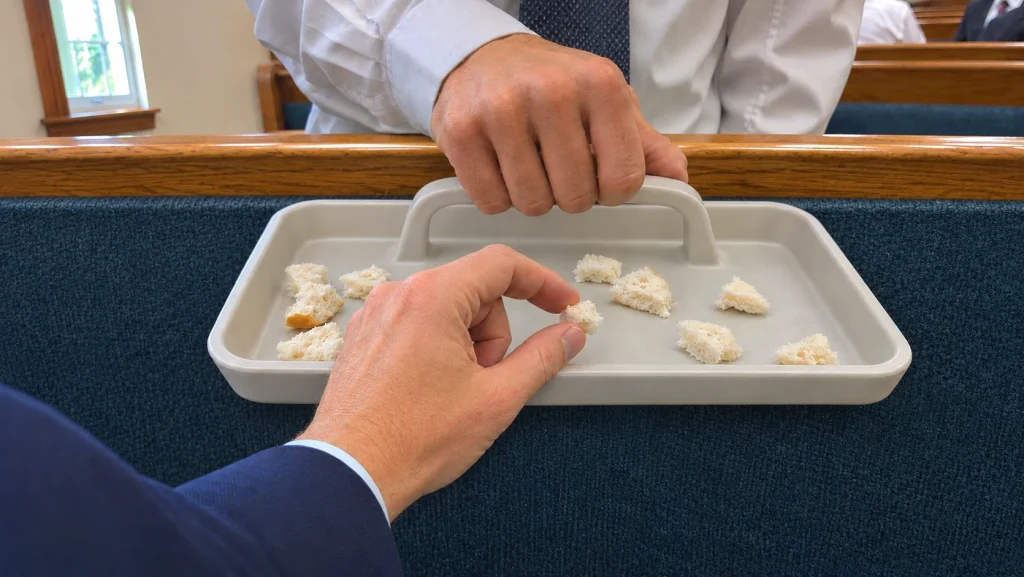
You reach for the bread with your left hand. The tray moves on, and you don’t give it another thought. Years later, someone tells you the Church handbook says to use your right. Did you miss an instruction? And does it change anything about all those Sundays?
Church leaders discussed that very question in 1952. Their answer is worth reading alongside what the handbook says today.
What the Handbook Actually Says
The General Handbook (section 18.9.4, item 7) says: “Members partake with their right hand when possible.”
That’s about taking the bread and water, not passing the tray to the person beside you. And when possible matters. If your right hand is in a cast, for example, the wording already makes room for using your left. The sacrament prayers themselves don’t specify a hand.
What Church Leaders Said in 1952
On February 20, 1952, David O. McKay brought up a concern at a First Presidency meeting: some members were coming to see taking the sacrament with the left hand as improper. The leaders recognized the custom of using the right hand when making a covenant. McKay’s diary records how they understood its limits:
… failure so to do would not vitiate the covenant.
In plain English, they didn’t believe using the other hand made the covenant invalid.
Why the Right Hand?
In the March 1983 issue of Ensign, Russell M. Nelson connected the gesture to the use of the right hand in making solemn promises. He also explained that people who have lost the use of their right hand, or who have no hands at all, can still make sacred covenants.
You may have learned the practice as a child, or this may be the first you’ve heard of it. The custom is older than the current handbook. The wording we read today, including when possible, appeared in the new General Handbook in 2020.
What If You’ve Always Used Your Left?
If the instruction is new to you, use your right hand next Sunday if you can. As for all those Sundays before that, McKay’s diary offers a reassuring answer: the leaders saw meaning in the gesture without making the covenant depend on it.
When the tray comes down the row again, the bread and water are there to help you remember Jesus Christ.
Sources