
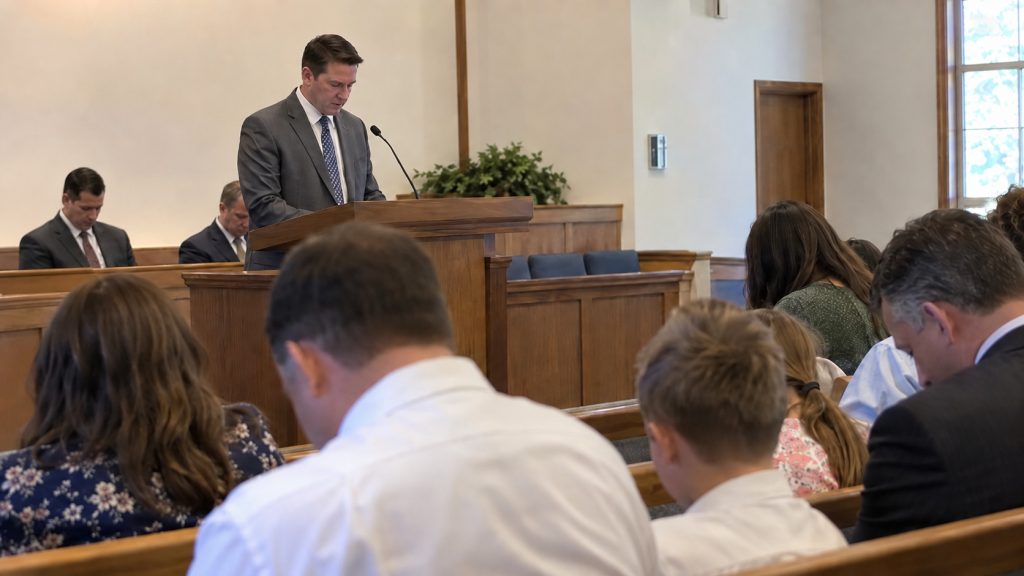
If you have been asked to give an opening or closing prayer at a Latter-day Saint Church meeting, you do not need to prepare a formal speech or memorize a prescribed prayer. The current General Handbook 29.6 says prayers in Church meetings should be brief, simple, and directed by the Spirit. The examples below are meant to help you know what a natural prayer can sound like—not to give you a script you are required to follow.
The opening prayer is also sometimes called the invocation, while the closing prayer may be called the benediction.
Quick LDS opening and closing prayer examples
Short LDS opening prayer example
Our Heavenly Father, we are grateful to be together on this Sabbath day. We thank Thee for the opportunity to worship and partake of the sacrament. We ask Thee to bless us with Thy Spirit and help us learn what we need to learn today. In the name of Jesus Christ, amen.
Short LDS closing prayer example
Our Heavenly Father, we thank Thee for this meeting and for the messages we have heard. We are grateful for Thy Spirit and for the opportunity to worship together. Please help us remember what we have learned and apply it in our lives. In the name of Jesus Christ, amen.
If your mind goes blank
A very short prayer is completely appropriate:
Heavenly Father, we thank Thee for bringing us together today. Please bless us with Thy Spirit as we worship. In the name of Jesus Christ, amen.
You do not need to make a prayer longer simply because you are praying in front of a congregation.
Need ideas for what to say?
If you are not sure what to include, choose just one or two things that naturally fit the meeting.
You might thank Heavenly Father for:
- the opportunity to meet together;
- the Sabbath day;
- Jesus Christ and the sacrament;
- the gospel or scriptures;
- a teacher, speaker, or hymn;
- the Spirit you have already felt.
You might ask for:
- the Spirit to be with the meeting;
- help for speakers or teachers;
- help understanding what is taught;
- help applying what is learned.
These are prompts, not a list you need to cover. A simple, sincere prayer may include only one expression of gratitude and one request.
How do Latter-day Saints pray in Church meetings?
Latter-day Saint prayers are normally offered in a person’s own words. There is no required four-part script for an ordinary opening or closing prayer.
EnglishConnect and other Church teaching materials commonly use a simple pattern that can be especially helpful if you are new to praying aloud:
- Address Heavenly Father — “Our Heavenly Father …”
- Express gratitude — “We thank Thee for …”
- Ask for appropriate blessings — “We ask Thee to …”
- Close in the name of Jesus Christ — “In the name of Jesus Christ, amen.”
This is a commonly taught pattern, not a required formula in which every prayer must contain exactly four parts or follow exactly the same wording.
The Church’s How to Pray page similarly emphasizes speaking sincerely to Heavenly Father rather than relying on eloquent or memorized words. That page explains personal prayer more broadly; the examples here focus specifically on opening and closing prayers in Church meetings.
What should you say in an LDS opening prayer?
There is no required checklist for an LDS opening prayer. The purpose is not to summarize the meeting agenda or give a miniature sermon.
An opening prayer may naturally include gratitude for being together, thanks for the Sabbath or the opportunity to worship, a request for the Spirit, or a request that speakers, teachers, and those attending will be helped.
For example, you might pray for those present to feel peace, understand the messages being shared, or draw closer to Jesus Christ.
These are ideas, not required elements.
LDS opening prayer example for sacrament meeting
Our Heavenly Father, we are grateful to gather together today and worship Thee. We thank Thee for Thy Son, Jesus Christ, and for the opportunity we have to partake of the sacrament and remember Him. We ask Thee to bless us with Thy Spirit during this meeting. Please bless those who will speak and help each of us receive the things we need to hear and feel today. We are grateful for Thy love and for the blessings Thou hast given us. In the name of Jesus Christ, amen.
Notice what this prayer does not do. It does not try to sound impressive, explain doctrine to the congregation, or mention every possible need in the ward. It is simply a prayer appropriate to the meeting.
What should you say in an LDS closing prayer?
A closing prayer does not have a separate required format.
In practice, however, a closing prayer often reflects on the meeting that has just taken place. It may express gratitude for the sacrament, speakers, teachers, music, or spiritual impressions and ask for help remembering or applying what was learned.
Again, this is common practice rather than a prescribed Church formula.
LDS closing prayer example for sacrament meeting
Our Heavenly Father, we thank Thee for the opportunity we have had to worship together today. We are grateful for the sacrament and for the messages that have been shared. We thank Thee for Thy Spirit and for the things we have been able to learn and feel. Please help us remember Jesus Christ throughout the coming week and help us act on the good impressions we have received. Please bless us as we return to our homes and responsibilities. In the name of Jesus Christ, amen.
The closing prayer should not simply repeat the opening prayer with a few words changed. It can naturally reflect the fact that the meeting has now taken place.
Opening prayer vs. closing prayer: Is there a difference?
There is no separate official formula for the two prayers, but their emphasis often differs naturally because they occur at different points in the meeting.
| Opening prayer (invocation) | Closing prayer (benediction) |
|---|---|
| Usually looks ahead to the meeting | Usually reflects on the meeting |
| May ask for the Spirit to be present | May express gratitude for what was felt or learned |
| May ask for help for speakers or teachers | May ask for help applying what was taught |
| May express gratitude for gathering together | May express gratitude for the meeting just completed |
| Has no prescribed script | Has no prescribed script |
COMMON PRACTICE: These are useful patterns, not separate formulas required by the Church.
How long should an LDS opening or closing prayer be?
The Church does not prescribe a specific number of seconds or minutes for an opening or closing prayer.
The current General Handbook teaches that prayers in Church meetings should be brief and simple and directed by the Spirit.
You do not need to count the length of your prayer. A sincere prayer may be quite short.
Longer does not automatically mean more spiritual.
Do you have to say “Thee” and “Thou” in an LDS prayer?
CURRENT CHURCH GUIDANCE: In English, the General Handbook teaches members to use language that expresses love and respect for Heavenly Father, including the pronouns Thee, Thy, Thine, and Thou when addressing Him.
This is why you will commonly hear phrases such as:
- “We thank Thee …”
- “We ask Thee …”
- “Please bless us with Thy Spirit …”
- “We are grateful for the blessings Thou hast given us.”
If you are not accustomed to this language, do not let it make you afraid to pray. A simple, sincere prayer is better than becoming so focused on grammar that you lose sight of whom you are addressing.
What about prayers in other languages?
The specific English pronouns Thee, Thy, Thine, and Thou apply to English. In other languages, members use forms of address that appropriately communicate love, reverence, respect, and closeness to Heavenly Father.
Church leaders have taught that the purpose of reverent prayer language is not simply to preserve old-fashioned English. The principle is to speak to Heavenly Father with love and respect. See Dallin H. Oaks’s general conference message, “The Language of Prayer.”
Who can give an opening or closing prayer in Church?
CURRENT CHURCH GUIDANCE: General Handbook 29.6 says that any baptized member of The Church of Jesus Christ of Latter-day Saints may offer an opening or closing prayer in a Church meeting.
That includes both men and women.
A baptized child may also be invited to pray. The Handbook separately states that children who have not yet been baptized may pray in Primary.
The Handbook also says leaders should avoid always asking a husband and wife to offer the two prayers in the same meeting.
There is therefore no rule that the opening prayer must be given by a priesthood holder or that a husband and wife should routinely give the opening and closing prayers together.
Prayer examples for other LDS meetings
Opening and closing prayers are not limited to sacrament meeting. Similar prayers may be offered in Sunday classes, quorum and organization meetings, youth meetings, and other Church settings.
The wording can simply reflect the purpose of the meeting.
Sunday School opening prayer example
Our Heavenly Father, we thank Thee for the scriptures and for the opportunity to study the gospel together. Please bless our teacher and bless each of us with Thy Spirit so that we can better understand what we study. In the name of Jesus Christ, amen.
Relief Society or elders quorum prayer example
Heavenly Father, we are grateful to meet together today. We thank Thee for the gospel and for the people in this ward. Please bless our discussion and help us learn how we can better follow Jesus Christ and serve those around us. In the name of Jesus Christ, amen.
Youth meeting prayer example
Our Heavenly Father, we thank Thee for the opportunity to be together. Please bless us with Thy Spirit as we learn and participate today. Help us strengthen our faith in Jesus Christ and be good examples to one another. In the name of Jesus Christ, amen.
These prayers do not need to sound dramatically different simply because the meeting has changed. A few words that fit the purpose of the gathering are usually enough.
What if you’re nervous about giving a prayer at Church?
Being asked to pray in front of a congregation can feel intimidating, especially if you have never done it before.
You do not need to sound eloquent.
You do not need to use complicated religious language.
You do not need to fill a certain amount of time.
Before the meeting, it can help to think of just one thing you are thankful for and one blessing you would like to ask for. That is already enough material for a simple prayer.
Also remember that you are praying to Heavenly Father, not giving a speech to the congregation.
If your mind goes blank at the front
Heavenly Father, we thank Thee for those who are here. Please bless this meeting and help us follow Jesus Christ. In the name of Jesus Christ, amen.
A short prayer does not need an apology or explanation.
Opening and closing prayers are not the sacrament prayers
An ordinary opening or closing prayer should not be confused with the prayers used to bless the sacrament.
Opening and closing prayers are offered in the member’s own words.
The sacrament prayers are different. Their wording is given in scripture and is used as part of the ordinance of the sacrament.
The prayer over the bread appears in Doctrine and Covenants 20:77, and the prayer over the water appears in Doctrine and Covenants 20:79. Corresponding texts also appear in Moroni 4 and Moroni 5.
So if someone asks you to give the “opening prayer” in sacrament meeting, you are not being asked to recite one of the sacrament prayers.
Common questions about LDS opening and closing prayers
Can a woman give the opening prayer in sacrament meeting?
Yes. The current General Handbook says that any baptized Church member may offer an opening or closing prayer. It does not reserve the opening prayer for men or priesthood holders.
Can children give opening or closing prayers?
A baptized child falls under the same general Handbook provision allowing baptized Church members to offer opening or closing prayers.
Children who have not yet been baptized may pray in Primary.
Can I think about my prayer beforehand?
Yes. There is nothing wrong with thinking beforehand about what you would like to thank Heavenly Father for or what blessings would be appropriate to request.
Preparation does not mean that the prayer needs to become a written speech or a memorized performance.
Do I have to memorize an LDS opening or closing prayer?
No. Ordinary Church-meeting prayers are not prescribed texts to memorize.
The examples in this article are models to help you understand what a simple prayer may sound like.
Should I say “we” instead of “I” when praying for a congregation?
When offering a prayer on behalf of a congregation, we often sounds natural because the group is praying together.
However, this should not be turned into a rigid grammatical rule. The important thing is to offer a sincere and appropriate prayer to Heavenly Father.
Can an LDS opening or closing prayer be very short?
Yes. The Church does not prescribe a minimum length. Current Handbook guidance emphasizes that prayers in Church meetings should be brief and simple.
Do opening and closing prayers have to be different?
No separate formula is required.
An opening prayer often asks for blessings on the meeting that is about to begin, while a closing prayer often expresses gratitude for the meeting and asks for help applying what was learned.
That distinction is a useful and common practice, not a formal Church rule.
A simple prayer is enough
If you have been asked to give an opening or closing prayer, you do not need to produce something memorable.
Address Heavenly Father. Express genuine gratitude. Ask for blessings that fit the occasion. Close in the name of Jesus Christ.
Then stop when you have said what you sincerely wanted to say.
The Church’s own guidance is reassuringly simple: prayers in Church meetings should be brief, simple, and directed by the Spirit. You can read the current guidance in General Handbook 29.6.