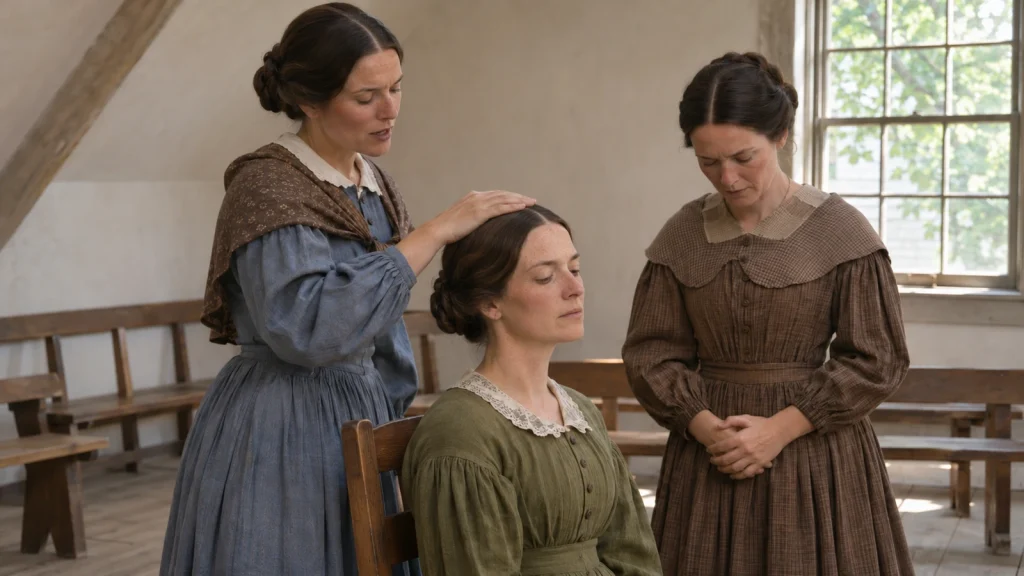
On April 19, 1842, Elizabeth Davis Durfee told a gathering of the Relief Society, the Church’s organization for women, what had happened after their previous meeting in Nauvoo. Emma Smith and her two counselors, Sarah Cleveland and Elizabeth Ann Whitney, had blessed her. Durfee said she had been healed. She even ventured that the sisters had more faith than the brethren.
Sarah Cleveland presided that day. After the meeting closed with prayer and singing, she and Elizabeth Ann Whitney blessed another woman, Abigail Leonard. The Relief Society minutes record both episodes. They tell us what the women did and what Durfee believed had happened to her.
Not everyone in the Society was comfortable with the practice. When Joseph Smith spoke to the women nine days later, he said he had heard concerns that some were going about it the wrong way. The minutes don’t say who raised those concerns or whether Durfee’s testimony had anything to do with them.
What Joseph Smith said in Nauvoo
The minutes of the April 28 meeting preserve a striking comparison. Joseph said there was no more sin in a woman laying hands on the sick than in “wetting the face with water.” He pointed to the signs Jesus said would follow believers, including healing the sick. He understood that promise to include both women and men.
Joseph defended the practice as an expression of faith. The minutes don’t record him ordaining women to a priesthood office or defining their blessings as a formal priesthood ordinance.
Faith, priesthood authority, and the temple
An 1880 draft circular from the Quorum of the Twelve described women and other lay members blessing the sick in their families by laying on hands or anointing with oil. The draft said they acted by faith in Christ rather than by priesthood authority. The Church Historian’s Press notes that the draft may never have been distributed. It shows how the distinction was expressed at the time, not what every congregation was told to do.
Four years later, Relief Society General President Eliza R. Snow answered a practical question: Did women need a special appointment from Church leaders to give such blessings? In her public reply, she said sisters who honored their temple endowments, the blessings and covenants they had received in the temple, could respond when asked. Her advice covered blessings for the sick and the practice of washing and anointing women before childbirth. These were distinct from the similarly named temple ordinances.
Within weeks, Church leaders met with Snow to correct her published answers on two points: when Relief Society members should seek counsel from bishops and whether women needed to be specially appointed to bless the sick. Franklin D. Richards’s diary entry, quoted in a note by the Church Historian’s Press editors, identifies the two questions but doesn’t record the corrections themselves. In an 1888 letter to Emmeline B. Wells, Wilford Woodruff approved washing and anointing before childbirth in the circumstances Wells described. He explained that the women acted as Church members exercising faith, not as priesthood holders.
Why the practice became uncommon
A 1914 First Presidency letter, summarized in the Church’s history of healing practices, still affirmed that women could bless the sick in faith. It also said that elders should be asked to administer when they could be called. As Church leaders standardized healing blessings in the first half of the twentieth century, they increasingly emphasized calling the elders.
On July 29, 1946, Apostle Joseph Fielding Smith wrote to the Relief Society general presidency, led by Belle Spafford. In an excerpt quoted by the Church Historian’s Press, he acknowledged that sisters could wash and anoint other sisters under certain conditions and with priesthood approval. But he said Church leaders considered it better to call the elders. The excerpt shows that he discouraged the practice without declaring an outright ban.
Today, the General Handbook, section 18.13, reserves the formal ordinance of administering to the sick for worthy holders of the Melchizedek Priesthood. Praying for someone who is ill remains open to anyone.
The April 19 minutes preserve something a handbook can’t: Elizabeth Durfee’s account of what it meant to have three women come to her aid. That’s where this history begins. The later letters show how Church leaders answered a different question: whom should members call to administer when someone is sick?