

Search for Mormon food storage and you will quickly find two very different answers. Some pages say Latter-day Saint families should store three months of food. Others still recommend a one-year supply and show large quantities of wheat, beans, powdered milk, and other staples.
Both numbers have a real basis—but they do not mean the same thing.
Current guidance from The Church of Jesus Christ of Latter-day Saints describes food storage as having both a three-month supply and a longer-term supply. For the three-month supply, members are encouraged to store foods that are part of their normal diet. Longer-term storage is built gradually and focuses more on durable staples. See the Church’s current Food Storage guidance.
| Question | Short answer |
|---|---|
| Does the Church still encourage food storage? | Yes |
| Does it teach a three-month supply? | Yes, for foods from the household’s normal diet |
| Is a one-year supply still relevant? | Yes, as a long-term planning reference |
| Is exactly one year required of every member? | Current guidance does not set one universal amount for every household |
| Should food storage be purchased all at once? | No |
| Should members go into debt to build it? | No |
3 Months vs. 1 Year: What Does Current LDS Guidance Say?
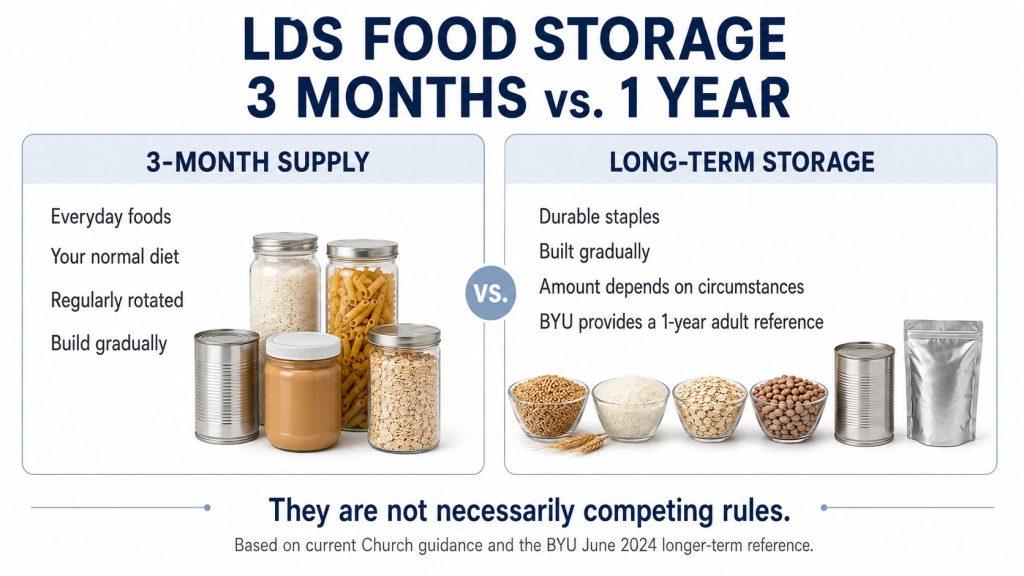
The easiest way to understand modern LDS food storage is to separate short-term food storage from long-term food storage.
The Church’s current Food Storage topic describes three main components of preparedness: a food supply consisting of three-month and long-term storage, a water supply, and a financial reserve. It says the three-month portion should contain foods that are part of the household’s normal diet.
The Church’s newer emergency-preparedness page, Preparing an Emergency Food Storage, last updated March 3, 2026, presents the process even more gradually. It recommends first determining enough food for one day, multiplying that into a one-week supply, then gradually expanding to a month and beyond according to the household’s situation.
For longer-term storage, the same current guidance recommends gradually accumulating foods that can last for extended periods and directs readers to a BYU resource for estimating quantities per person.
So why does one year still appear everywhere?
Because it is not an internet myth. Older official Church materials explicitly encouraged members to work toward a year’s supply. A 2006 Church Newsroom article on emergency preparedness, for example, described Church leaders as encouraging members to maintain a year’s supply of food.
Current guidance is framed differently. Rather than assigning every household one fixed universal quantity, it emphasizes personal circumstances, a three-month supply of normal foods, and a gradually developed longer-term supply. The General Handbook section on extreme preparation or survivalism also cautions against excessive preparation and against going into debt to establish food storage.
There is another important detail: current Church preparedness materials still link to a June 2024 BYU longer-term food-storage reference based on quantities for one adult for one year. The Church’s March 2026 preparedness page refers to it as a “food storage calculator guide.” You can view the BYU 2024 reference here.
That means three months and one year are not necessarily competing rules.
A three-month supply is a practical working supply of everyday food. A one-year calculation can still be useful as a reference for longer-term planning—but it should not be confused with a current universal requirement for every Latter-day Saint household.
How Much Food Should You Actually Store?
For a three-month supply, the most practical starting point is not an old Mormon food storage chart. It is what your household already eats.
The Church specifically recommends storing foods from your normal diet for short-term storage and rotating them to avoid spoilage.
Quick 3-Month Estimate
Average weekly household use × 13
Three months is roughly 13 weeks.
This is a practical shortcut, not an official Church formula.
For example, suppose your household normally uses:
- 2 pounds of rice per week
- 3 packages of pasta per week
- 4 cans of beans per week
An approximate 13-week supply would be:
- 26 pounds of rice
- 39 packages of pasta
- 52 cans of beans
The advantage is simple: you are stocking foods that will actually be eaten and rotated instead of filling shelves with products your family rarely uses.
The Church’s own current approach follows the same basic principle: determine what feeds the family for one day, multiply it into a week, and gradually build from there. See the current step-by-step guidance.
What about long-term storage?
For longer-term planning, current Church resources point to the BYU Department of Nutrition, Dietetics, and Food Science.
The June 2024 BYU guide says its example quantities are designed to likely provide adequate calories and protein for one adult for one year. It also explicitly says the plan should be adjusted for personal needs and preferences and that adding other fruits, vegetables, meats, and similar foods improves nutritional value, variety, and sustainability.
Here are several of the main quantities from that reference:
| Food | BYU reference: 1 adult / 1 year |
| Wheat | 132 lb |
| White rice | 65 lb |
| Rolled oats | 29 lb |
| Pasta | 21 lb |
| Legumes | 62 lb |
| Nonfat dry milk | 60 lb |
View the complete BYU June 2024 table.
The numbers only work if the food works for your family
A one-year reference is not a shopping list. Storing 132 pounds of wheat may make little sense if your household does not normally eat wheat, does not have a practical way to grind or prepare it, or cannot store it under suitable conditions.
Current Church guidance recommends gradually building longer-term storage with foods you know you will eat. In practice, that means learning how to prepare stored staples, using some of them before an emergency, and adapting the quantities to your family, storage space, climate, and cooking options.
A food supply you cannot realistically prepare or use is not much of a food supply.
The four grain categories—wheat, rice, oats, and pasta—total 247 pounds in this particular plan. BYU also notes that pounds of grains can be interchanged according to individual needs and preferences.
This helps explain why older LDS food-storage lists can appear to disagree dramatically. Different lists may use different combinations of grains, different assumptions, or guidance from different periods.
The BYU table is best treated as a planning reference, not a mandatory Mormon food-storage list.
Long-Term BYU Reference Formula
Annual adult amount × number of adults × fraction of a year
For example, the BYU wheat reference is 132 pounds per adult per year.
For two adults for six months:
132 × 2 × 0.5 = 132 pounds of wheat
This is simply a mathematical way to scale the BYU adult reference. It is not a separate Church recommendation.
The current BYU document is specifically framed around an adult, so old child multipliers found in unrelated preparedness charts should not automatically be presented as current BYU guidance.
Why Do LDS Food Storage Numbers Differ So Much Online?
If two food-storage pages give different numbers, it does not automatically mean one is wrong. Before comparing them, ask three questions.
Are they from the same period? Older official Church counsel often used explicit one-year language, while current guidance emphasizes a three-month everyday supply plus gradual longer-term storage.
Are they counting the same foods? A “grain” total may include wheat, rice, oats, pasta, corn, or other grains. BYU’s current reference, for example, divides its grain quantity among several foods rather than treating the entire amount as wheat.
Is the number a requirement or a reference? The BYU document describes an approach that should be adjusted for individual needs and food preferences. Current Church guidance likewise says the amount stored depends on a household’s situation.
That distinction is one of the most important things missing from many older Mormon food-storage calculators and lists.
What Foods Should You Store?
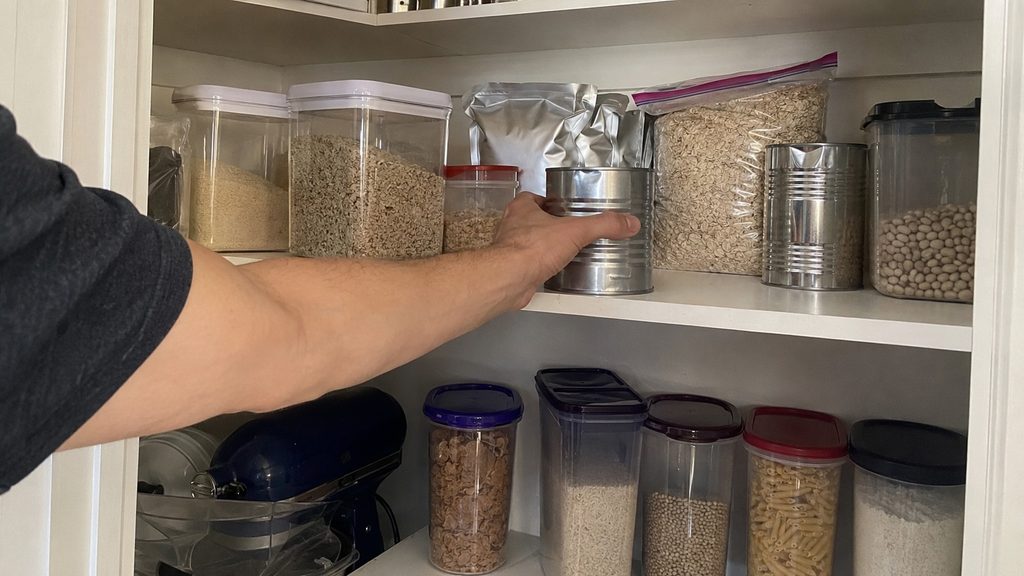
For a three-month supply, start with normal foods your household already uses.
That may include:
- rice and pasta
- oats or cereal
- canned beans
- canned fruits and vegetables
- peanut butter
- shelf-stable proteins
- sauces and ingredients used in normal meals
There is little value in creating a working pantry full of foods your household dislikes simply because they appeared on an old preparedness list.
Current Church guidance says short-term food storage should come from the normal diet, include different food groups, and be rotated regularly.
For long-term storage, the Church currently highlights foods such as wheat, white rice, pasta, oats, dry beans, and potato flakes. Suitable foods must be correctly packaged and stored under appropriate conditions. See the current Long-Term Food and Water Storage guide.
Home Storage Centers: In the United States and Canada, Church-operated Home Storage Centers sell prepackaged long-term storage foods such as wheat, beans, rice, oats, and other staples. Most items are also available through the Church’s online store.
One important caution: not every dry-looking food is suitable for decades of low-oxygen storage.
The current Church guide says foods placed in oxygen-reduced packaging should generally be dry—about 10 percent moisture or less—and low in oil. It warns that storing moist foods in reduced-oxygen packaging can create a botulism risk.
For suitable foods, current Church instructions discuss foil pouches and PETE bottles, among other appropriate containers. For foil pouches, the instructions specify an impulse sealer and explicitly advise against using a household iron because it may not produce an adequate seal.
Storage conditions matter too. The current long-term guide recommends temperatures of 75°F / 24°C or lower whenever possible, keeping the storage area dry, protecting appropriate products from light, and preventing insect and rodent damage.
A note about “30-year food”
Be careful with blanket claims that a food “lasts 30 years.”
The Church’s current long-term page gives life-sustaining estimates of 30 years or more for properly packaged wheat and white rice, while shelf-life estimates for other products vary. The linked BYU 2024 planning sheet also uses somewhat different shelf-life estimates for several foods.
Rather than combining those separate tables into one supposedly universal list, it is safer to consult the current source for the specific food and packaging method you plan to use.
Temperature, packaging, moisture, initial food quality, and other conditions can all affect actual shelf life.
Food Storage Is Only One Part of Preparedness
Food does not exist in isolation. Church preparedness guidance also emphasizes drinking water, financial reserves, medication, hygiene supplies, important documents, and other necessities appropriate to your circumstances.
And practically, think about how you would prepare the food you store if normal utilities were unavailable. Rice, beans, wheat, and pasta are useful only if your household has the water, equipment, and cooking method needed to use them.
5 Common Mormon Food Storage Myths
| Claim | What current sources actually show |
| “Every Mormon is required to keep exactly one year of food.” | Older Church materials did explicitly teach a year’s supply, but current guidance does not set one fixed amount for every household. |
| “The Church replaced the one-year supply with only three months.” | Current guidance includes both a three-month supply and longer-term food storage. |
| “There is one official list every family should follow.” | Current guidance emphasizes personal circumstances and normal diet; the BYU long-term table is a reference that can be adjusted. |
| “You should buy the entire supply as quickly as possible.” | Current Church guidance says to build gradually and not go into debt. |
| “Any dry food can be sealed up and stored for 30 years.” | Food type, moisture, oil content, packaging, temperature, and other conditions all matter. |
The underlying principle is much simpler than many old charts make it look: build a useful supply gradually, according to your circumstances, without going to extremes.
Frequently Asked Questions
Does the LDS Church still recommend a one-year food supply?
Current Church guidance does not state that every household must maintain exactly one year of food. It teaches a three-month supply of foods from the normal diet together with gradual longer-term storage.
However, current Church preparedness resources still link to a BYU planning reference based on quantities for one adult for one year.
Is there still an LDS food storage calculator?
The current Church preparedness page does not provide the old-style interactive family calculator. Instead, it links to the June 2024 BYU document as a food storage calculator guide for estimating quantities of longer-term foods per person.
For a three-month working pantry, a simple practical estimate is to track your household’s normal weekly consumption and multiply it by roughly 13 weeks.
Why do Latter-day Saints store food?
Food storage is part of the Church’s broader emphasis on self-reliance and responsible preparation for adversity. Current Church materials mention emergencies such as natural disasters, economic hardship, and illness, while the General Handbook specifically cautions against fear-driven or extreme survivalism.
Do I need a basement to build food storage?
No. Current Church guidance recognizes that homes and circumstances differ. A household can begin with whatever storage space is available and gradually build a supply that fits its situation.
For short-term food, that may simply mean keeping more of the shelf-stable foods already used in everyday meals.
How This Guide Was Researched
Reviewed August 2026
Because older LDS food-storage recommendations remain widely available online, this guide prioritizes current primary sources and clearly separates historical counsel from present guidance.
The main sources reviewed were:
- Food Storage — The Church of Jesus Christ of Latter-day Saints
- Preparing an Emergency Food Storage — last updated March 3, 2026
- Long-Term Food and Water Storage — last updated March 3, 2026
- General Handbook 38.8.16: Extreme Preparation or Survivalism
- BYU: An Approach to Longer-Term Food Storage — revised June 2024
- Church Home Storage Centers
Where current Church and BYU resources provide different types of estimates, this article keeps those sources separate rather than combining them into a single “official” number.
Last reviewed: August 2026
A note on terminology: This article uses the phrase “Mormon food storage” because it remains a common search term people use when looking for information on this topic. The correct name of the Church is The Church of Jesus Christ of Latter-day Saints, and throughout this article we use the Church or Latter-day Saints when referring to the Church and its members.