
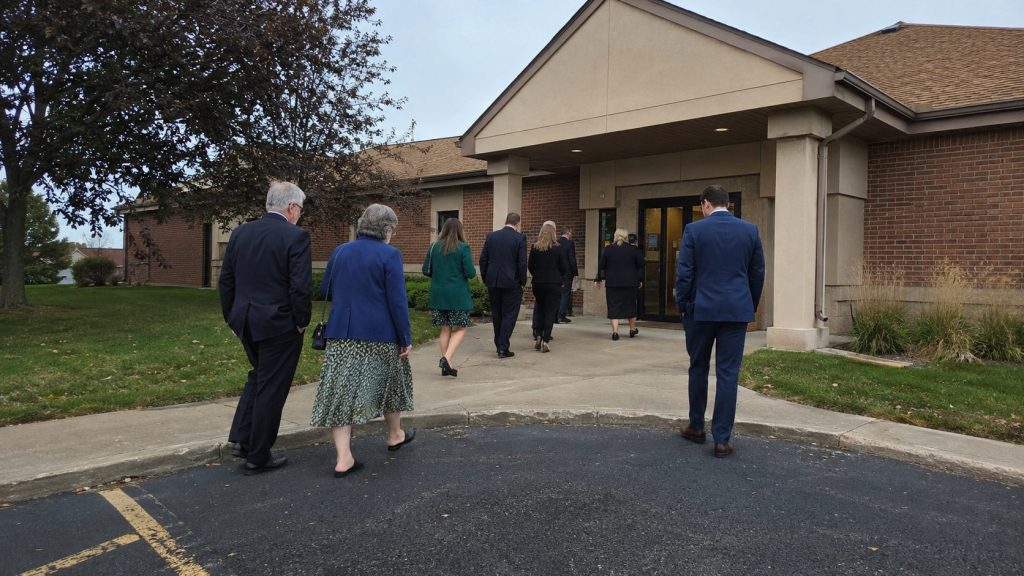
If you have never attended a Latter-day Saint funeral, you may wonder what happens, what to wear, whether nonmembers can attend, and which customs actually come from Church teaching.
The short answer: a Latter-day Saint funeral is usually a simple, reverent Christian service centered on Jesus Christ, His Atonement, and the Resurrection. Depending on the family and local culture, the day may include a viewing, a funeral service in a meetinghouse or another appropriate location, a graveside service, and a meal afterward.
This guide to Mormon funeral traditions explains which practices come from current Church guidance and which reflect family, regional, or cultural customs.
That distinction matters because many explanations online mix official Church policy with customs particularly associated with Utah and North American Latter-day Saint culture.
Terminology note: “Mormon funeral” remains a common search phrase. The Church’s preferred name is The Church of Jesus Christ of Latter-day Saints, so this guide generally uses “Latter-day Saint” while also addressing terms people commonly search.
If You Are Attending a Mormon Funeral for the First Time
You can usually expect a Christian funeral with prayers, sacred music, brief talks, memories of the person who died, and a strong emphasis on hope through Jesus Christ.
Non-Latter-day Saint friends and relatives may attend unless the family has chosen a private service. You do not need a temple recommend to enter a normal Church meetinghouse.
Wear respectful clothing. The Church does not require guests to wear black.
A viewing may take place before the funeral, and a graveside service may follow it. You do not need to participate in prayers, hymns, or other parts of the service if you do not feel comfortable doing so.
Mormon Funeral Traditions at a Glance
| Practice | Church guidance or cultural tradition? | What it means |
|---|---|---|
| Viewing before the funeral | Custom recognized in Church guidance | Families may hold one where local custom supports it |
| Family prayer after the viewing | Optional Church practice | The family may choose a prayer before the funeral begins |
| Bishop conducts the funeral | Church practice in a Church building | The bishop normally conducts a member’s funeral held in a meetinghouse |
| Christ-centered messages | Church guidance | Music and brief addresses should center on the gospel and the comfort Jesus Christ offers |
| Funeral of 90 minutes or less | Church guidance | Funerals generally should not last more than 1.5 hours |
| Open casket | Family or local custom | Church policy does not require an open casket |
| Temple burial clothing | Church guidance for endowed members | It applies to members who received the endowment during life |
| Burial or cremation | Family decision | Current Church policy leaves the choice to the family while respecting the deceased person’s wishes |
| Dedication of the grave | Optional priesthood ordinance | An authorized Melchizedek Priesthood holder may dedicate the grave |
| Funeral luncheon | Common cultural practice | Congregations may help families with food, but Church policy does not require a luncheon |
| Funeral potatoes | Regional cultural tradition | Strongly associated with Utah Latter-day Saint culture, not Church doctrine |
| Black clothing for guests | Not a Church requirement | Respectful dress matters more than a specific color |
How This Guide Was Researched
This guide separates official Church teaching and current policy from customs that vary by family, country, and local culture.
We checked funeral practices against the current General Handbook: Serving in The Church of Jesus Christ of Latter-day Saints, especially its guidance about funerals and services for the deceased.
We also checked the Handbook’s current guidance on temple burial clothing, burial, and cremation and the Church’s instructions for dedicating graves.
For cultural traditions such as funeral potatoes, this guide identifies them as culture rather than Church requirements.
That distinction matters because a practice can be common among Latter-day Saints without being doctrine or official policy.
Images in this guide are AI-generated illustrations and do not depict a specific funeral or real individuals.
Last reviewed: August 2026.
What Do Latter-day Saints Believe About Death and the Afterlife?
Latter-day Saints believe physical death separates the spirit from the body, but death does not end a person’s existence.
The Church teaches that Jesus Christ overcame death and that, because of His Resurrection, all people will eventually be resurrected. Resurrection reunites the spirit and body in an immortal state. The Church explains this teaching further in its official study guide on the Resurrection.
That belief shapes the tone of a Latter-day Saint funeral.
Families still grieve. Church teaching does not ask people to pretend that loss does not hurt. In fact, Latter-day Saints covenant to “mourn with those that mourn” and comfort those who need comfort.
At the same time, Church funeral guidance asks speakers and leaders to point people toward the Savior.
The General Handbook’s funeral guidance says an important purpose of services for the deceased is to testify of the plan of salvation, particularly the Atonement and Resurrection of Jesus Christ.
That helps explain why a Latter-day Saint funeral can feel deeply sorrowful and hopeful at the same time.
A personal example of that balance can be seen in the story of Irene Diloi, who found that temple covenants gave her hope while grieving the death of her father without simply making the pain disappear.
Latter-day Saints also believe family relationships can continue after death through temple sealing covenants as people remain faithful to those covenants.
It is more accurate to describe this hope in connection with Jesus Christ, covenants, and sealing than to say simply that every family automatically reunites in the same way after death.
What Happens Before a Latter-day Saint Funeral?
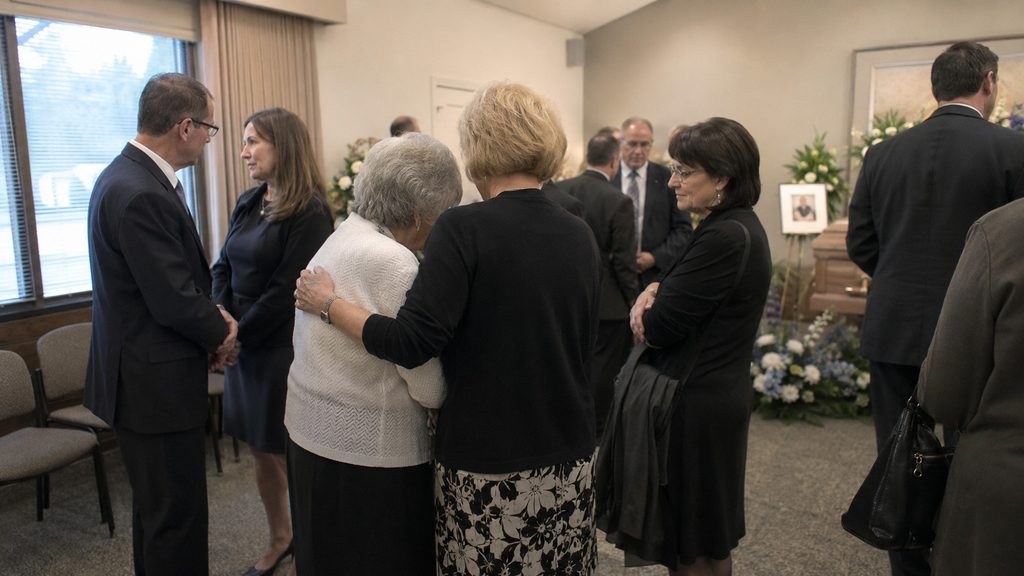
No single schedule applies to every family.
Local law, family wishes, culture, cost, travel, and the circumstances surrounding the death can all affect funeral arrangements.
Outside North America, the cultural details of a Latter-day Saint funeral may look very different. Families in Europe, Latin America, Africa, Asia, the Pacific, and other regions often follow local funeral customs while Church-conducted services continue to follow the same principles found in the General Handbook.
Viewing or Visitation
In places where viewings are customary, a family may hold one before the funeral.
The General Handbook specifically recognizes viewings and explains how Church leaders should accommodate them when they take place in a meetinghouse.
A viewing gives relatives and friends time to greet the family, offer condolences, and remember the deceased before the formal religious service.
Some families choose an open casket. Others choose a closed casket, an urn, photographs, or no formal viewing at all.
The Church does not require every Latter-day Saint funeral to include an open casket.
Family Prayer and Closing the Casket
After a viewing in a Church meetinghouse, the family may choose to offer a family prayer.
Church guidance then calls for the casket to be closed before the funeral service begins.
That sequence helps distinguish the more personal viewing from the worship service that follows.
What Happens During a Mormon Funeral Service?
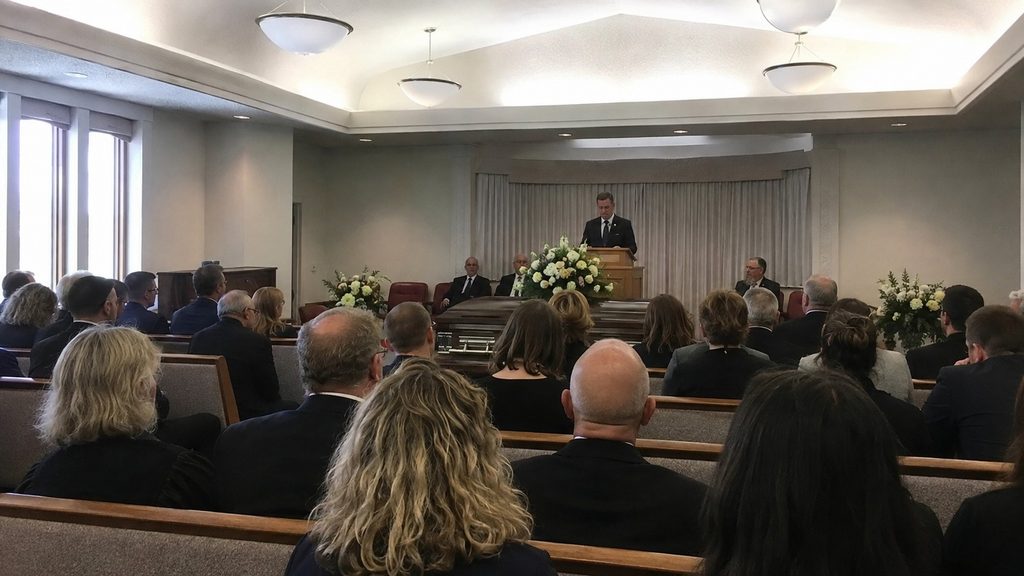
If a member’s funeral takes place in a Church building, the bishop conducts it.
If the family holds the funeral at home, at a mortuary, or at the graveside, they may also ask the bishop to conduct it there.
A bishop-conducted funeral counts as a Church meeting and a religious service. The Church’s current funeral guidelines ask leaders to keep the service simple, dignified, spiritual, and centered on the gospel.
A typical service may include:
- an opening prayer;
- hymns or other appropriate sacred music;
- brief talks;
- memories or tributes;
- a message about Jesus Christ and the Resurrection;
- a closing prayer.
The exact program can vary.
The Church allows tributes to the deceased, but it asks families not to let those tributes dominate the service.
If a family wants more time for stories, photographs, videos, or extended memories, a separate family gathering may better serve that purpose.
Family members also do not have to speak simply because they were close to the person who died.
How Long Does a Mormon Funeral Last?
The current General Handbook says funerals should start on time and generally should not last more than 1.5 hours.
Many services are shorter.
The Handbook also says funeral services are not normally held on Sunday.
Can a Mormon Funeral Include a Video Tribute?
Families often create photo slideshows or video tributes, but Church guidance says video presentations should not form part of a funeral service held in a chapel.
A family can use another appropriate setting for extended memories or multimedia presentations.
Where Are Latter-day Saint Funerals Held?
Families may hold a funeral in a Church meetinghouse, mortuary or funeral home, a home, or at the graveside.
People unfamiliar with the Church sometimes confuse a meetinghouse with a temple. They serve very different purposes.
A local meetinghouse hosts regular congregational worship and may also host a funeral.
Temples serve as houses of worship for sacred ordinances such as endowments and sealings.
Are Mormon Funerals Held in Temples?
No.
A Latter-day Saint funeral is not a temple ordinance.
Families commonly hold funerals in meetinghouses, funeral homes, homes, or at gravesides rather than inside temples.
Nonmembers do not need a temple recommend to enter a normal Church meetinghouse. Unless the family has chosen a private service, friends and relatives of other faiths may attend and offer support.
What Happens at the Graveside?
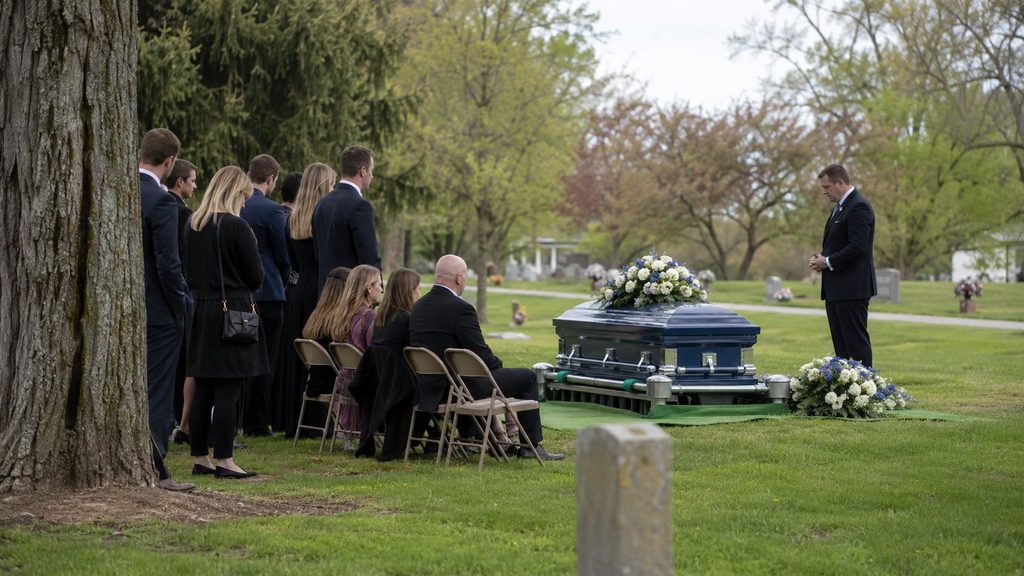
After the funeral, the family may travel to a cemetery for burial and a shorter graveside service.
One distinctive Latter-day Saint practice is the dedication of the grave.
A man who holds the Melchizedek Priesthood may dedicate the grave when the appropriate priesthood leader authorizes him.
The Church explains this ordinance in its official instructions for dedicating graves.
The family does not have to choose a grave dedication.
If they prefer, anyone the family chooses may offer a graveside prayer instead.
Church guidance also allows a priesthood leader to consider dedicating the place where a cremated member’s ashes will remain, taking family wishes, local customs, and law into account.
Mormon Burial Clothing and Temple Clothing
Burial clothing is one of the areas where online explanations most often lose important context.
Not every Latter-day Saint is buried in temple clothing.
Current Church guidance on temple burial clothing applies this practice to members who received the temple endowment during their lifetime.
If possible, deceased endowed members should be buried or cremated in temple clothing. If cultural traditions or burial practices make that difficult or inappropriate, Church guidance provides other options.
The Church treats temple clothing as sacred.
A public explanation of funeral traditions does not need to display or describe every ceremonial detail in order to answer the practical question.
The key point is straightforward:
Temple burial clothing applies to endowed members, not automatically to every person who belongs to the Church.
That distinction corrects a common overgeneralization in general funeral guides.
Do Mormons Allow Cremation?
Yes. Latter-day Saints may choose cremation.
The current General Handbook guidance on burial and cremation says the family decides whether to bury or cremate the body while respecting the wishes of the person who died.
Cremation does not prevent Resurrection.
The Handbook specifically reassures members that the power of the Resurrection always applies.
The Church asks families to treat the body with respect and reverence whether they choose burial or cremation. Law, cost, local custom, and practical circumstances may also influence the decision.
Where possible, a deceased endowed member may be cremated in temple clothing just as an endowed member may be buried in temple clothing.
This is an important area where current Church guidance provides more context than some older explanations found online.
Mormon Funeral Etiquette for Non-LDS Guests
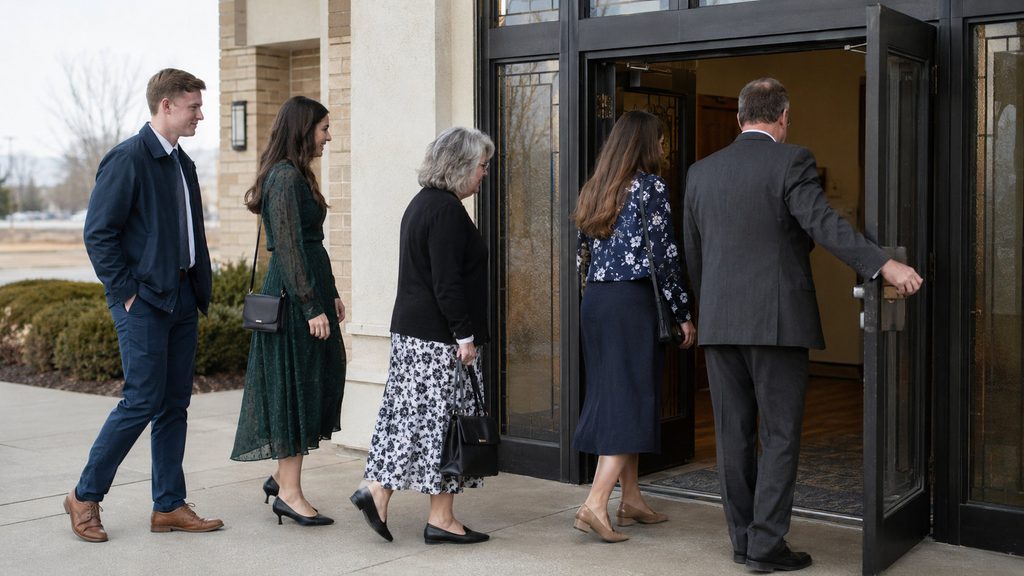
You do not need to understand every Latter-day Saint belief or custom to attend a funeral respectfully.
What Should I Wear to a Mormon Funeral?
The Church does not set a special rule requiring funeral guests to wear black.
Choose clean, respectful clothing appropriate for a religious funeral and the local culture.
Dark or subdued colors remain common at many North American funerals, but showing respect matters more than wearing a particular color.
You do not need to dress like a missionary or copy the Sunday clothing of Church members.
Do I Have to Participate in Prayers or Hymns?
No.
You may follow the congregation’s lead when people sit or stand.
If the congregation sings a hymn and you would like to participate, you are welcome to sing. You can also simply listen.
During a prayer, respectful silence is enough. Visitors do not need to imitate beliefs or practices they do not share.
Are Flowers Appropriate at a Mormon Funeral?
The current General Handbook does not establish a Church-wide funeral rule requiring or prohibiting flowers.
The best approach is to follow the family’s obituary, invitation, or stated wishes.
If the family asks for charitable donations or another expression of sympathy instead of flowers, honor that request.
What Should I Say to the Family?
Simple words usually work best.
“I’m sorry for your loss,” “I’m thinking of your family,” or a brief sincere memory of the deceased can mean more than trying to explain why the death happened.
You do not need to provide a theological answer to grief.
Mormon Funeral Luncheons and Funeral Potatoes
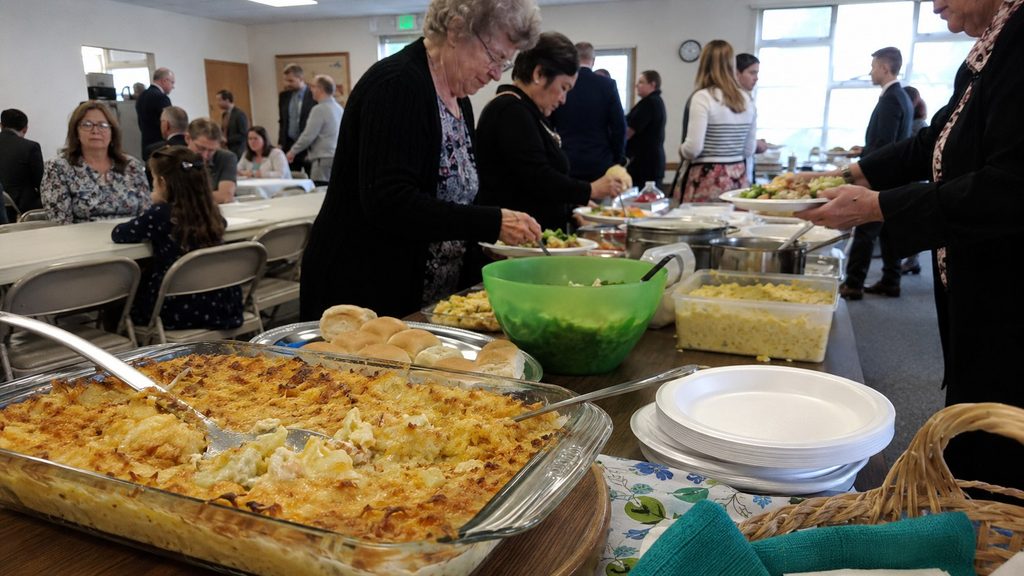
After the funeral or burial, some Latter-day Saint families gather for a meal.
In many North American wards, people may call this a funeral luncheon.
The General Handbook does not require such a meal. It does, however, encourage Church members to help grieving families in practical ways, which may include preparing food.
Relief Society and elders quorum members may help organize that support.
The tradition varies widely around the world.
A ward in Utah may provide casseroles and other familiar American funeral foods, while Latter-day Saints in Mexico, Brazil, the Philippines, Europe, Africa, or elsewhere may serve foods and follow post-funeral customs familiar to their local culture.
The meal itself is not part of the religious funeral service.
Why Are They Called Mormon Funeral Potatoes?
“Funeral potatoes” are a cheesy potato casserole strongly associated with Utah and Latter-day Saint culture.
Recipes vary, but many versions combine potatoes, cheese, a creamy sauce, and a crunchy topping.
The exact origin of funeral potatoes remains unclear.
Deseret News has explored the history of funeral potatoes and their connection with Utah and Latter-day Saint food culture, including meals prepared for grieving families.
The casserole works well for groups because people can prepare it in advance, transport it easily, and serve many guests.
But funeral potatoes are not a religious requirement.
A Latter-day Saint funeral in Utah may include them. A funeral in another country may involve completely different food traditions—or no luncheon at all.
Funeral potatoes therefore offer a useful example of the difference between Latter-day Saint culture and Church doctrine.
Common Mormon Funeral Claims That Need More Context
Several claims appear repeatedly in online guides to Mormon funeral traditions. The current General Handbook provides a more precise picture.
“All Mormons Are Buried in Temple Clothes”
No.
Temple burial clothing applies to members who received the endowment during their lifetime.
“Mormons Cannot Be Cremated”
No.
The family chooses burial or cremation while respecting the deceased person’s wishes. Church teaching affirms Resurrection regardless of that choice.
“A Mormon Funeral Must Happen Within Seven Days”
The current General Handbook does not establish a universal seven-day deadline.
Timing can depend on family circumstances, local law, culture, travel, and funeral arrangements.
“Mormon Funerals Take Place in Temples”
No.
A funeral is not a temple ordinance. Families commonly use meetinghouses, mortuaries, homes, or gravesides.
“Everyone Must Wear Black”
No.
The Church has no universal funeral rule requiring black clothing.
These distinctions matter because repeating a common cultural practice as though it were doctrine can mislead both visitors and Church members.
Frequently Asked Questions About Mormon Funerals
Can Non-Mormons Attend a Latter-day Saint Funeral?
Usually, yes.
Church meetinghouses welcome visitors, and friends or relatives of other faiths commonly attend funeral services. Respect any privacy limits the family sets.
Do Latter-day Saints Have Open-Casket Funerals?
Some do, particularly in places where open-casket viewings are culturally common.
Church policy does not require an open casket.
How Long Does an LDS Funeral Usually Last?
Church guidance says a funeral generally should not last more than 1.5 hours.
Many services are shorter.
Are LDS Funerals Held on Sunday?
Not normally, according to the General Handbook.
Can Latter-day Saints Choose Cremation?
Yes.
Current Church policy leaves the decision to the family while asking them to respect the deceased person’s wishes and treat the body reverently.
Does Every Latter-day Saint Wear Temple Clothing for Burial?
No.
The guidance applies to deceased members who received the temple endowment during life.
Can an LDS Funeral Be Livestreamed?
Yes, in some circumstances.
The bishop may authorize a livestream of a funeral held in a meetinghouse for people who cannot attend in person.
Do Latter-day Saints Believe Families Can Be Together After Death?
Latter-day Saints believe all people will be resurrected through Jesus Christ.
They also believe temple sealings can unite family relationships eternally as people remain faithful to their covenants.
Are Mormon Funeral Potatoes Required?
No.
Funeral potatoes are a Utah and Latter-day Saint cultural tradition, not a Church ordinance or requirement.
Do Mormon Funerals Have to Be Held in an LDS Church?
No.
Families may hold funerals in meetinghouses, funeral homes, homes, at gravesides, or in other appropriate locations depending on circumstances and local customs.
The Central Message of a Latter-day Saint Funeral
A viewing, family prayer, grave dedication, luncheon, or regional food tradition may become part of a Latter-day Saint funeral.
None of those customs carries the central message by itself.
The center is Jesus Christ.
Latter-day Saints believe grief is real and death creates a painful separation. They also believe Christ conquered death and made Resurrection possible for every person.
That belief explains why Church guidance asks funeral services to offer more than remembrance.
The service should point grieving people toward the Savior and the hope of Resurrection.
Customs can differ from one family, ward, country, and generation to another.
The hope behind the service remains the same:
Because of Jesus Christ, death is not the end.
Primary Sources
This article relies first on current official Church sources:
- General Handbook — Meetings in the Church, including funerals and services for the deceased
- General Handbook — Church Policies and Guidelines, including temple burial clothing and burial or cremation
- General Handbook — Priesthood Ordinances and Blessings, including dedicating graves
- The Church of Jesus Christ of Latter-day Saints — Resurrection Study Guide
- Deseret News — A History of Funeral Potatoes
Jesus in Focus is an independent publication. This guide is not an official publication of The Church of Jesus Christ of Latter-day Saints