
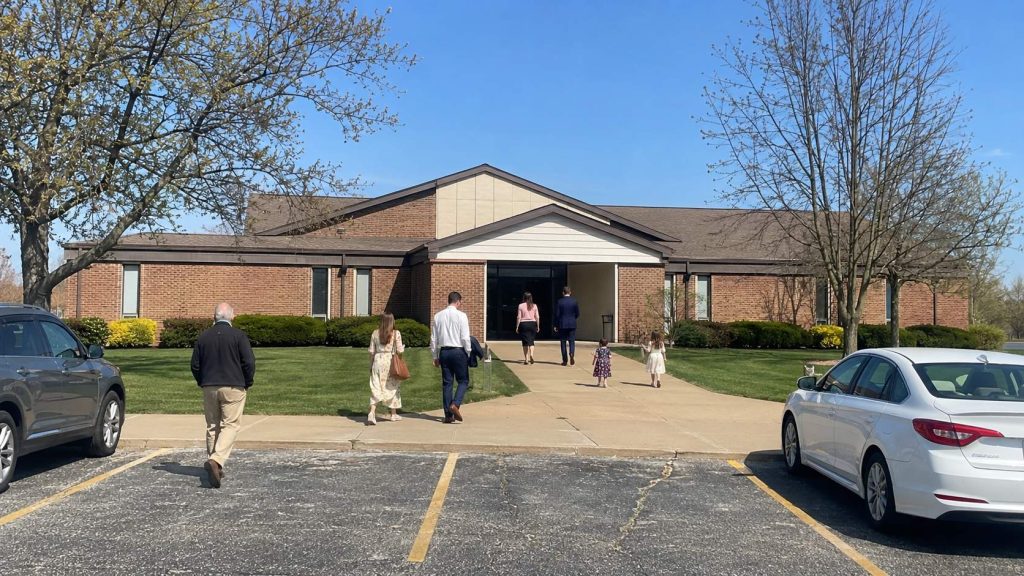
An LDS ward is a local congregation, while a stake is a larger Church organization made up of several congregations. A branch is also a local congregation, generally organized with fewer members or less available leadership, while a district is an administrative unit made up of branches.
Wards are led by bishops, branches by branch presidents, stakes by stake presidents, and districts by district presidents.
The simplest way to remember the four terms is:
Ward = local congregation
Branch = local congregation, generally smaller
Stake = group of congregations
District = group of branches
These terms describe how members of The Church of Jesus Christ of Latter-day Saints are organized locally.
Ward vs. Branch vs. Stake vs. District at a Glance
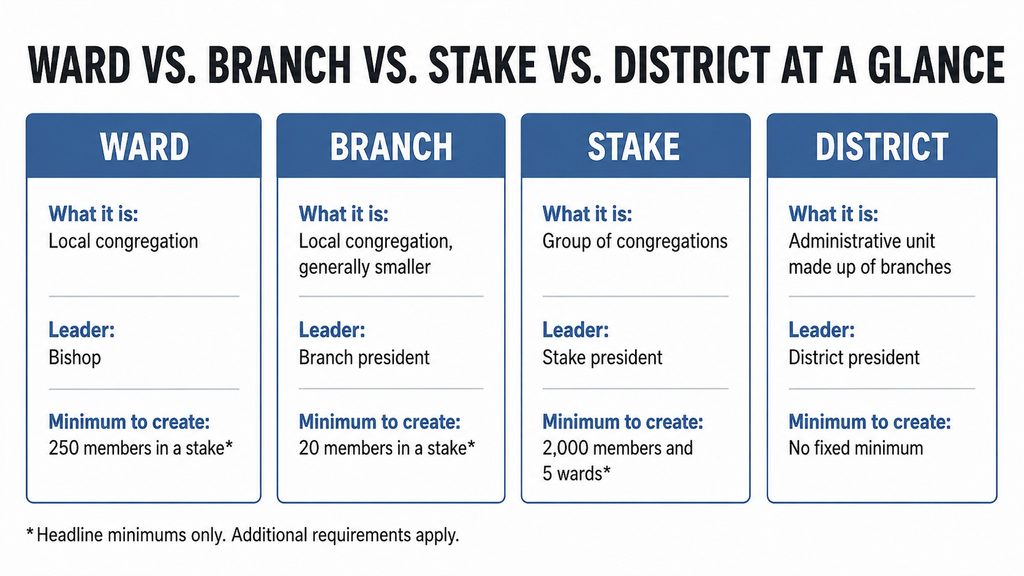
These are only the headline membership requirements for regular geographic units. Creating a ward or stake also requires specific levels of participating adults and qualifying Melchizedek Priesthood holders. The complete current requirements are listed later in this article.
Branches can also be organized in missions under different requirements. Specialized congregations, such as young single adult and language units, have separate criteria.
How LDS Local Units Fit Together
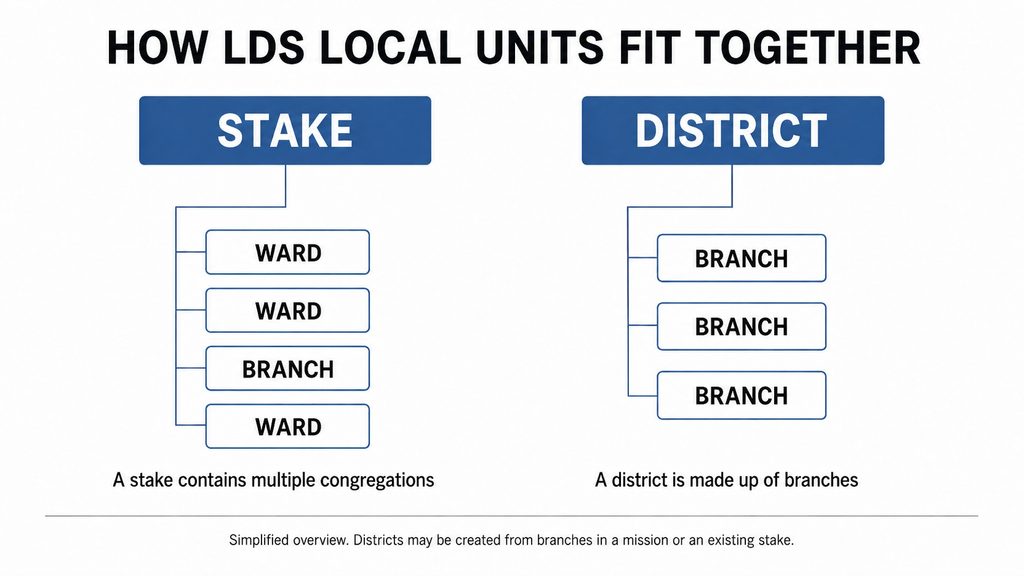
A stake can include wards and branches. Districts consist of branches and may be created from branches in a mission or, in some circumstances, from branches in an existing stake.
Ward vs. Stake: What’s the Difference?
A ward is one local congregation. A stake is a larger Church organization containing several local congregations.
A ward is led by a bishop. A stake is led by a stake president.
For most members, the ward is where everyday Church life happens. It is where they normally worship on Sunday, take the sacrament, receive callings, participate in Church organizations, and build relationships with other members.
A stake supports and coordinates the congregations within its boundaries. It also provides stake-level leadership, conferences, training, activities, and other functions.
The easiest distinction is:
Ward = one congregation
Stake = several congregations
Under current Church requirements, at least five wards are needed to create a new regular stake.
What Is a Ward in the LDS Church?
A ward is a local congregation of The Church of Jesus Christ of Latter-day Saints.
It can be roughly compared to a parish or local congregation in some other Christian traditions, although the leadership structure is different.
A ward is led by a bishop, assisted by two counselors. Together they form the bishopric.
The bishop holds priesthood keys to lead the work of the Church in the ward. The General Handbook identifies several major responsibilities of a bishop and describes his foremost responsibility as caring for the rising generation — children, youth, and young single adults.
For members who belong to a ward, it normally becomes their primary local Church community.
How Large Does a Ward Need to Be?
Under the current General Handbook, creating a new regular ward within a stake normally requires at least:
- 250 members
- 20 active, full-tithe-paying Melchizedek Priesthood holders capable of serving in leadership positions
- 100 participating adults
- 20 participating youth recommended, but not required
These are requirements for creating a new ward, not a rule that every existing ward must always contain at least 250 members.
Actual ward sizes can vary considerably. Sunday attendance may also be significantly lower than the total number of members officially assigned to the ward.
What Is a Branch?
A branch is also a local congregation of the Church.
Branches are generally organized where there are fewer members or where the available local leadership is not yet sufficient for a ward.
A branch is led by a branch president rather than a bishop.
To someone attending on Sunday, a ward and a branch can feel quite similar. Both exist so members can worship Jesus Christ together, receive ordinances, learn the gospel, serve one another, and participate in Church life.
But a branch is not simply a ward with fewer people.
Ward vs. Branch: What’s the Difference?
The most visible difference is that a branch can operate with fewer members and fewer available leaders than a ward.
But the distinction also involves leadership structure, authority, and responsibility.
A ward is led by a bishop. A branch is led by a branch president.
The General Handbook specifically notes that the callings of bishop and branch president are not equivalent in authority and responsibility. A bishop is also ordained to the priesthood office of bishop, while a branch president serves in a different calling.
In very small Church units, organization can be simpler. As membership and available leadership increase, additional quorums, organizations, and leadership positions can be established.
So in some places, Church development may look roughly like:
small group → branch → ward
But a branch does not automatically become a ward when its membership reaches a certain number.
Participation, priesthood leadership, local circumstances, and Church approval also matter.
How Large Does a Branch Need to Be?
For a new regular branch created inside a stake, current requirements call for at least:
- 20 members
- 4 active, full-tithe-paying Melchizedek Priesthood holders capable of serving in leadership positions
- no minimum number of participating adults
- no minimum number of participating youth
Branches created inside missions follow different requirements.
For a mission branch, there is no minimum number of members required. However, a new branch generally should have at least four priesthood holders, including at least one active, full-tithe-paying Melchizedek Priesthood holder.
This allows congregations to be organized in areas where Church membership is still small or geographically scattered.
What Is a Stake?
A stake is a larger geographic Church organization containing multiple local congregations.
It is led by a stake president, assisted by two counselors.
The stake president holds priesthood keys to lead the work of the Church within the stake. A stake also has a high council and stake-level organization leaders who help support the wards and branches within its boundaries.
The word stake comes from biblical imagery of a tent secured by stakes. In Latter-day Saint usage, the term describes one of the larger geographic units of Church organization.
A stake is sometimes loosely compared with a diocese in other Christian traditions, although the two systems are not identical.
How Many Members Are Needed to Create a Stake?
The current General Handbook lists the following minimum requirements for creating a new regular stake:
- 2,000 members
- 150 active, full-tithe-paying Melchizedek Priesthood holders capable of serving in leadership positions
- 500 participating adults
- 100 participating youth recommended, but not required
- at least 5 wards
These figures matter because older online explanations may still give different numbers.
When checking current requirements, the latest General Handbook should take priority over older manuals or articles.
What Is a District?
A district is an administrative Church unit made up of branches.
Districts are often found where a stake has not yet been organized, although that shorthand does not describe every situation.
The General Handbook allows districts to be created from branches in a mission or an existing stake.
Unlike a stake, there is no fixed minimum number of members or branches required to create a district.
A district is led by a district president.
A district can eventually become a stake as local membership, participation, congregations, and leadership develop. Before a mission president can propose that change, the district must maintain the level of strength required for a stake for at least six months.
Stake vs. District: What’s the Difference?
A stake and a district both help organize multiple congregations, and both have presidencies.
However, a stake president and a district president do not have identical authority or responsibilities.
A stake president is the presiding high priest in the stake.
In a district, the mission president remains the presiding high priest. A district president holds keys needed to preside over the district but works under the direction of the mission presidency, and some responsibilities that belong to a stake presidency remain with the mission presidency.
One practical example involves temple recommends. For members living in a district, the second interview for a temple recommend is normally conducted through the mission presidency rather than the district presidency unless specific authorization has been given.
So the common explanation that “a district is a smaller stake” is useful as a starting point, but incomplete.
The difference involves Church administration and priesthood authority as well as size.
Current LDS Unit Requirements — 2026
The main current requirements for regular geographic units are:
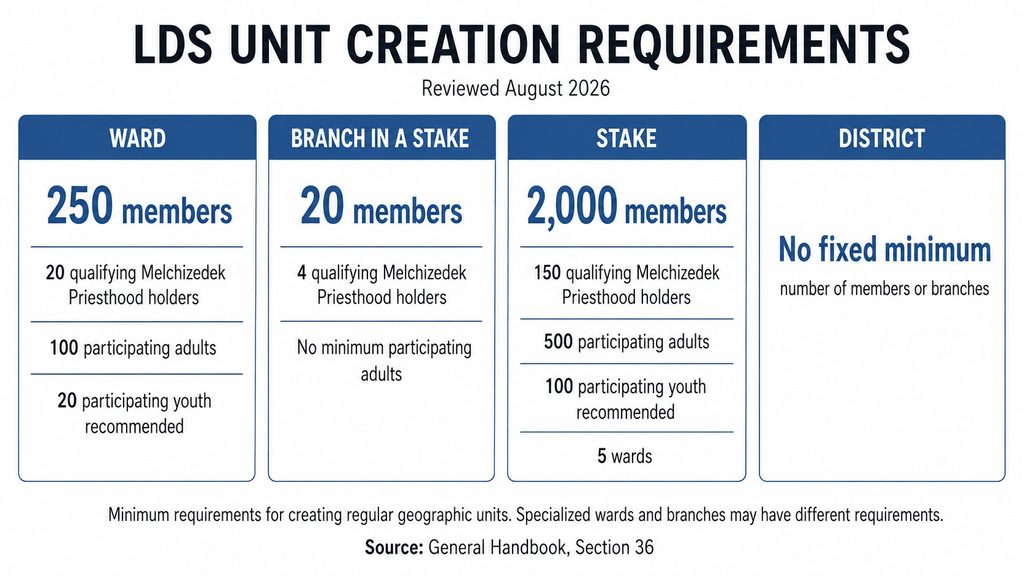
| Requirement | Ward in a Stake | Branch in a Stake | Stake | District |
|---|---|---|---|---|
| Members | 250 | 20 | 2,000 | No fixed minimum |
| Qualifying Melchizedek Priesthood holders | 20 | 4 | 150 | No fixed minimum |
| Participating adults | 100 | No minimum | 500 | No fixed minimum |
| Participating youth | 20 recommended | No minimum | 100 recommended | No fixed minimum |
| Wards required | — | — | 5 | — |
What Does “Participating Adults” Mean?
The General Handbook uses the term participating adults as part of the requirements for creating wards and stakes.
The public Handbook does not provide the complete operational definition in this section. Instead, Church leaders are referred to the Church’s Boundary and Leadership Proposals system for additional details.
For that reason, it is better not to substitute an unofficial attendance formula for the Church’s own term.
Specialized Wards and Branches Have Different Requirements
The figures above apply to regular geographic units.
Some specialized congregations have their own requirements.
For example, under the current Handbook, a new young single adult ward in a geographic stake requires at least:
- 125 active members
- 15 qualifying Melchizedek Priesthood holders
A young single adult branch has lower minimum requirements.
Language wards and branches also operate under separate criteria.
So the commonly quoted figure of 250 members for a ward should not be interpreted as applying to every possible type of ward in the Church.
What Does This Mean for an Ordinary Church Member?
For most members, the ward or branch is their everyday Church community. It is where they normally worship on Sundays, serve in callings, participate in Church organizations, and interact most often with other members.
A stake or district connects multiple congregations.
Stake- or district-level conferences, training, youth activities, leadership meetings, and other events may involve members from several wards or branches.
Why Don’t Latter-day Saints Usually Choose Their Ward?
One distinctive feature of Latter-day Saint organization is that members generally belong to congregations based on where they live.
In most cases, a member does not compare several nearby congregations and choose one based on the bishop, worship style, or preferred Sunday schedule.
A home address generally determines the member’s geographic ward or branch.
This means two families living only a few streets apart can sometimes belong to different wards.
It also means that moving even a relatively short distance can place a family in a different congregation.
Several wards may also share the same meetinghouse, meeting there at different times on Sunday.
So a ward is a congregation, not a building.
Are There Exceptions?
Yes.
The Church also organizes specialized congregations in some areas, including:
- language wards and branches
- young single adult wards and branches
- some single adult wards
- certain units created for special circumstances
Eligible young single adults may choose between a young single adult unit and their geographic unit where those options are available.
Members who qualify for a language unit may also have a choice between that congregation and their regular geographic congregation.
So “your address determines your ward” is a useful general rule, but it is not absolute in every situation.
How Do I Find My LDS Ward or Branch?
The Church provides an official Meetinghouse Locator where people can enter an address or location and see nearby congregations, meetinghouses, Sunday meeting times, and available contact information.
One important distinction is that the closest meetinghouse is not necessarily the same thing as your assigned congregation.
Because wards have geographic boundaries and multiple wards can use the same building, Church records and official Church tools are the best way for members to confirm their assigned unit.
Why Do Ward and Stake Boundaries Change?
Ward and stake boundaries are not permanent.
As membership grows, declines, or moves geographically, Church leaders may propose:
- creating new units
- dividing units
- combining units
- realigning boundaries
- discontinuing units
Membership totals are not the only consideration.
The General Handbook directs leaders to consider the strength of existing units before creating new ones.
Participation and available leadership therefore matter alongside raw membership numbers.
This helps explain why two areas with similar membership totals may not necessarily be organized in exactly the same way.
Can a Branch Become a Ward?
Yes.
A stake president may propose changing a branch into a ward when the branch meets the required conditions and a suitable candidate has been identified to serve as bishop.
The change is not automatic when membership reaches 250.
Other factors — including participation, available Melchizedek Priesthood leadership, and Church approval — also matter.
Can a District Become a Stake?
Yes.
A district may become a stake as Church membership, participation, congregations, and local leadership develop.
The current General Handbook says that a district should have the required level of strength for a stake for at least six months before a mission president proposes creating a stake from it.
Creating a stake therefore involves much more than simply changing a district’s name.
It represents a significant development in local Church organization and leadership.
Is an LDS Mission the Same as a Stake or District?
No.
A mission is a different Church organization led by a mission president.
Most people associate missions with full-time missionaries, but mission presidents can also have important responsibilities for branches and districts in places where stakes are not yet organized.
That is why discussions of districts often mention the mission president or mission presidency.
In simple terms:
Stake → led by a stake president
District → led locally by a district president, with important responsibilities remaining with the mission presidency
Mission → separate Church organization led by a mission president
Frequently Asked Questions
What is an LDS ward?
A ward is a local congregation of The Church of Jesus Christ of Latter-day Saints. It is normally based on geographic boundaries and is led by a bishop.
What is the difference between a ward and a stake?
A ward is one local congregation. A stake is a larger Church organization containing multiple congregations and is led by a stake president.
What is the difference between a ward and a branch?
Both are local congregations. A ward is led by a bishop and requires greater membership, participation, and leadership strength to be created. A branch is led by a branch president and can operate with fewer members.
How many people are in an LDS ward?
There is no single standard size for every existing ward.
A new regular ward created in a stake currently requires at least 250 members, but existing wards can be larger or smaller depending on local circumstances.
How many wards are in an LDS stake?
There is no universal number.
At least five wards are currently required to create a new regular stake. An existing stake may contain more wards and may also include branches.
How do I find my LDS ward?
Use the Church’s official Meetinghouse Locator to find nearby congregations and meeting information.
Members can also use official Church account tools to confirm their assigned ward and stake.
Can a branch become a ward?
Yes. A branch within a stake may be proposed for conversion into a ward once it meets the applicable requirements and suitable leadership is available.
Can a district become a stake?
Yes. A district that develops sufficient membership, participation, wards, and leadership can eventually become a stake.
Is a ward the same as a church building?
No.
A ward is a congregation. A meetinghouse is a building.
Several wards can use the same meetinghouse at different times.
What does “Mormon ward” mean?
“Mormon ward” is a common search phrase people use when looking for information about a local congregation of The Church of Jesus Christ of Latter-day Saints.
The Church asks writers to use its full official name on first reference and appropriate shortened forms afterward rather than “Mormon Church.”
The term ward, however, remains the normal name for this type of local congregation.
The Simple Version
If the four terms still seem confusing, remember:
Ward = local congregation led by a bishop
Branch = local congregation led by a branch president, generally requiring fewer members and leaders
Stake = multiple congregations led by a stake president
District = group of branches led locally by a district president, with important responsibilities remaining with the mission presidency
For most Latter-day Saints, the ward or branch is their weekly Church community.
The stake or district is part of the larger organization that helps local congregations function together.
Although these terms describe Church administration, their purpose ultimately goes beyond organization. These units help members worship Jesus Christ together, receive ordinances, learn the gospel, serve one another, and strengthen their faith.
Sources and Fact-Check
Last reviewed: August 27, 2026
This guide was checked primarily against current official Church sources:
- General Handbook — Section 36: Creating, Changing, and Naming New Units
- General Handbook — Section 6: Stake Leadership
- General Handbook — Section 7: The Bishopric
- General Handbook — Section 26: Temple Recommends
- General Handbook — Section 37: Specialized Stakes, Wards, and Branches
- Church Newsroom — Ward
- Church Newsroom — Stake
- Church Newsroom — District
- Official Meetinghouse Locator
- Church Newsroom — Style Guide
This is an independent explanatory article and is not an official publication of The Church of Jesus Christ of Latter-day Saints.