
There are moments at church when silence suddenly feels very loud.
Someone stands at the pulpit and loses their words. A teenager begins a prayer and freezes. A child struggles through a Primary part. A new member is asked to do something unfamiliar and becomes visibly nervous.
Our instinct is often immediate: Help them. Fix the moment. Make the discomfort go away.
Sometimes that is exactly the loving thing to do.
But sometimes love looks different.
Sometimes it means waiting.
A Young Man, a Handwritten Talk, and Several Minutes of Silence
In an August 2026 Liahona article titled “We Ask Thee,” Jennifer Mackley shared a quiet experience from her ward in Washington state.
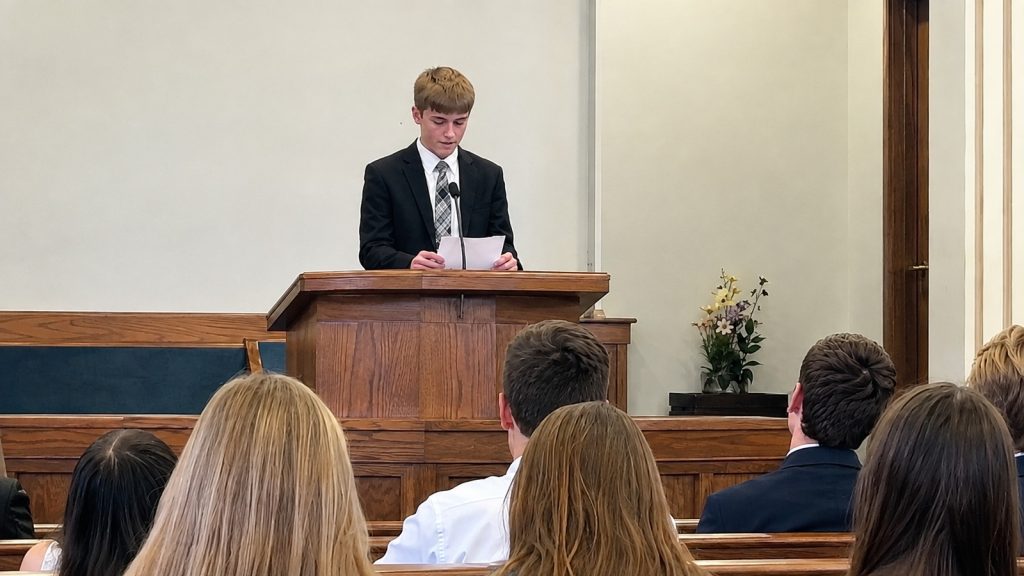
Nearly two years earlier, a young man had walked to the pulpit carrying a handwritten talk. He stood there silently, his head bowed, unable to begin. For several agonizing minutes, he shifted his feet, straightened his paper, took a few deep breaths, and sighed.
Finally, his father came forward, gently put an arm around him, and explained that he would read the words his son had hoped to share.
It was a tender act of help. The young man’s message was still heard, and he did not have to face the moment alone.
Then, almost two years later, Mackley saw him in another vulnerable situation.
This time, he was kneeling behind the sacrament table for the first time.
Again, there was silence.
But this time, no one immediately stepped in.
The congregation waited.
Mackley began to pray for him. She believed she was not the only person in the room joining her faith with his. After a few moments, the congregation heard a syllable, followed by another long silence.
Then, slowly and carefully, the young man began the sacrament prayer—one word at a time.
He finished it.
The first time he struggled, someone helped by stepping forward.
The second time, people helped by giving him enough space to continue himself.
Both responses can be acts of love.
Knowing which one a person needs may be one of the quieter skills of Christian discipleship.
Our Discomfort Can Make Us Help Too Quickly
Watching another person struggle can be uncomfortable.
Silence feels longer when dozens of people are listening. We may start imagining how embarrassed the person must feel. We want to save them from that embarrassment—and perhaps save ourselves from feeling it too.
So we finish someone’s sentence.
We answer the question for them.
We take the assignment out of their hands.
We tell a nervous child, “It’s OK. You don’t have to do it.”
Again, there are situations when assistance is absolutely appropriate. The young man’s father reading his son’s prepared talk was not a failure. It was compassion.
But help becomes more complicated when it unintentionally communicates:
You cannot do this without me.
There is another possibility.
Instead of asking only, “How can I make this easier?” we might sometimes ask:
“How can I make it possible for this person to keep trying?”
Those are not always the same thing.
Belonging Means More Than Being Allowed in the Room
Mackley does not explain why the young man found speaking difficult, and we should not speculate about or assign a diagnosis to him.
Still, his experience raises a broader question about how Church communities make room for people whose participation may look different from what we expect.
The Church’s official guidance on including members with disabilities identifies both providing opportunities to serve and participate and giving assistance as important principles.
Those ideas belong together.
Real inclusion is not simply making sure someone can enter the room or attend a meeting.
It also means making room for people to contribute—even when their contribution may take longer, look different, or require support.
The First Presidency’s statement on accessibility expresses a similar commitment: helping people with disabilities “connect, worship, and serve.”
That principle can change how we think about an awkward moment at church.
A long pause does not necessarily mean something has gone wrong.
A trembling voice does not mean someone should never be asked again.
A child who needs extra time has not ruined the program.
A new member who does not yet understand the familiar rhythm of a meeting has not failed a cultural test.
Sometimes the most Christlike thing a congregation can offer is enough patience for someone to finish.
A Ward Can Quietly Say, “You Have Time”
Think about that moment behind the sacrament table.
Dozens of people were waiting.
But waiting does not have to mean judging.
It can communicate something very different:
We are still here.
You are not inconveniencing us.
You do not have to perform for us.
Take the time you need.
No announcement was required. No special program had to be created.
A congregation simply allowed a difficult moment to remain difficult long enough for one person to move through it.
That kind of patience can matter far beyond a single sacrament meeting.
There are people sitting in our chapels who may already feel as though they do not quite fit the expected pattern.
Some are new converts learning an unfamiliar religious culture. Some are returning after years away. Some are naturally quiet or uncomfortable speaking in front of others. Some speak the local language imperfectly. Some live with disabilities or other challenges. Some children and teenagers simply need more time to develop confidence.
In his October 2022 general conference message “The Doctrine of Belonging,” Elder D. Todd Christofferson taught that belonging in the Church is centered in Jesus Christ and reminded members, “We need one another.”
He also warned that we can unintentionally communicate that a person’s worth depends on achievements or Church callings. Instead, he taught, the Lord cares about our desires and “what we are becoming.”
That principle changes the question.
Instead of asking only, “Did they perform the assignment well?”
we can ask:
“Did we help them feel that there is still a place for them while they are becoming?”
Sometimes Help Means Stepping Forward. Sometimes It Means Staying in Your Seat.
There is no universal rule for when to intervene.
That is part of what makes Mackley’s original account in Liahona so meaningful: it contains two very different kinds of help.
One day, a father walked forward.
Another day, a congregation stayed still.
The goal was not to prove that the young man could do everything alone. Nor was it to remove every difficult experience from his path.
The goal was to stand with him.
That may be an important distinction for parents, teachers, youth leaders, bishoprics, and ordinary members.
Before rushing to rescue someone, we can sometimes give them a moment.
Before assuming that silence means failure, we can allow silence to exist.
And when assistance really is needed, we can offer it without making the person feel that needing help has made them less capable, less faithful, or less welcome.
The Power of “We”
As Mackley listened to the young man slowly pronounce the sacrament prayer, one word struck her differently:
“we.”
“We ask thee.”
He was the person saying the words, but he was not spiritually alone.
Around him was a congregation praying, hoping, and waiting with him. In Mackley’s account, the experience changed the way she understood those words in the sacrament prayer.
Perhaps there is something larger in that small word.
A ward brings together people at very different stages of life, confidence, experience, and faith.
Some speak easily.
Some struggle to get the words out.
Some arrive carrying decades of experience.
Others are still learning where to sit and what happens next.
The goal is not to make everyone look equally polished.
It is to become more like Christ together.
And sometimes that begins with one of the simplest gifts a ward can offer:
enough love to help when help is needed—and enough patience to wait when it isn’t.
Help Us Share More Meaningful LDS Stories
Stories like this take time to discover and tell. Support Jesus in Focus by becoming a Facebook subscriber and receive additional original Latter-day Saint stories and faith-centered content.
Become a SubscriberYour support helps us continue publishing thoughtful, faith-centered content.