
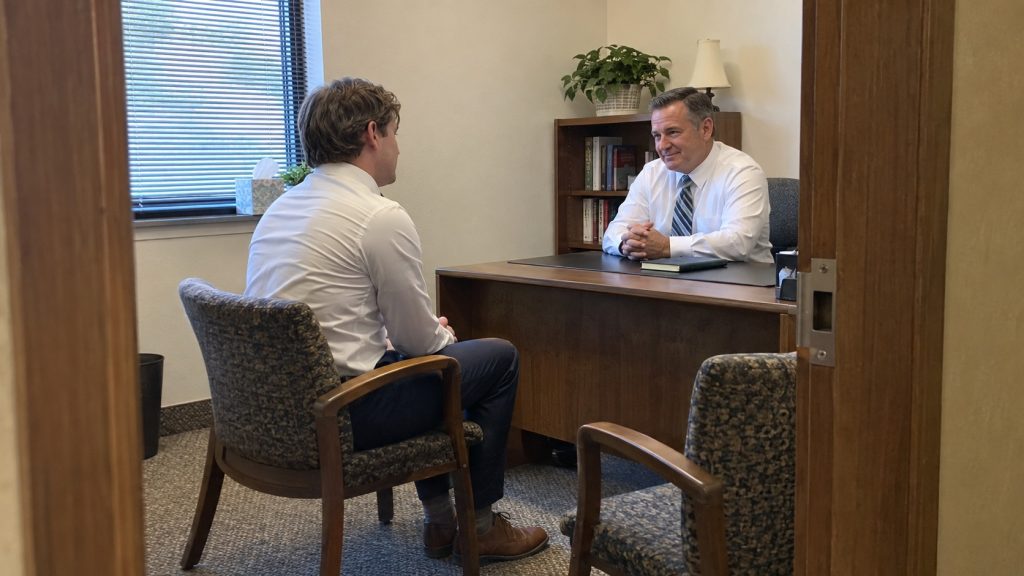
If you are preparing for an LDS temple recommend interview, you do not have to walk in wondering what will happen or what you will be asked.
The Church of Jesus Christ of Latter-day Saints publicly publishes the temple recommend interview questions. The current General Handbook contains 16 numbered questions, but not every member is asked every question, and the interview process depends on the type of temple recommend you need.
This guide explains which process applies to you, gives the current official questions, and covers what happens before and after the interview.
Temple Recommend Interview: Quick Answer
A temple recommend interview is a private worthiness interview conducted by an authorized priesthood leader. It covers testimony, personal conduct, commandments and covenants, and whether you consider yourself prepared to enter the temple.
The Church currently uses three types of temple recommends, as explained in General Handbook, Chapter 26: Temple Recommends.
| Type of recommend | Who it is for | First interview | Second interview |
|---|---|---|---|
| Proxy baptisms and confirmations | Baptized and confirmed members who have not been endowed | Bishop or assigned counselor in a ward; branch president in a branch | No stake-level interview |
| Recommend for endowed members | Members who have previously received the endowment | Bishop or assigned counselor; branch president in a branch | Member of the stake presidency; member of the mission presidency in a district |
| Recommend for living ordinances | Members receiving their own endowment or certain living sealings | Normally the bishop or branch president personally | Normally the stake president personally; mission president or assigned counselor in a district |
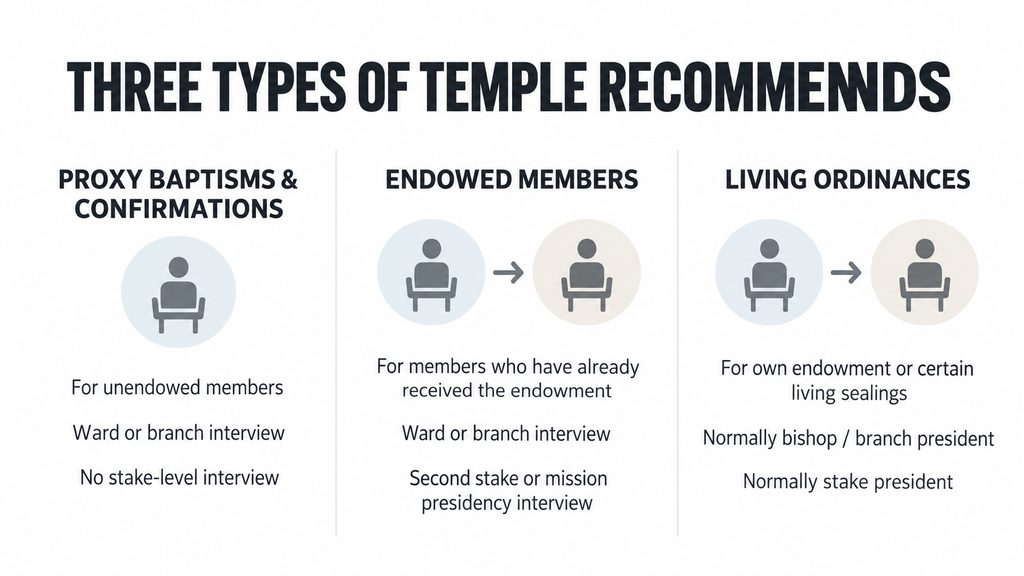
Branches, districts, missions, and some sealing situations have additional rules. The table is a practical overview, not a substitute for the General Handbook.
Temple recommend interviews should be private and should not be rushed. Depending on the type of interview, a member may invite a spouse, parent, or another adult to be present.
What Is a Temple Recommend Interview?
Members ages 8 and older need a current temple recommend to enter a dedicated temple.
Children younger than 8 do not need a recommend to be sealed to their parents.
The interview is not designed to surprise members with secret questions. Authorized priesthood leaders use the Church’s published questions to determine whether a member is spiritually prepared and sincerely striving to live the standards associated with temple worship.
The Handbook places a firm limit on the process: leaders should not add or remove requirements. They may adapt the questions to a member’s age and circumstances and may explain basic gospel principles when clarification is needed. They should not present personal beliefs, preferences, or interpretations as Church doctrine or policy.
If you do not understand a question, it is appropriate to ask what it means.
Which Temple Recommend Process Applies to You?

The most common source of confusion online is the assumption that every temple recommend follows the same process.
It does not.
Proxy Baptisms and Confirmations
This recommend is for baptized and confirmed members who have not received their own endowment.
Members become eligible beginning in January of the year they turn 12. A male Church member must be ordained to a priesthood office before receiving the recommend.
In a ward, the bishop or a counselor he assigns may conduct the interview. In a branch, the branch president conducts it.
There is no second stake-presidency interview for this recommend. If it is issued, it is activated at the ward or branch level.
Endowed Members Renewing a Recommend
Members who have already received the endowment use the recommend for endowed members.
In a ward, the first interview may be conducted by the bishop or an assigned counselor. In a branch, the branch president conducts it.
A member living in a stake then has a second interview with a member of the stake presidency. In a district, the second interview is conducted by a member of the mission presidency.
A district president does not conduct these interviews unless authorized by the First Presidency.
After the second interview in a stake, a member of the stake presidency or a stake clerk activates the recommend in Leader and Clerk Resources (LCR). In a district, a member of the mission presidency or a mission clerk activates it.
Receiving Your Own Endowment or Another Living Ordinance
A recommend for living ordinances is a separate type of recommend. It is used when a member is preparing to receive his or her own endowment or certain living sealing ordinances.
Normally, the bishop or branch president personally conducts the first interview, and the stake president personally conducts the second.
Counselors may conduct these interviews only in limited circumstances, such as urgent unavailability or certain large young single adult units. In a district, the mission president or an assigned counselor conducts the interviews.
Living-ordinance recommends are prepared digitally through Ordinance Preparation in LCR and submitted electronically to the temple where the ordinance will take place.
If you are receiving your own endowment: the current Handbook requires both a recommend for living ordinances and a current recommend for endowed members. They can be issued as part of the same interview process. The endowed-member recommend is the additional current recommend required for temple entry in this situation; it does not mean you have already received the endowment.
See General Handbook, Chapter 27: Temple Ordinances for the Living for the current living-ordinance requirements.
Sealings of children to parents have more detailed age-based requirements. Children younger than 8 do not need a recommend to be sealed to their parents. Older children and youth may need a living-ordinance recommend and, in some circumstances, another current recommend depending on age and endowment status.
How to Prepare for a Temple Recommend Interview
You do not need to memorize a speech or guess the wording someone wants to hear.
The questions are publicly available, so reading them beforehand is appropriate.
A simple way to prepare is:
- Read the current questions in General Handbook 26.4.1, “Temple Recommend Interview Questions”.
- Think honestly about how you would answer them.
- Note anything you do not understand.
- Speak with an appropriate Church leader if you have a concern you want to discuss before the interview.
- Confirm scheduling and practical details with your bishopric or branch.
The General Handbook section on temple recommend interviews does not prescribe a specific dress code for the interview itself. A white shirt or another local custom should therefore not be presented as a Handbook requirement for the interview.
Appointment procedures also vary by unit.
The interview is not a vocabulary test. The questions are meant to be answered sincerely.
The 16 Temple Recommend Questions
The official wording below is from General Handbook 26.4.1. The short notes after each question explain what the question covers. They are not additional worthiness standards.
Question 1: Faith in God, Jesus Christ, and the Holy Ghost
Official question: Do you have faith in and a testimony of God, the Eternal Father; His Son, Jesus Christ; and the Holy Ghost?
This is a testimony question, not a request for a theological essay. It asks whether you have faith in and a testimony of the Godhead.
Question 2: The Atonement of Jesus Christ
Official question: Do you have a testimony of the Atonement of Jesus Christ and of His role as your Savior and Redeemer?
The focus is your testimony of Christ’s saving role.
Question 3: The Restoration
Official question: Do you have a testimony of the Restoration of the gospel of Jesus Christ?
This asks about your testimony of the Restoration as taught by the Church.
Question 4: Sustaining Church Leaders
Official question: Do you sustain the President of The Church of Jesus Christ of Latter-day Saints as the prophet, seer, and revelator and as the only person on the earth authorized to exercise all priesthood keys? Do you sustain the members of the First Presidency and the Quorum of the Twelve Apostles as prophets, seers, and revelators? Do you sustain the other General Authorities and local leaders of the Church?
The official wording has several parts, but it is one numbered question.
Question 5: Moral Cleanliness and the Law of Chastity
Official question: The Lord has said that all things are to be “done in cleanliness” before Him (Doctrine and Covenants 42:41). Do you strive for moral cleanliness in your thoughts and behavior? Do you obey the law of chastity?
Individual circumstances can be sensitive. This article does not invent a list of behaviors or predict an interview outcome.
If you are unsure how the standard applies to you, discuss it with the authorized priesthood leader conducting the interview.
Question 6: Private and Public Conduct
Official question: Do you follow the teachings of the Church of Jesus Christ in your private and public behavior with members of your family and others?
The interview is not limited to what happens at church on Sunday. It includes private and public conduct with family and others.
Question 7: Teachings Contrary to the Church
Official question: Do you support or promote any teachings, practices, or doctrine contrary to those of The Church of Jesus Christ of Latter-day Saints?
The official question is intentionally concise. An independent article should not invent examples and present them as additional Church policy.
If you are unsure how it applies to your situation, ask the interviewer for clarification.
Question 8: Sabbath Day, Church Meetings, and the Sacrament
Official question: Do you strive to keep the Sabbath day holy, both at home and at church; attend your meetings; prepare for and worthily partake of the sacrament; and live your life in harmony with the laws and commandments of the gospel?
The question ties together Sabbath observance, meeting attendance, the sacrament, and living the commandments.
For a practical look at work, shopping, restaurants, sports, travel, and other Sunday questions, see What Can Mormons Do on Sunday? A Guide to LDS Sabbath Rules.
Question 9: Honesty
Official question: Do you strive to be honest in all that you do?
The wording matters. The question asks whether you strive to be honest, not whether you have lived a flawless life.
Question 10: Tithing
Official question: Are you a full-tithe payer?
Modified wording for new members seeking a recommend to perform proxy baptisms and confirmations: Are you willing to obey the commandment to pay tithing?
Most members are asked the standard full-tithe question. New members seeking a proxy-baptism recommend are asked about willingness to obey the commandment.
For the separate question of whether Latter-day Saints calculate tithing on gross or net income, see LDS Tithing: Gross or Net? What the Church Actually Says.
Question 11: The Word of Wisdom
Official question: Do you understand and obey the Word of Wisdom?
Practical questions about products or substances not named in the original revelation belong in a broader Word of Wisdom discussion rather than in extra homemade temple-recommend rules.
See Mormon Word of Wisdom: Coffee, Tea, Caffeine & More (2026).
Question 12: Obligations to a Former Spouse or Children
Official question: (This question is omitted when interviewing a child or youth.) Do you have any financial or other obligations to a former spouse or to children? If yes, are you current in meeting those obligations?
Adult members may be asked this question. It is omitted for children and youth.
Question 13: Temple Covenants
Official question: (This question is omitted when interviewing a member who is not endowed.) Do you keep the covenants that you made in the temple?
This question applies to endowed members. It is omitted for members who have not been endowed.
Question 14: Wearing the Temple Garment
Official question: (This question is omitted when interviewing a member who is not endowed.) Do you honor your sacred privilege to wear the garment as instructed in the initiatory ordinances? (Read the “Wearing the Temple Garment” statement to each member.)
This question applies to endowed members only.
The interviewer also reads the separate statement in General Handbook 26.4.2. It identifies the garment as a sacred symbol of Jesus Christ, instructs members to wear it day and night, and says it should be restored as soon as possible after activities that cannot reasonably be done while wearing it.
The current wording appears immediately after the questions in General Handbook, Chapter 26.
Question 15: Serious Sins and Repentance
Official question: Are there serious sins in your life that need to be resolved with priesthood authorities as part of your repentance?
This article does not turn that question into an unofficial catalog of sins.
If a serious unresolved matter requires priesthood help as part of repentance, it may need to be addressed before a recommend is issued. That determination belongs to the member and the authorized leader, not to an online checklist.
Question 16: Your Own Assessment of Worthiness
Official question: Do you consider yourself worthy to enter the Lord’s house and participate in temple ordinances?
The final question makes your own honest assessment part of the interview.
Who Is Not Asked All 16 Temple Recommend Questions?
There are 16 numbered questions, but not every member is asked every one.
| Question | Child or youth | Unendowed adult | Endowed adult |
|---|---|---|---|
| Q12 — former spouse or children obligations | Omitted | Asked | Asked |
| Q13 — temple covenants | Omitted | Omitted | Asked |
| Q14 — temple garment | Omitted | Omitted | Asked, followed by the garment statement |
Leaders may also adapt the questions to a member’s age and circumstances without adding or removing requirements.
That is why it is inaccurate to say every teenager answers the same 16 questions as an endowed adult.
What Is Different for a Newly Baptized Member?
A newly baptized member who is old enough to receive a recommend for proxy baptisms and confirmations is interviewed soon after confirmation, normally within a week.
The bishop normally conducts the interview, but a bishop or branch president may assign a counselor to conduct it. For a brother, the interview may be combined with the interview to receive the Aaronic Priesthood. A male member must be ordained to a priesthood office before receiving the recommend.
New members also receive the modified tithing question for a proxy-baptism recommend. It asks about willingness to obey the commandment, not an established history as a full-tithe payer.
Receiving your own endowment is different.
A newly baptized member may normally receive the endowment only after at least one full year has passed from the confirmation date, not the baptism date. Only the First Presidency may authorize an exception to that one-year requirement.
A member preparing to receive the endowment must also:
- be at least 18;
- have completed or no longer be attending high school, secondary school, or the equivalent;
- have passed the one-year point from confirmation;
- desire to receive and honor temple covenants.
A man must also hold the Melchizedek Priesthood before receiving the endowment.
See General Handbook, Chapter 27: Temple Ordinances for the Living for the current eligibility guidance.
What If I Can’t Answer a Question the Expected Way?
Answer honestly.
Reading the questions beforehand can help you identify concerns. It should not become an exercise in memorizing whatever answer you think will produce a recommend.
If you do not understand a question, ask. The Handbook allows the interviewer to explain basic gospel principles and help members understand the questions. Leaders should not create additional requirements or present personal interpretations as Church policy.
If there is a serious unresolved matter that requires priesthood help as part of repentance, receiving a recommend may need to wait while that matter is addressed.
That is different from being nervous, having a question, or needing clarification.
No online guide can promise the outcome of an individual interview.
Privacy, Virtual Interviews, and Bringing Someone With You
Is the Interview Private?
Yes. Temple recommend interviews are private and should not be rushed.
For endowed-member and living-ordinance interviews, the Handbook says a member may invite a spouse, parent, or another adult to be present. For proxy-baptism recommends, it specifically provides for a parent or another adult.
Can the Interview Be Done by Video?
Leaders usually meet members in person.
Church policy allows virtual interviews when meeting in person is not practical. Chapter 26 specifically addresses this option for some members in isolated areas, including members of the military in isolated locations.
When a temple recommend interview is held virtually, the leader can digitally sign the recommend according to the applicable process.
Can the Interview Be Recorded?
No.
The General Handbook states that interviews and other meetings between leaders and members should not be recorded. The same rule applies to virtual meetings.
See General Handbook, Chapter 31: Interviews and Other Meetings with Members.
What Happens After the Interview?
The next step depends on the type of recommend.
After a Proxy-Baptism Recommend Interview
There is no second stake-level interview.
If the recommend is issued, a member of the bishopric or the branch president activates it in LCR. The member may choose a printed or mobile recommend.
After an Endowed-Member Recommend Interview
After the ward or branch interview, a member in a stake completes the second interview with a member of the stake presidency.
A member of the stake presidency or a stake clerk then activates the recommend in LCR. In a district, activation is handled by a member of the mission presidency or a mission clerk.
The member may choose a printed or mobile recommend.
After a Living-Ordinance Interview
The bishop or branch president reviews the member’s information through Ordinance Preparation in LCR and digitally signs the recommend.
After the second interview, the stake president or appropriate mission presidency member digitally signs it and submits it electronically to the temple where the ordinance will take place.
Mobile or Printed Temple Recommend?
For proxy baptisms and confirmations and for endowed-member recommends, members may choose a printed or mobile recommend.
Living-ordinance recommends work differently: they are submitted digitally to the temple through Ordinance Preparation.
What If My Temple Recommend Is Expired, Lost, or Stolen?
A standard adult temple recommend is generally valid for two years, but not every recommend follows the same expiration period or process.
For example, a young missionary returning from service away from home may receive a recommend that expires three months after returning home. Living-ordinance recommends are handled separately through Ordinance Preparation.
The safest place to confirm your own expiration date is the date shown on your printed or mobile recommend.
If a recommend has expired, it is no longer current. The member needs to complete the applicable renewal process before using it for temple entry.
If a recommend is lost or stolen, notify the bishop as soon as possible.
If the member is still living the required standards, the bishop, an assigned counselor, or a clerk can reprint the recommend through LCR. The replacement keeps the same expiration date as the original. Losing the physical recommend does not restart its validity period.
If the member is no longer living the applicable standards, the bishop cancels the recommend instead.
Frequently Asked Questions
Are LDS Temple Recommend Questions Secret?
No. The Church publishes the current questions in General Handbook 26.4.1.
How Many Temple Recommend Questions Are There?
There are currently 16 numbered questions. Some are omitted depending on the member’s age and whether the member has received the endowment.
How Long Is a Temple Recommend Valid?
A standard adult temple recommend is generally valid for two years. Some circumstances have different expiration rules, so check the expiration date on your actual printed or mobile recommend.
How Long Does a Temple Recommend Interview Take?
The Church does not publish a standard number of minutes. Its instruction is that temple recommend interviews should not be rushed.
Can a Non-Member Get a Temple Recommend or Enter a Dedicated Temple?
No. A temple recommend is issued through the Church’s interview process to eligible members. Being accompanied by a member does not replace the recommend requirement for entering a dedicated temple.
Before a new or renovated temple is dedicated, a public open house may allow non-members to tour the building. Temple grounds and visitors’ centers, where available, are different from entering the dedicated temple itself.
See the Church’s current information about temple open houses.
What Was a “Limited-Use Temple Recommend”?
“Limited-use temple recommend” is an older name that is still common online.
The current Handbook calls it a temple recommend for proxy baptisms and confirmations.
Bottom Line
A temple recommend interview does not need to be mysterious.
The Church publishes the interview questions, and the current General Handbook contains 16 numbered questions. The process is not identical for every member. The Church distinguishes between recommends for proxy baptisms and confirmations, recommends for endowed members, and recommends for living ordinances.
Some questions are omitted for youth or unendowed members. Newly baptized members have specific provisions. Living ordinances use a digital preparation process, while proxy and endowed-member recommends may be printed or mobile.
The best preparation is not memorizing answers. It is reading the current questions, considering them honestly, asking for clarification when needed, and discussing unresolved concerns with the appropriate Church leader.
For the complete current policy and interview wording, see General Handbook 26.4.1, “Temple Recommend Interview Questions”.