

The Word of Wisdom is the Latter-day Saint law of health. It calls for abstaining from alcohol, tobacco, coffee and tea, while also teaching members to avoid harmful or addictive substances and make wise choices about their physical, spiritual and emotional health.
But what does that mean for caffeine, Coke, energy drinks, green tea, matcha, decaf coffee, vaping or medical marijuana?
Some of these have clear answers. Others are left to personal judgment.
This guide separates current Church teaching from common cultural assumptions and explains what The Church of Jesus Christ of Latter-day Saints actually teaches today.
Sources and Church policies in this article were last reviewed on August 23, 2026.
Note: This is an independent explanatory article and is not an official publication of The Church of Jesus Christ of Latter-day Saints.
Word of Wisdom at a Glance
| Food, drink, or substance | Current Latter-day Saint teaching |
|---|---|
| Alcohol | ❌ Avoid |
| Tobacco | ❌ Avoid |
| Coffee | ❌ Avoid |
| Decaf coffee | ❌ Still coffee-based; removing caffeine does not create an exception |
| Black tea | ❌ Avoid |
| Green tea | ❌ Avoid |
| Matcha | ❌ Made from green tea |
| Iced black or green tea | ❌ Still tea |
| Vaping / e-cigarettes | ❌ Prohibited |
| Recreational marijuana | ❌ Prohibited |
| Prescription medication | ✅ Appropriate when properly prescribed; misuse should be avoided |
| Medical marijuana | ⚠️ Permitted under specific medical conditions |
| Caffeine itself | ⚠️ Not specifically prohibited; personal judgment applies |
| Caffeinated soda | ⚠️ Not specifically prohibited because of caffeine alone |
| Energy drinks | ⚠️ Not specifically prohibited as a category; ingredients and health effects matter |
| Herbal tea / herbal infusions | ⚠️ Generally not the same category as black or green tea; check ingredients |
| Fruits and vegetables | ✅ Encouraged |
| Grains | ✅ Encouraged |
| Meat | ✅ Permitted; scripture counsels using it “sparingly” |
The distinction in this table matters.
Not specifically prohibited does not mean officially recommended.
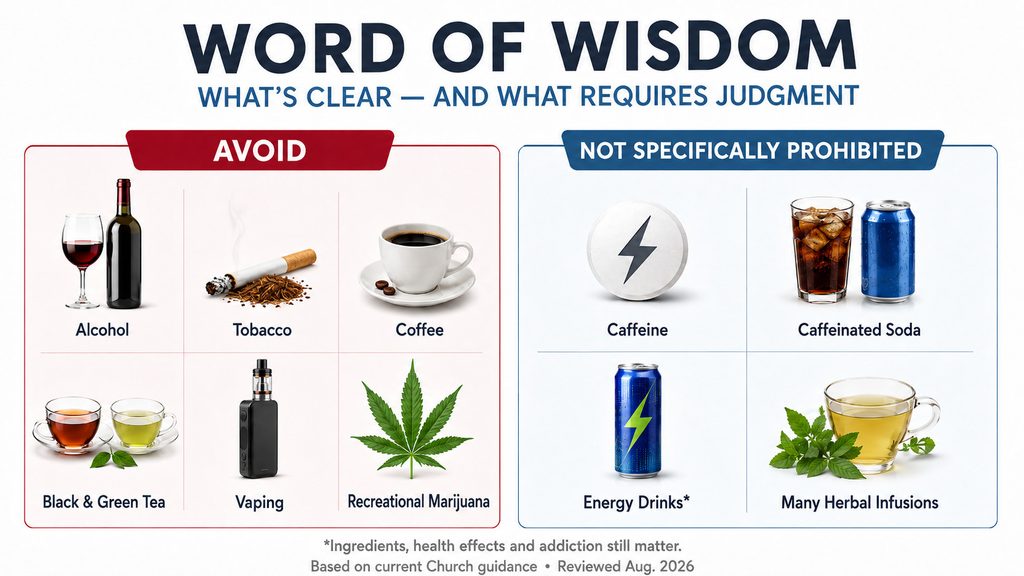
The current General Handbook lists clear standards but also says that not every harmful substance or practice can be specifically named. Members are therefore asked to use wisdom and prayerful judgment in choices affecting their health.
What Is the Word of Wisdom?
The Word of Wisdom is a revelation received by Joseph Smith in 1833 and now recorded in Doctrine and Covenants 89.
It contains both restrictions and positive guidance about caring for the body. It warns against alcohol, tobacco and what the revelation calls “hot drinks,” later understood by Church leaders as tea and coffee. It also encourages grains, fruits and wholesome plants and counsels that meat be used sparingly.
Today, the Church describes the Word of Wisdom as a commandment and as part of God’s law of health.
Its purpose is not merely physical.
Latter-day Saints believe obedience can bring both physical and spiritual blessings, including greater sensitivity to spiritual guidance.
What Does the Word of Wisdom Prohibit Today?
Some modern standards are explicit.
Alcohol
Latter-day Saints are taught to abstain from alcoholic drinks.
The current standard is not merely to avoid drunkenness or excessive alcohol. Church teaching calls for abstinence from alcohol.
Tobacco
Tobacco is also specifically prohibited.
Modern Church teaching applies the broader principle beyond the exact products available in 1833 by warning against substances that are harmful, illegal, addictive or impair judgment.
Coffee
Coffee is included in the Church’s interpretation of the Word of Wisdom.
This is not simply a rule against caffeine.
In 2019, the Church issued an official clarification specifically identifying coffee-based products among substances prohibited by the Word of Wisdom.
That distinction becomes important when considering decaf coffee, soda and energy drinks.
Black and Green Tea
Tea is also included in the Word of Wisdom standard.
The Church’s 2019 clarification specifically mentioned green tea, while current Church teaching identifies tea and coffee as the “hot drinks” from which members abstain.
Black tea and green tea therefore fall within the standard.
Changing the temperature does not change the category. Current Church educational material explicitly notes that iced tea is still tea.
Vaping and E-Cigarettes
Vaping is not treated as a loophole around the tobacco language of an 1833 revelation.
The Church’s official 2019 statement specifically identifies vaping and e-cigarettes as prohibited under the Word of Wisdom.
This illustrates an important principle: Church leaders may apply the Word of Wisdom to substances and practices that did not exist when Doctrine and Covenants 89 was received.
Recreational Drugs and Drug Misuse
Current Church teaching prohibits recreational drug use while permitting the authorized use of prescription medications.
The General Handbook adds the broader instruction to avoid substances that are harmful, illegal, addictive or impair judgment.
Prescription medication itself is therefore not contrary to the Word of Wisdom when used appropriately. Misusing medication is a different matter.
Why Don’t Latter-day Saints Drink Coffee?
One of the most common questions about the Word of Wisdom is also one of the most misunderstood.
Latter-day Saints do not avoid coffee simply because:
- it is hot;
- it contains caffeine;
- coffee is automatically considered unhealthy in every circumstance.
The religious reason is that Church leaders have interpreted the “hot drinks” mentioned in Doctrine and Covenants 89 as tea and coffee.
That interpretation remains part of current Church teaching.
This explains why an iced coffee is still coffee and why a hot drink that is not coffee or tea does not automatically violate the Word of Wisdom.
It also explains the apparent puzzle of a Latter-day Saint who avoids coffee but drinks a caffeinated soda.
The rule is not simply “no caffeine.”
Is Caffeine Against the Word of Wisdom?
No. Caffeine itself is not specifically prohibited by the Word of Wisdom.
This is one of the most persistent misconceptions about Latter-day Saint practice.
The Church’s historical explanation says that the use of substances such as caffeine has been left to the judgment of individual Latter-day Saints. It also notes that caffeine is not prohibited as a requirement for receiving a temple recommend.
That creates an important distinction:
Coffee is specifically included in the Church standard.
Caffeine itself is not.
So avoiding coffee while consuming caffeine from another source is not inherently contradictory under current Church teaching.
At the same time, “not prohibited” does not mean “unlimited consumption is encouraged.”
A Church physical-health resource updated in January 2026 advises members to be mindful of caffeine intake and recommends limiting caffeine, particularly because it can interfere with sleep.
The most accurate summary is therefore:
Caffeine itself is not specifically forbidden. Members are expected to use judgment about how much they consume and whether its use is affecting their health or becoming a dependency.
Can Latter-day Saints Drink Coke or Other Caffeinated Soda?
Caffeinated soda is not specifically prohibited because of caffeine alone.
Because the Church leaves caffeine itself to individual judgment, drinking a caffeinated soft drink does not automatically constitute a Word of Wisdom violation.
Some Latter-day Saints choose to avoid caffeinated soda for health or personal reasons.
That choice is perfectly valid.
But a personal or family practice should not automatically be presented as a universal Church rule.
This is one reason confusion about caffeine can persist: individual Latter-day Saint families sometimes adopt standards stricter than the minimum Church requirement.
What About Energy Drinks?
Energy drinks are not specifically prohibited as a category in current Church policy.
But that does not mean the Church has declared every energy drink advisable.
The General Handbook says that not every harmful substance or practice is specifically identified and tells members to use wisdom and prayerful judgment in making decisions that promote physical, spiritual and emotional health.
With an energy drink, several questions can matter:
- How much caffeine does it contain?
- Does it contain coffee or tea ingredients?
- What other stimulants are present?
- Is its use becoming habitual or addictive?
- Is it negatively affecting sleep or health?
Caffeine alone does not automatically make an energy drink prohibited.
But the broader principles of health, moderation and freedom from addiction still apply.
What About Tea, Matcha and Herbal Tea?
The word tea can cause confusion because it is used for many different beverages.
Black Tea
Black tea falls within the Church’s teaching about tea and is avoided under the Word of Wisdom.
Green Tea
Green tea is also avoided.
The Church specifically identified green tea in its 2019 clarification of the Word of Wisdom.
Matcha
Matcha is powdered green tea.
Because it is made from green tea leaves, changing its form into a powder does not make it a different substance from green tea for purposes of the Word of Wisdom.
Iced Tea
If an iced drink is made from black or green tea, cooling it does not change what it is.
Current Church educational material explicitly states that iced tea is still tea.
Herbal Tea
Herbal drinks require a little more nuance.
Many products marketed as “herbal tea” are technically infusions made from plants such as peppermint, chamomile, ginger, hibiscus or rooibos rather than traditional tea leaves.
Church materials have distinguished herbal tea from the tea prohibited by the Word of Wisdom.
However, commercial products can contain mixtures of ingredients.
The practical approach is therefore to check what the drink is actually made from rather than relying only on the word “tea” on the package.
What About Decaf Coffee?
This question demonstrates why caffeine and coffee should not be treated as the same thing.
The Church’s 2019 statement identifies coffee-based products as prohibited.
Decaffeination removes most of the caffeine from coffee, but the product remains coffee-based.
For that reason, removing caffeine should not be understood as creating a caffeine-based exception to the Church’s teaching about coffee.
In other words:
Caffeine itself is not specifically prohibited.
Coffee is.
That is the relevant distinction.
What About Marijuana and Prescription Drugs?
Current Church teaching distinguishes recreational drug use from legitimate medical treatment.
Recreational Marijuana
The Church opposes marijuana use for non-medical purposes.
Medical Marijuana
The General Handbook permits marijuana for medicinal purposes when:
- a licensed physician or another legally authorized medical provider determines that it is medically necessary; and
- the person follows the prescribed dosage and method of administration.
The Church does not approve of smoking marijuana, including for medical purposes.
It also does not approve of vaping marijuana unless a medical provider has specifically authorized that method based on medical necessity.
Prescription Medication
Appropriate prescription-drug use is permitted.
Church teaching distinguishes authorized prescription medication from recreational drug use while warning against misuse or abuse of medications.
Why Does Doctrine and Covenants 89 Say “Hot Drinks”?

Doctrine and Covenants 89 uses the phrase “hot drinks” rather than the modern words “coffee and tea.”
Church leaders historically interpreted that phrase as referring to tea and coffee, and that remains the interpretation reflected in current Church policy.
Temperature itself is therefore not the determining factor.
An iced coffee is still coffee.
Iced black tea is still tea.
A beverage does not automatically become prohibited simply because it is hot.
The phrase “hot drinks” is understood through the interpretation given by Church leaders rather than as a general prohibition against hot beverages.
What Does the Word of Wisdom Encourage?
The Word of Wisdom is frequently described online as a list of things Latter-day Saints cannot consume.
That is incomplete.
Doctrine and Covenants 89 also gives positive guidance about food and caring for the body.
Fruits, Vegetables and Grains
The revelation encourages wholesome plant foods and grains.
Current Church health guidance similarly recommends a balanced diet containing foods such as fruits, vegetables and whole grains.
What Does “Eat Meat Sparingly” Mean?
Doctrine and Covenants 89 says that the flesh of animals is ordained for human use but should be used “sparingly.”
Current Church materials continue to include meat, with that scriptural qualification, when summarizing the Word of Wisdom.
The Church does not currently establish a vegetarian requirement or publish a universal number of servings of meat that members may eat.
That makes this another useful distinction between a scriptural principle and a detailed administrative rule.
Members can take the counsel seriously without creating precise universal requirements the Church itself has not established.
Exercise, Sleep and Healthy Habits
Modern Church teaching about physical health is broader than food and drink.
A current Church resource recommends:
- nutritious, balanced meals;
- regular physical activity;
- adequate sleep;
- hydration;
- moderation;
- avoiding harmful substances.
It also advises limiting caffeine and avoiding it near bedtime when it interferes with sleep.
This helps show the broader purpose of the Word of Wisdom.
A person could avoid coffee, alcohol and tobacco while neglecting sleep, nutrition or other harmful habits.
That might follow several explicit rules while missing part of the larger principle of caring responsibly for the body.
How Did the Word of Wisdom Become a Commandment?
Doctrine and Covenants 89 was originally introduced as being given “not by commandment or constraint.”
So why is it treated as a commandment today?
The change was gradual.
Early Latter-day Saints lived in a culture where alcohol, coffee, tea and tobacco were common. Church leaders increasingly encouraged members to observe the Word of Wisdom more strictly over the following decades.
By the later nineteenth century, Church leaders were placing greater emphasis on full observance.
According to the Church’s current historical account, in 1921 President Heber J. Grant required Latter-day Saints to abstain from alcohol, tobacco, coffee and tea in order to obtain a temple recommend.
Today, the Church describes the Word of Wisdom as a commandment.
The current Word of Wisdom Study Guide says that observance is connected with receiving the full blessings of Church participation, including baptism, missionary service and temple ordinances.
Is the Word of Wisdom Required for a Temple Recommend?
Yes. Observance of the Word of Wisdom is part of the standard expected for temple worship.
But that does not mean every personal health decision is a temple-worthiness rule.
Caffeine is an excellent example.
Church historical guidance says that caffeine use is left to individual judgment and is not prohibited as a requirement for receiving a temple recommend.
There is therefore an important difference between:
an established Church standard
and
a person’s individual application of a broader health principle.
Rule or Principle? Where Personal Judgment Applies
Trying to turn the Word of Wisdom into a detailed list covering every modern product quickly creates problems.
Coffee?
Coke?
Energy drinks?
Pre-workout powder?
Chamomile tea?
Protein supplements?
A prescription medication?
The Church does not publish an approved-product database.
Instead, current Church teaching combines clearly established standards with broader principles requiring individual judgment.
| Specifically identified in Church teaching | Not specifically prohibited / personal judgment may apply |
| Alcohol | Caffeine itself |
| Tobacco | Caffeinated soda |
| Coffee | Energy drinks as a category |
| Black and green tea | Many herbal infusions |
| Vaping / e-cigarettes | Other modern foods and beverages not specifically identified |
| Recreational drugs | Other health practices not specifically addressed |
This leads to an important principle:
Not specifically prohibited does not mean officially recommended.
The General Handbook says there are harmful substances and practices that have not been specifically identified by the Word of Wisdom or Church leaders.
Members are expected to use wisdom and prayerful judgment when deciding how to protect their physical, spiritual and emotional health.
Personal judgment also works both ways.
A member may choose to avoid something that the Church has not specifically prohibited.
That can be a sincere and worthwhile personal decision.
But a personal practice should not automatically be turned into a universal Church rule for everyone else.
Frequently Asked Questions
Can Mormons drink coffee?
No. Latter-day Saints are taught to abstain from coffee under the Word of Wisdom. Current Church teaching identifies tea and coffee as the “hot drinks” members should avoid.
Can Mormons drink caffeine?
Caffeine itself is not specifically prohibited. The Church leaves its use to individual judgment, although current health guidance encourages moderation.
Can Mormons drink Coke?
Caffeinated soda is not specifically prohibited because of caffeine alone. Some members choose not to drink it personally, but that should not be confused with a universal Church rule.
Can Mormons drink green tea or matcha?
Green tea is specifically prohibited. Matcha is made from powdered green tea leaves, so it falls into the same category.
Can Mormons drink herbal tea?
Many herbal infusions are different from black or green tea. Because commercial products vary, checking the ingredients is the safest way to determine what a drink contains.
Can Latter-day Saints use medical marijuana?
Yes, under specific conditions. Current Church policy permits medical marijuana when a legally authorized medical provider determines that it is medically necessary and the patient follows the prescribed dosage and method of administration.
More Than a List of Forbidden Drinks
The Word of Wisdom is easy to reduce to one famous rule:
Latter-day Saints don’t drink coffee.
But Doctrine and Covenants 89 presents something larger.
It combines clear boundaries with positive counsel about food, moderation and caring for the body.
Modern Church teaching extends that principle by asking members to avoid substances that can harm, addict or impair them — while recognizing that not every possible modern product can be addressed by a specific rule.
Some boundaries are clear.
Others require judgment.
That means the most useful question is not always:
“Is this technically allowed?”
Sometimes the better question is:
“Does this choice help me care for my body, preserve my judgment and avoid unhealthy dependence?”
That is where the Word of Wisdom becomes more than a list of foods and drinks Latter-day Saints can or cannot consume.
It becomes what its name suggests:
a principle of wisdom.
Primary Sources
The factual claims in this article were checked against current or official resources published by The Church of Jesus Christ of Latter-day Saints:
- Doctrine and Covenants 89
- General Handbook — Word of Wisdom and Healthy Practices
- General Handbook — Medical Marijuana
- Word of Wisdom — Gospel Topics
- Word of Wisdom Study Guide
- Word of Wisdom (D&C 89) — Church History Topics
- Statement on the Word of Wisdom — August 15, 2019
- Doctrine and Covenants 89:1–17 — 2025 Seminary Teacher Manual
- Developing Habits to Build and Maintain Good Physical Health — updated January 13, 2026
Church policies and instructional materials can be updated. For questions involving current Church policy, readers should consult the latest General Handbook and ChurchofJesusChrist.org.
Related: Mormon Missionary Rules: What Missionaries Can and Can’t Do