
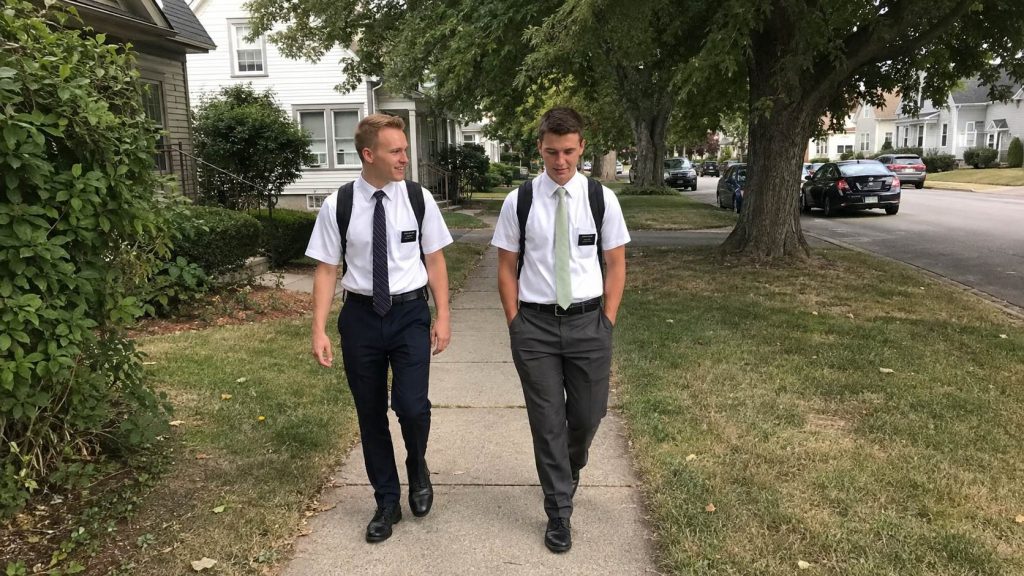
Full-time missionaries of The Church of Jesus Christ of Latter-day Saints follow standards that cover companions, schedules, relationships, technology, family communication, media, recreation, dress, finances, and personal conduct.
However, if you search for “Mormon missionary rules” online, you will also find information from very different eras of missionary service. Some frequently repeated claims—such as missionaries being able to call home only rarely or having no access to the internet—no longer describe current missionary life.
This guide focuses primarily on young full-time teaching missionaries and uses the Church’s current Missionary Standards for Disciples of Jesus Christ as its main source. Service missionaries follow a separate set of standards.
Sources last verified: August 2026.
Short answer: LDS missionaries do not date, normally stay with a companion, follow a structured schedule, avoid most ordinary entertainment, and use phones and social media only for approved purposes. They can communicate with family weekly.
At a Glance
The biggest change: Latter-day Saint missionaries can now communicate with their families every week on preparation day through approved methods, including phone calls and video chat.
The biggest misconception: The Church does not universally ban internet access, smartphones, or social media. Missionaries use technology for missionary work under specific safeguards and mission-specific approvals.
The biggest variable: Mission and Area leaders can adapt some details—especially approved technology, local schedules, and dress guidance—to local circumstances.
One of the most consistent standards: Young full-time teaching missionaries normally work within an assigned companionship rather than independently.
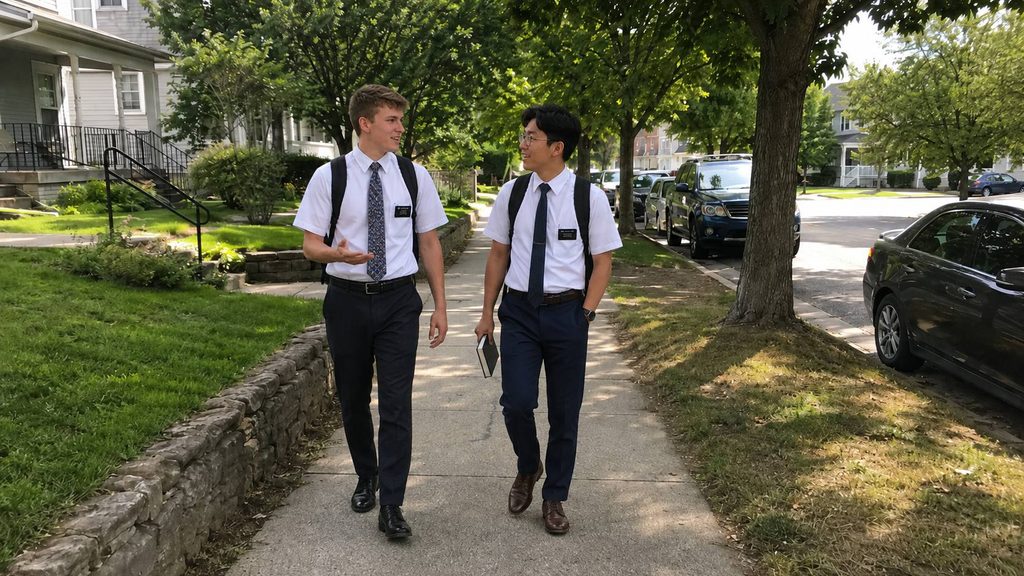
Quick Answer: What Rules Do Mormon Missionaries Follow?
Latter-day Saint missionaries live under a structured set of standards designed specifically for full-time missionary service.
| Area | Current General Standard |
|---|---|
| Companions | Teaching missionaries normally stay with an assigned companion |
| Dating | Full-time teaching missionaries do not date while serving |
| Physical contact | Missionaries limit contact with someone of the opposite gender to a handshake |
| Family communication | The Church allows weekly preparation-day communication |
| Phone & video calls | Missionaries can call or video chat with family on preparation day |
| Internet | Missionaries can use approved internet resources for missionary work |
| Social media | Missionaries may use social media when their mission approves it |
| Movies & TV | Missionaries generally avoid ordinary entertainment viewing |
| Video games | Missionaries generally avoid them |
| Recreation | Missionaries may exercise and enjoy approved recreation but avoid higher-risk activities |
| Swimming | Current standards list swimming among unauthorized recreational activities |
| Dress | Missionaries follow professional dress standards, with some local adaptations |
| Preparation day | Missionaries receive weekly time for practical needs, family communication, rest, and approved recreation |
Importantly, not every practical detail is identical worldwide. Mission and Area leaders can adapt some schedules, technology practices, dress guidance, and other details to local circumstances.
Mormon Missionary Rules That Have Changed
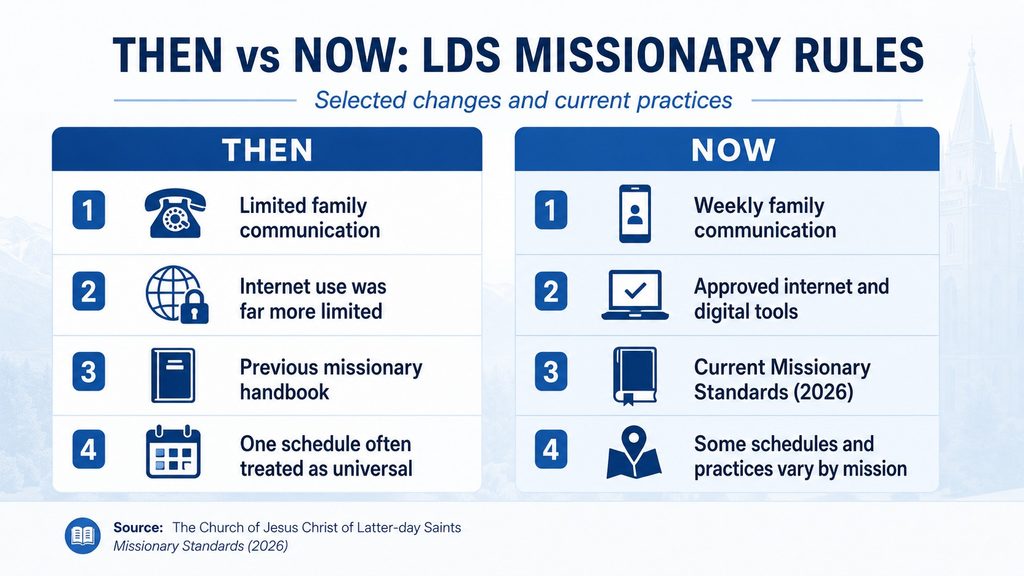
One of the biggest problems with searching for LDS missionary rules online is that old information rarely disappears from Google.
As a result, a page written 10 or 20 years ago can still appear beside the current Church handbook. Search results may therefore mix current standards, former rules, local practices, and sometimes outright misconceptions.
| Common Claim Online | Current Situation in 2026 |
|---|---|
| Missionaries can call home only a few times a year | Outdated. The Church now allows weekly family communication |
| Missionaries cannot use the internet | Outdated as a blanket rule. Missionaries use approved digital technology for missionary work |
| Missionaries cannot use social media | Not universally true. Missionaries may use approved social media |
| Every missionary can use the same apps | Not supported. Approved technology can vary by mission |
| Every missionary follows exactly the same daily schedule | Too absolute. The handbook gives a sample schedule that leaders can adjust |
| There are exactly 167 missionary rules | Legacy framing. That number comes from an older missionary-handbook era |
Family communication changed significantly in 2019
The familiar idea that missionaries could communicate with home only very rarely describes an earlier period of missionary life.
On February 15, 2019, the Church announced that missionaries could communicate with their families every week on preparation day through text messages, online messaging, phone calls, and video chat, in addition to letters and email.
Read the Church’s 2019 family communication announcement
The Church later incorporated that policy into its missionary standards.
The Church replaced the old missionary handbook
In November 2019, the Church released Missionary Standards for Disciples of Jesus Christ and replaced the previous missionary handbook, which had last received an update in 2010.
The new handbook used a more principle-based approach and included updated guidance about technology, safety, cultural awareness, family communication, and other aspects of modern missionary life.
Read the 2019 announcement about the new missionary handbook
Later revisions followed, including a significant update in 2023. The Church now publishes a 2026 edition of the standards.
Read about the 2023 missionary handbook update
Therefore, an old numbered list should not automatically serve as a description of missionary life today.
How This Guide Was Researched
For this article, we checked the Church’s current 2026 Missionary Standards for Disciples of Jesus Christ, current supplemental standards, Preach My Gospel, technology safeguards, dress-and-appearance guidance, and official Church announcements that document major policy changes.
When a practice can vary by mission, this guide identifies that uncertainty instead of presenting local instructions as universal Church rules.
We use older descriptions only to explain why outdated missionary information still appears online—not as authorities for current Church policy.
Why Do Latter-day Saint Missionaries Have Special Rules?
Full-time missionary service differs from ordinary employment, travel, or student life.
Young teaching missionaries devote their time to representing Jesus Christ and His Church, teaching the gospel, serving people, studying, and developing as disciples.
The First Presidency and Quorum of the Twelve Apostles explain that missionary standards help protect missionaries physically, spiritually, and emotionally while helping them become more devoted disciples of Jesus Christ.
Read the First Presidency message in the current Missionary Standards
That distinction matters because missionary standards are not a general list of rules for all Latter-day Saints.
For example, an ordinary Church member may date, watch movies, use social media personally, travel independently, swim, or spend time without an assigned companion. By contrast, a full-time missionary voluntarily accepts a much more structured way of life for the period of missionary service.
What Is a Typical LDS Missionary Daily Schedule?
The standard sample missionary day begins at 6:30 a.m., but the exact schedule does not have to look identical in every mission.
The current handbook gives a sample schedule in which missionaries begin their day at 6:30 a.m. Morning hours include prayer, exercise, getting ready, personal study, and planning.
From approximately 10:00 a.m. until 9:00 p.m., missionaries focus primarily on finding people, teaching, serving, maintaining records, studying with their companions, preparing lessons, and—when applicable—language study.
Missionaries normally return to their housing around 9:00 p.m. When they have a teaching appointment, they may return by 9:30. The sample schedule then places bedtime between approximately 9:30 and 10:30 p.m.
What varies by mission: A mission president can adjust daily schedules for holidays, special events, and other local circumstances.
Therefore, the common statement that “every Mormon missionary follows exactly the same 6:30-to-10:30 schedule everywhere in the world” is too rigid.
Missionary life remains highly structured. However, leaders can adapt the precise timetable to local circumstances.
Read the current Missionary Organization and Activities standards
What Is P-Day?
P-day means preparation day—a weekly period when missionaries handle practical needs, communicate with family, rest, and participate in approved recreation.
The current handbook’s sample preparation-day schedule gives missionaries time for those activities until approximately 6:00 p.m. Afterward, they return to normal missionary work.
Typical preparation-day activities include family communication, laundry, shopping, cleaning, grooming, rest, and approved recreation.
P-day is therefore not simply a weekly vacation day. Missionaries have more flexible time, but they remain missionaries and continue to follow missionary standards.
Why Do LDS Missionaries Stay With a Companion?
Young teaching missionaries normally work and live within an assigned companionship rather than conducting missionary work independently.
Current standards tell missionaries to stay with their companions during interactions with adults and children. The companionship model provides teaching support, practical safety, and accountability.
Moreover, technology rules extend the same principle into digital life. Current safeguards call for regular device-accountability reviews with a companion and encourage missionaries to use devices in ways that maintain companionship accountability.
Read the Church’s guidance on missionary device accountability
Of course, this does not mean two missionaries literally remain within sight of one another every second. Ordinary privacy and specific exceptions exist.
Still, companionship—not independent day-to-day missionary life—remains the standard operating model.
Can Mormon Missionaries Date?
No. Young full-time teaching missionaries do not date while serving.
The current teaching-missionary handbook does not place this rule under a simple stand-alone heading called “No Dating.” Instead, it establishes the standard through guidance on relationships, chastity, companionship, flirting, and physical contact.
Current standards specifically tell teaching missionaries not to flirt or associate inappropriately with anyone. They also limit physical contact with a person of the opposite gender to a handshake and establish additional safeguards for certain visits, teaching situations, travel, and meals.
Read the current Missionary Conduct standards
This distinction matters because it gives a more precise answer than a simple internet rule.
Missionaries still build real relationships with the people they teach and serve. They talk with people, visit families, listen, teach, and become part of communities.
However, they do not pursue romantic relationships while serving as full-time teaching missionaries.
Service missionaries follow a separate handbook, which states the dating restriction even more explicitly.
For an example of how service missionary life can differ from the teaching-mission model, see the Jesus in Focus story about Matthew Cooper and the mission call he did not expect.
Read Matthew Cooper’s service-mission story
Can LDS Missionaries Hug People?
The current public handbook does not contain one universal rule saying that missionaries may never hug another person under any circumstance.
Instead, the standards give more specific boundaries.
For interactions with adults, missionaries limit physical contact with someone of the opposite gender to a handshake.
For children, the rules become stricter. Current standards instruct missionaries not to hold or hug children, allow children to sit on their laps, babysit them, or remain alone with anyone younger than 18.
Therefore, the statement “Mormon missionaries are forbidden from ever hugging anyone” overstates what the current public handbook actually says.
A more accurate description is that missionaries follow deliberately conservative physical-contact standards, with especially clear boundaries involving the opposite gender and children.
Phones, Internet, and Social Media
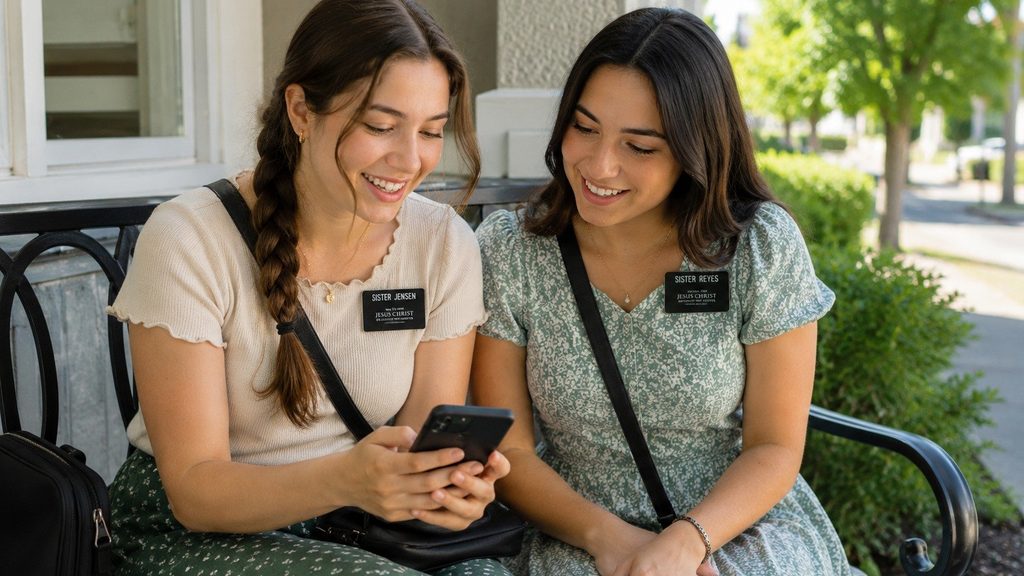
Technology is one of the clearest areas where descriptions of missionary life have become outdated.
Current standards do not treat digital technology as something missionaries simply never use. Instead, missionaries use technology as a tool for their work while following specific safeguards.
Do LDS missionaries have smartphones?
Many Latter-day Saint missionaries use mobile devices as part of missionary work, but they have far less freedom with technology than ordinary smartphone users.
Current missionary materials discuss mobile technology, approved internet access, digital teaching, social media, email, and device safeguards.
Therefore, the old blanket statement “missionaries are not allowed to use phones” no longer describes modern missionary work.
Can missionaries use the internet?
Yes. Missionaries can use approved internet resources as part of missionary service.
Church materials describe technology as a tool that can help missionaries study, plan, teach, find people, communicate, and accomplish missionary work.
However, the key word is approved.
Missionaries do not receive ordinary unrestricted personal internet time. Instead, they use technology to support their missionary purpose and follow Church safeguards.
Read Preach My Gospel guidance on using technology wisely
Can LDS missionaries use social media?
Yes. Missionaries can use social media when their mission approves it for missionary purposes.
Current standards refer to social media, mobile apps, and online media approved for the mission.
That wording matters because there is no public universal list stating that every missionary everywhere can use exactly the same platforms.
For example, a chart claiming that Facebook, Instagram, or WhatsApp are always allowed everywhere—or that another platform is always forbidden everywhere—would go beyond what the public standards establish.
What varies by mission: Approved platforms and practical implementation can differ by location and mission circumstances.
As a result, one missionary may appear regularly on social media while another missionary serving elsewhere rarely does.
Are missionary phones monitored?
The public standards clearly describe companion accountability. They do not establish that Church headquarters continuously watches every missionary phone in real time.
Missionaries follow technology safeguards that include device accountability with their companions and rules that reduce isolated or inappropriate device use.
This creates substantial accountability. However, “missionary phones have accountability safeguards” and “Church headquarters watches every missionary screen continuously” are very different claims.
Current public Church materials support the first statement. The sources used for this article do not establish the second.
How Often Can LDS Missionaries Call Home?
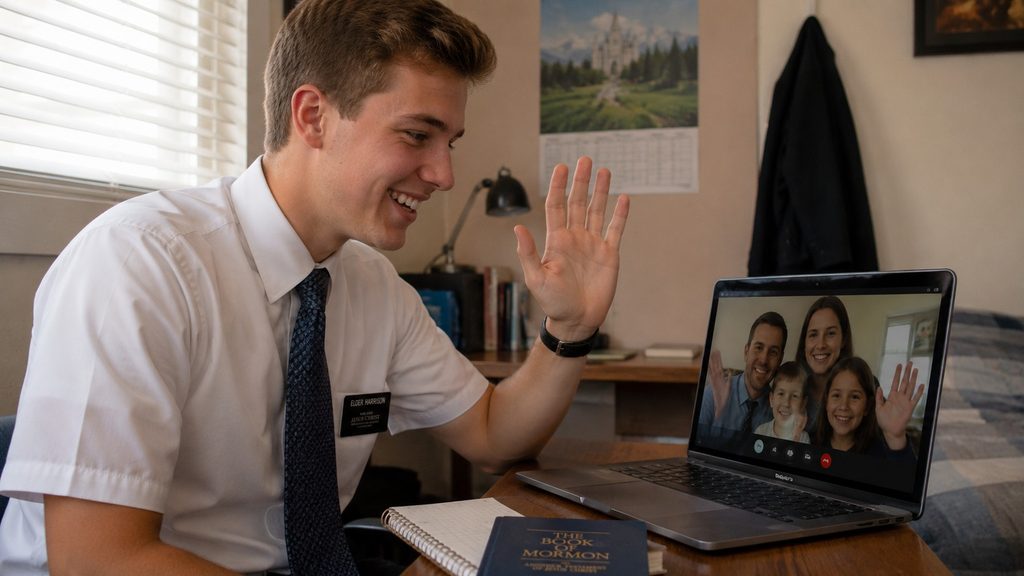
Missionaries may communicate with their families every week on preparation day.
Current standards allow weekly family communication through letters, email, text messages, online messaging, phone calls, and video chat.
In addition, missionaries may contact family on certain important occasions. The handbook says missionaries should normally initiate calls or chats. When a family faces an urgent need, it can contact the mission president.
This arrangement dates to the major policy change announced on February 15, 2019.
Therefore, if you encounter the claim that LDS missionaries may call home only on Christmas or Mother’s Day, you are reading a description associated with an older era of missionary communication—not the current 2026 standard.
Can Family Visit an LDS Missionary?
Generally, family and friends should not visit a missionary during the mission. However, a mission president can approve an exception in special circumstances.
Current standards say that an approved visit should remain brief and should not interfere with missionary responsibilities, inconvenience a companion or other missionaries, or create financial problems for the missionary’s family.
This provides a good example of why many missionary standards do not fit neatly into simplistic “always” or “never” lists.
The general standard is restrictive, but the handbook itself provides for exceptions.
Can Mormon Missionaries Watch Movies or TV?
Missionaries generally avoid ordinary television, movies, video games, and unauthorized videos.
Instead, current standards direct them toward appropriate media that supports their missionary purpose. Music, audiobooks, reading material, and other media should remain uplifting and compatible with missionary service.
That does not mean missionaries never watch a video. They may use video and other digital media for teaching, Church training, and missionary work.
In other words, approved missionary media is different from ordinary entertainment viewing.
Can LDS Missionaries Listen to Music?
Yes, but missionaries should choose music that fits their religious calling.
The current handbook directs missionaries toward music and other media that increase faith in Jesus Christ, invite the Spirit, and uplift them.
Mission leaders can also provide additional guidance about appropriate media.
Because local guidance can matter, broad internet claims such as “every missionary may listen only to one particular genre of music” deserve caution unless a current official source supports them.
Can LDS Missionaries Swim?
No. Current missionary standards list swimming among unauthorized recreational activities.
The standards identify recreational activities that create increased risk and specifically include water sports, including swimming.
The same section also identifies other higher-risk activities such as contact sports, winter sports, mountain and rock climbing, riding motorcycles or horses, traveling in private boats or airplanes, handling firearms, and using fireworks or explosives.
At the same time, missionaries can exercise and participate in safe recreation.
The principle is not that missionaries must avoid every enjoyable activity. Instead, the standards aim to reduce unnecessary risk of serious injury during missionary service.
What Are the Missionary Dress and Grooming Rules?
Missionaries should maintain a clean, professional appearance appropriate to representing Jesus Christ and the Church.
Current standards direct missionaries to the Church’s official dress-and-appearance resources. Mission leaders and Area Presidencies can modify some guidelines to accommodate local conditions.
This flexibility matters in a worldwide missionary program. For example, appropriate clothing in a tropical climate does not have to look identical to clothing used through a Canadian winter.
Current grooming guidance includes neat and professional hairstyles, natural-looking hair color, regular personal hygiene, and an appearance that does not unnecessarily draw attention. Elders should remain clean-shaven.
See the Church’s current Dress and Appearance guidance
Again, missionary dress illustrates an important principle: Church-wide expectations exist, but not every practical detail looks identical in every mission.
Which Missionary Rules Can Vary by Mission?
Church-wide missionary standards apply broadly, but mission and Area leaders intentionally adapt some practical details to local circumstances.
Church-wide standards
Church-wide standards include principles such as companionship, chastity, honesty, appropriate interaction with others, missionary purpose, family-communication standards, and general safety expectations.
Mission-specific details
By contrast, some practical details may vary. These can include the exact daily schedule, approved technology, available social-media platforms, adaptations to dress, local transportation practices, and additional safety instructions.
The Church’s supplemental missionary guidance includes instructions that apply according to the particular mission and local circumstances. Likewise, mission and Area leaders can adapt dress guidance.
Therefore, two returned missionaries can sometimes give different answers to a practical question without either person remembering incorrectly.
Their missions may genuinely have implemented some details differently.
Are There Really 167 Mormon Missionary Rules?
No current official 2026 handbook presents missionary standards as a fixed list of exactly 167 rules.
The phrase “167 missionary rules” comes from lists based on an older missionary-handbook era. The previous handbook also became widely known informally as the “White Bible.”
In November 2019, the Church replaced that earlier handbook with Missionary Standards for Disciples of Jesus Christ. The Church has continued to update those standards since then.
Some principles from older handbooks remain recognizable today. However, other rules and practices have changed.
In addition, older lists can mix broad Church standards with instructions or assumptions that belonged to a particular period or local context.
For that reason, the number 167 should not serve as the official count of rules every Latter-day Saint missionary follows in 2026.
Are Missionary Rules the Same as Rules for All Latter-day Saints?
No. Many missionary standards apply specifically to people who serve full-time missions.
Some standards reflect broader commandments and expectations shared by Church members, including honesty and the law of chastity.
However, ordinary Latter-day Saints do not generally need to live and work with an assigned missionary companion, organize each day around missionary service, avoid ordinary entertainment, use only mission-approved media, communicate according to a preparation-day schedule, follow missionary recreation restrictions, or dress as missionaries every day.
This distinction matters whenever someone uses missionary rules to answer the broader question, “What are Mormons allowed to do?”
A missionary temporarily lives under a specialized set of standards connected to a full-time religious calling.
Frequently Asked Questions
Can Mormon missionaries date?
No. Young full-time teaching missionaries do not date while serving. Current standards prohibit flirting and inappropriate associations and establish companionship and physical-contact boundaries.
Can LDS missionaries hug?
It depends on whom you mean. Current standards limit physical contact with a person of the opposite gender to a handshake and specifically instruct missionaries not to hold or hug children. The public handbook does not state a universal “never hug anyone” rule.
Can missionaries call home every week?
Yes. Missionaries may communicate with family every week on preparation day through approved methods that include phone calls, video chat, texts, online messaging, email, and letters.
Can LDS missionaries use social media?
Yes, when their mission approves it for an appropriate missionary purpose. Current public standards do not provide one universal list of platforms available to every mission worldwide.
Can Mormon missionaries swim?
No as a recreational missionary activity. Current standards list water sports, including swimming, among activities missionaries should avoid because of increased risk.
Are there exactly 167 Mormon missionary rules?
No. The current official handbook does not organize missionary standards as a fixed list of 167 rules. That number comes from material associated with an earlier missionary-handbook era.
The Simplest Way to Understand LDS Missionary Rules
Latter-day Saint missionary life remains highly structured in 2026.
Young teaching missionaries work with companions, organize their days around religious service, step away from dating and most ordinary entertainment, follow conservative relationship boundaries, use technology under safeguards, and accept restrictions that ordinary Church members do not live under.
However, missionary life has also changed.
Digital technology now plays a significant role in missionary work. Families can communicate weekly. Missionaries can use social media when their mission approves it. In addition, some schedules and practical details can vary by mission.
Meanwhile, many missionary-rules lists still visible online describe an earlier generation of missionary service.
That is why the most useful answer to “What are the Mormon missionary rules?” is not simply the longest numbered list available online.
A more accurate approach asks three questions:
What is the current Church-wide standard?
What has changed?
What can legitimately vary from one mission to another?
Those distinctions make the difference between describing missionary life as it once worked—or as someone remembers it—and describing the standards missionaries actually follow today.
Sources and Further Reading
Core Missionary Standards
Missionary Standards for Disciples of Jesus Christ — 2026
The primary current source for teaching-missionary organization, conduct, recreation, technology, family communication, physical well-being, finances, and other missionary standards.
Read the 2026 Missionary Standards
Title Page — Missionary Standards for Disciples of Jesus Christ
Identifies the current publication information and revision history for the handbook.
View the official title page
Missionary Organization and Activities — Section 2
The main source for companionships, daily activities, the sample daily schedule, preparation day, and schedule adjustments.
Read Missionary Organization and Activities
Missionary Conduct — Section 3
The main source for relationships, interactions with adults and children, recreation, media, technology, family communication, and personal visits.
Read Missionary Conduct
Physical Well-Being — Section 4
Covers health, appearance, grooming, finances, and related standards.
Read Physical Well-Being
Missionary Standards: Supplemental Information — 2026
Provides additional mission-dependent guidance involving technology, safety, service, communication, and practical circumstances.
Read the Supplemental Missionary Standards
Technology and Digital Use
Preach My Gospel, Chapter 2
Explains missionary principles for using technology wisely while maintaining spiritual focus, discipline, and accountability.
Read Preach My Gospel, Chapter 2
Using Technology Wisely: Device Accountability
Addresses companionship and accountability in missionary technology use.
Read Device Accountability guidance
Dress and Appearance
Dress and Appearance — Official Missionary Resource
Provides current practical guidance for missionary clothing, grooming, and adaptations to local circumstances.
View current Dress and Appearance guidance
Major Policy Changes
Missionaries Now Have More Options to Communicate With Families — February 15, 2019
Documents the change that expanded preparation-day family communication to additional digital methods.
Read the 2019 family communication announcement
Church Releases New Missionary Handbook — November 15, 2019
Documents the Church’s replacement of the previous handbook with Missionary Standards for Disciples of Jesus Christ.
Read the 2019 missionary handbook announcement
Missionary Handbook Update — August 21, 2023
Documents later revisions involving schedules, music, finances, dress and appearance, leadership, technology, and other clarifications.
Read about the 2023 missionary handbook update
Service Missionaries
Missionary Standards for Service Missionaries
The separate official handbook helps explain why service-missionary standards should not automatically be treated as identical to those for young full-time teaching missionaries.
Read the Service Missionary Standards