
Matthew Cooper hoped to serve in another country and learn another language. Instead, his mission call kept him close to home — and taught him something deeper about faith, agency and what it really means to help another person.
In May 2025, Matthew Cooper sat at a table with other high school football players preparing for what came next.
That day, he committed to join the St. George Eagles, a post-high-school football program.
For Cooper, reaching that table had already required years of persistence.
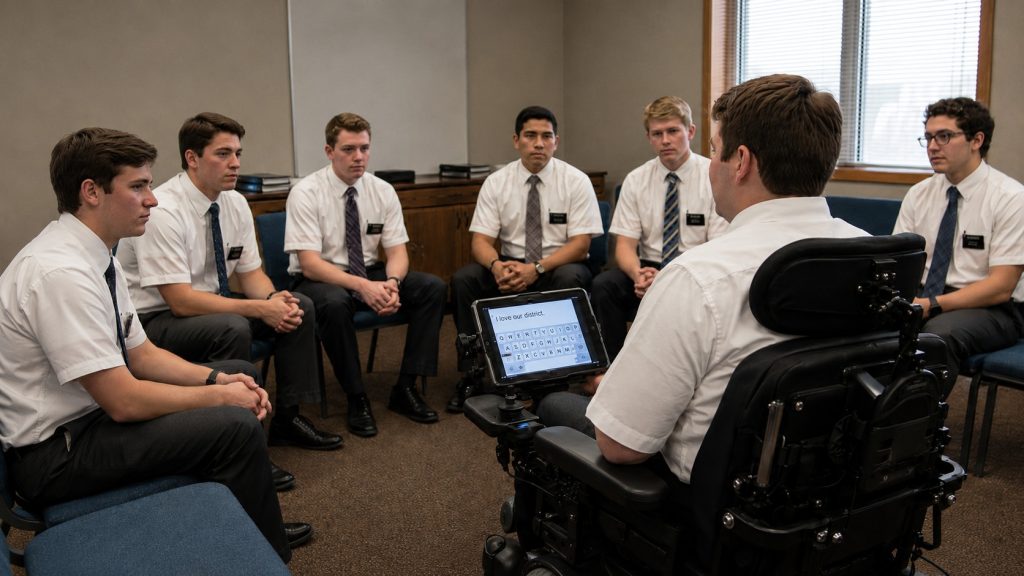
Born with quadriplegic cerebral palsy, he uses an electric wheelchair for most of his mobility and communicates through a speech device, typing words with his left hand before the device speaks them aloud.
But football had been part of his life for years.
As a child, Cooper watched friends play flag football and decided he wanted to play too. His mother initially assumed the league would say no.
Instead, they said yes.
Later, he pushed to play tackle football. After passing the required physical, he joined a team. In high school, coaches and teammates found ways to include him, and after his senior season he was invited to participate in a game featuring high school players from Utah and Nevada.
During that game, Cooper carried the ball for one yard.
Afterward, a coach from the St. George Eagles gave him his business card. Conversations followed, and eventually Cooper was offered another opportunity to stay involved with the sport he loved.
So in May 2025, he sat beside other football players and made his commitment to the Eagles.
But something else happened that same day.
His mission call arrived.
According to Church News, Cooper later described it simply:
“It was a great day.”
One dream and one calling arrived together.
A promise he had carried for years
The idea of serving a mission had been with Cooper long before that call arrived.
When he was about 13 or 14 years old, he was going through a difficult period and asked his father for a priesthood blessing.
During the blessing, his father told him that God wanted him to serve a mission.
Cooper remembered those words.
And as he grew older, he formed his own picture of what that mission might look like.
He wanted to leave the United States.
He hoped to serve in another country.
He wanted to learn another language.
Then came the call.
Instead of sending him overseas, Cooper was assigned to serve as a service missionary in the Utah Provo Mission.
It was not the mission he had imagined.
But it soon became clear that staying close to home did not mean serving in a smaller way.
The mission he did not expect
Two days each week, Cooper helps orient new missionaries at the Provo Missionary Training Center and assists missionaries arriving from the Salt Lake City International Airport.
He serves in the Provo City Center Temple.
He contributes his thoughts and testimony in a weekly adaptive ability institute class.
Whenever possible, he joins teaching missionaries for contacting and lessons.
He attends district and zone meetings with both teaching and service missionaries.
He also participates in priesthood service. On one occasion, a neighbor battling cancer asked Cooper to perform the anointing as part of a priesthood blessing.
These details of Cooper’s missionary service were reported by Church News and were also shared through the official Church Newsroom.
His mission is not an imitation of missionary service.
It is missionary service.
And that distinction matters.
Cooper may depend on other people for some physical assistance, but dependence is not the same thing as passivity.
His mother, Laura Cooper, has described independence for her son in a way that challenges the way many people think about the word.
For Matthew, independence has never meant doing everything alone.
It means being able to exercise his own agency wherever he can.
He may need another person to help him physically accomplish something. But he can still decide. He can still contribute. He can still serve. He can still speak for himself.
That understanding of independence may be one of the most important parts of his story.
Helping without taking over
Photographs from Cooper’s missionary service show him typing comments into his speech device during district meetings, one word at a time.
The process takes time.
And that simple reality points toward something Cooper himself has learned about helping people well.
Asked what lesson he hoped others might learn from his life, Cooper told Church News:
“Don’t try to take away their burdens. Just support them.”
It is a striking message in a culture that often treats helping as fixing.
When someone struggles, our first instinct may be to remove the difficulty as quickly as possible.
A parent may want to solve a problem before a child has the chance to work through it.
A friend may want to make a painful choice disappear.
A Church leader may be tempted to solve a struggle before allowing someone the space to work through it.
And when a person has a visible disability, that instinct can become even stronger. People may begin doing things for someone without first asking whether that help is actually needed.
But support and control are not the same thing.
Sometimes genuine help means making room for another person to act.
Even if it takes longer.
Even if the process looks different.
Even if doing it for them would seem easier.
Agency still matters
There is something deeply consistent with the gospel of Jesus Christ in that idea.
Christ lifts, strengthens and helps. His grace provides what we could never provide for ourselves.
But His help does not erase agency.
Again and again, the gospel invites people not only to receive grace, but also to choose, act, grow and participate.
That is why Cooper’s mother does not define her son’s independence primarily by how many physical tasks he can perform without assistance.
A person can need substantial physical help and still exercise remarkable agency.
Cooper’s own life makes that visible.
He needs help.
He also wants responsibility.
He relies on others.
He also serves others.
He receives support.
He also teaches, bears testimony, participates in priesthood blessings and helps other missionaries in their own service.
None of those truths cancels the others.
The call was different. The purpose was not.
Cooper began his mission in June 2025.
The mission he once imagined overseas became something geographically much closer to home.
But it has not been smaller in purpose.
He has said that his missionary experiences have strengthened his testimony of the gospel and helped him develop a solid testimony of the Book of Mormon that continues to grow.
When his mission ends, football is still part of the future he imagines.
He hopes to return to the field and pursue college and professional dreams.
Whether every dream unfolds exactly as he imagines is almost beside the point.
His mission has already taught him something about expectations.
Years ago, he believed God wanted him to serve a mission.
He was right.
He simply did not know what that mission would look like.
The foreign country never came.
The new language never came.
Instead came the MTC.
The temple.
District meetings.
Teaching appointments.
Missionaries arriving from the airport.
Priesthood service.
And a lesson about what it can mean to truly support another person.
Perhaps that is why Cooper’s advice carries so much weight.
“Don’t try to take away their burdens. Just support them.”
He knows what it means to carry burdens other people can see.
But his answer is not that every burden must disappear.
Sometimes love removes a burden.
Sometimes love helps carry part of it.
And sometimes love means staying close enough to support someone without taking away the opportunity to act for themselves.
A similar lesson appears in another story we shared about a young man whose congregation chose not to step in too quickly, but instead gave him the space to finish on his own.
Help Us Share More Meaningful LDS Stories
Stories like this take time to discover and tell. Support Jesus in Focus by becoming a Facebook subscriber and receive additional original Latter-day Saint stories and faith-centered content.
Become a SubscriberYour support helps us continue publishing thoughtful, faith-centered content.