
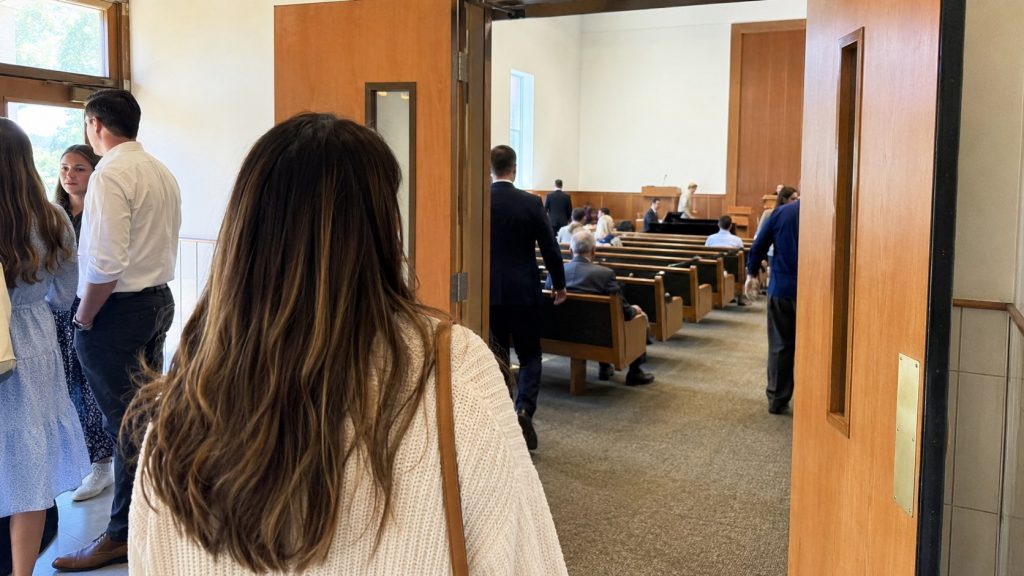
If you are thinking about attending a Mormon church service for the first time, you may be wondering what will happen once you walk through the doors — what to wear, where to sit, whether you will be expected to participate, and how long the service lasts.
The short answer: visitors are welcome, and a typical Sunday schedule lasts about two hours. The main worship service, called sacrament meeting, includes hymns, prayers, the sacrament with bread and water, and talks given by members of the congregation. Children, teenagers, and adults also attend smaller classes and meetings.
You do not need to be a member, bring a Bible or Book of Mormon, donate money, or participate in anything that makes you uncomfortable. You can simply come, find a seat, and observe.
In this guide, “Mormon church” refers to Sunday worship services of The Church of Jesus Christ of Latter-day Saints. “Mormon” remains a common search term, although members generally use “Latter-day Saint” or the full name of the Church.
Last reviewed: August 28, 2026
Updated for the Sunday schedule beginning September 6, 2026.
If you are visiting before September 6, the class rotation may be different, but the overall Sunday schedule is still about two hours and the sacrament meeting experience described below is the same.
Mormon Church Service at a Glance
| Question | Quick Answer |
|---|---|
| How long is church? | About 2 hours on a regular Sunday |
| Can non-members attend? | Yes |
| What is the main service called? | Sacrament meeting |
| How long is sacrament meeting? | About 60 minutes |
| What should I wear? | Come as you are; many people dress somewhat formally |
| Do I have to participate? | No |
| Will I be asked for money? | No |
| Can I bring children? | Yes |
| Do I need to bring anything? | No |
| What if I don’t want to take the sacrament? | Simply pass the tray to the next person |
Can Anyone Attend a Mormon Church Service?
Yes. Sunday worship services of The Church of Jesus Christ of Latter-day Saints are open to visitors.
You do not need an invitation, and you do not need to meet with missionaries before attending.
You can come with a member friend, with your family, or by yourself.
Some people visit because they are interested in the faith. Others attend with a friend or relative, visit while traveling, or simply want to experience a Latter-day Saint worship service for themselves.
You do not have to explain why you are there or make any commitment simply because you attend.
Before You Go: Find the Right Meetinghouse and Time
One thing that can confuse first-time visitors is the difference between a Latter-day Saint meetinghouse and a temple.
Regular Sunday worship services take place in local meetinghouses, sometimes informally called chapels or church buildings. Temples serve a different purpose and are not where local congregations normally gather for Sunday worship.
Before leaving home, check both the address and meeting time for the specific congregation you plan to visit. More than one congregation — usually called a ward or branch — may share the same building and meet at different times.
The Church’s official Find a Church tool lets you search by address or location and see nearby congregations and service times.
Arriving about 10 to 15 minutes early can make a first visit easier.
What Happens When You Walk In?
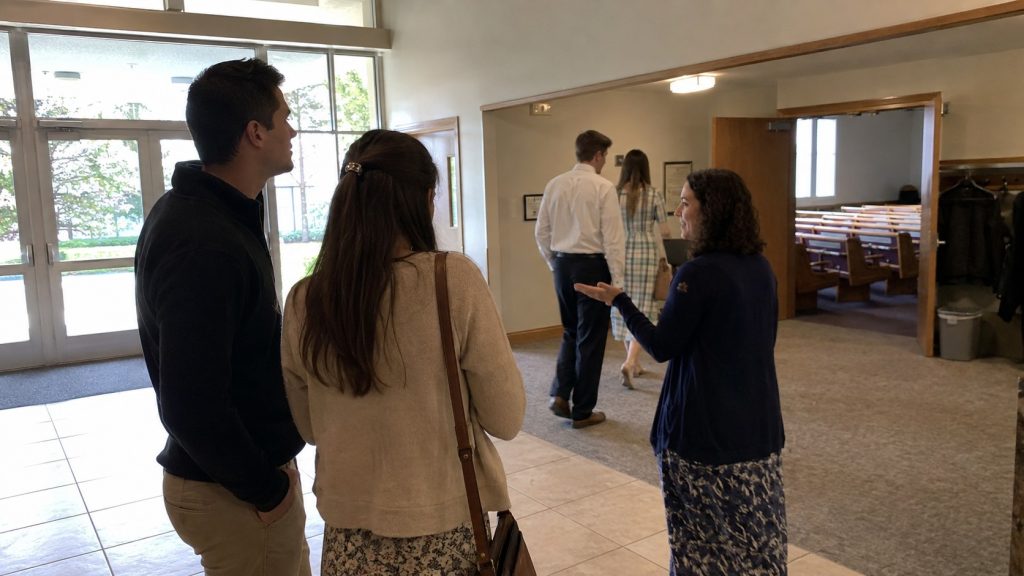
Most Latter-day Saint meetinghouses are fairly simple rather than ornate.
You will usually enter a foyer or hallway that leads to the chapel and classrooms elsewhere in the building. Someone may greet you, or you may simply walk in with everyone else.
Church guidelines encourage members, including youth, to welcome visitors, answer questions, and help people find seats when needed.
If you are unsure where to go, you can simply ask:
“Hi, this is my first time here. Where is sacrament meeting?”
You do not need to check in.
The chapel itself is usually simple. You may see rows of pews or chairs facing a raised stand, a piano or organ, and a sacrament table near the front.
There are no assigned seats for visitors, so you can sit wherever you feel comfortable. Families often sit together, and quiet prelude music may be playing while people arrive.
You can also request in advance for local missionaries to meet you at the building if that would make your first visit easier, but this is entirely optional.
What Should You Wear to a Mormon Church?
There is no admission dress code for visitors.
Many Latter-day Saints wear dressier clothing for Sunday worship. You will often see dress shirts, ties, dresses, skirts, slacks, jackets, and similar Sunday clothing.
But you do not need to buy special clothes before visiting.
If jeans and a clean shirt are what you feel comfortable wearing, you can still come. The Church’s visitor guidance specifically invites people to come as they are.
For a first visit, think comfortable and respectful, not “I need to look like everyone else.”
What Happens During Sacrament Meeting?
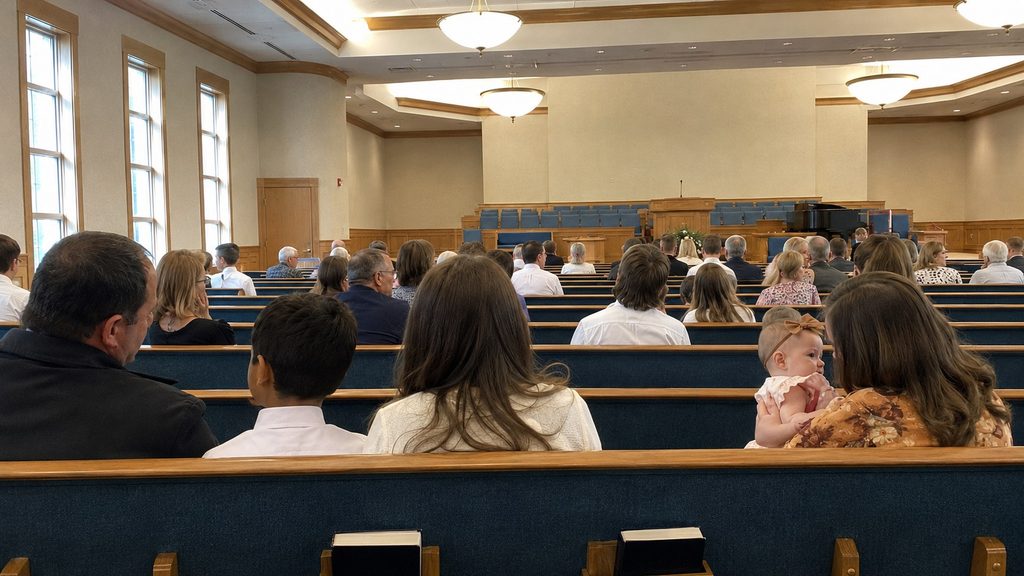
Sacrament meeting is the main worship service and lasts about 60 minutes.
Adults, teenagers, and children attend together.
The exact program can vary slightly from week to week, but the basic pattern is consistent.
Welcome, Hymns, Prayer, and Church Business
The meeting normally begins with a welcome, followed by an opening hymn and prayer.
The congregation sings together, but visitors do not have to sing.
A member of the congregation offers the prayer. You are not expected to pray aloud.
There may also be brief announcements and items of local Church business.
One thing that can surprise a first-time visitor is seeing members raise their hands during what Latter-day Saints call sustaining. This is one way members show support when people are called to responsibilities in the congregation.
As a visitor, you do not need to participate.
The Sacrament: Bread and Water
The central part of the meeting is the sacrament, which has similarities to Communion in other Christian traditions.
A sacrament hymn is sung. Prayers are offered over bread and water, and trays are then passed through the congregation while people remain seated.
Church members take a small piece of bread and a small cup of water in remembrance of Jesus Christ and His sacrifice.
For baptized members, the sacrament has particular covenant meaning and is the central focus of the meeting.
This is often the quietest part of the service as people reflect on the Savior.
Can Visitors Take the Sacrament?
If you are visiting and do not want to participate, simply pass the tray to the next person. That is completely normal.
The Church’s Newsroom explains that while the sacrament is intended for baptized Church members, visitors are not prevented from partaking of the bread and water.
So you do not need to worry about making a social mistake. You may quietly participate or simply pass the tray along.
Talks Given by Members of the Congregation
After the sacrament, members of the congregation usually give talks about Jesus Christ, scripture, faith, discipleship, family life, or another gospel topic.
This may feel different if you are accustomed to a church where the same pastor delivers a sermon each week.
Local Latter-day Saint congregations have a lay ministry rather than paid local professional clergy. Speakers are normally members of the congregation, including men, women, and youth.
A parent, student, retiree, teacher, tradesperson, or another person sitting somewhere in the congregation may be one of the speakers that Sunday.
A closing hymn and prayer normally end sacrament meeting.
What If You Visit on Fast and Testimony Sunday?
Once each month — usually on the first Sunday — sacrament meeting follows a different format called fast and testimony meeting.
There are normally no assigned speakers.
After the sacrament, members of the congregation may voluntarily come forward and briefly share their testimony of Jesus Christ and His gospel.
If you happen to visit on one of these Sundays and see different people spontaneously going to the front to speak, nothing unusual has gone wrong. It is the planned format for that Sunday.
You are not expected to go up and speak.
Fast and testimony meeting can occasionally be moved to another Sunday because of general conference, stake conference, or other scheduling needs.
What Happens After Sacrament Meeting?
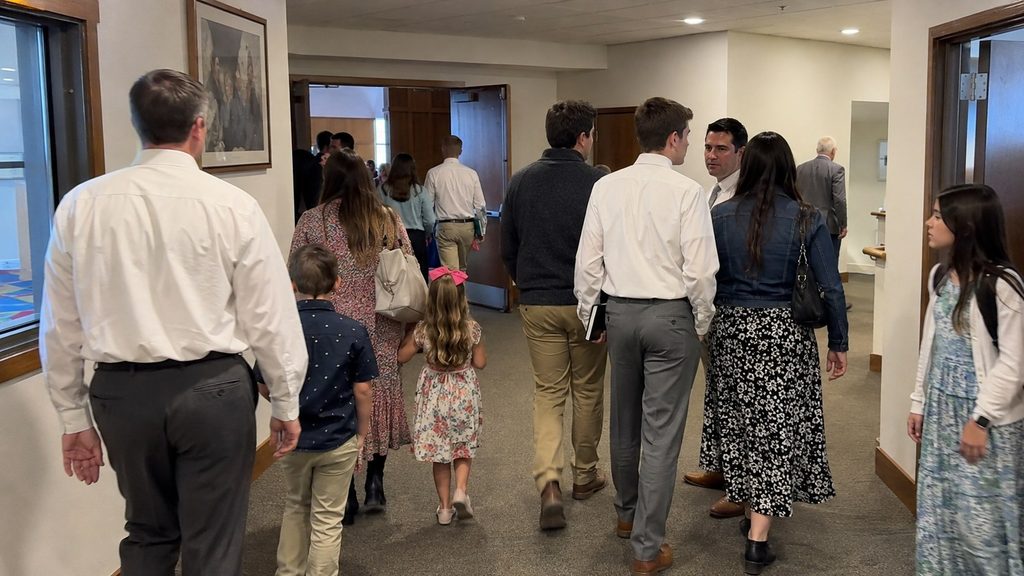
In many congregations, sacrament meeting comes first.
When it ends, the building can suddenly feel much busier. Adults and teenagers head toward smaller classes, parents help children find Primary, and people move through the hallways.
Local circumstances can sometimes require the order to be reversed, with classes held before sacrament meeting.
If you only want to attend sacrament meeting on your first visit, you do not have to stay for the remaining classes.
If you want to stay, you do not need to understand the organizational system beforehand.
Simply say:
“This is my first Sunday. Where should I go next?”
Someone can help.
Sunday Schedule Beginning September 6, 2026
Beginning September 6, 2026, the standard Sunday schedule for youth and adults includes:
Sacrament meeting — 60 minutes
5-minute transition
Sunday School — 25 minutes
5-minute transition
Quorum and class meetings — 25 minutes
Adults then attend Relief Society or elders quorum. Young women attend Young Women classes, while young men attend Aaronic Priesthood quorum meetings.
Children attend Primary for 55 minutes while adults and youth attend these classes and meetings.
Where local circumstances make it necessary, a congregation may reverse the order and hold classes before sacrament meeting.
For a first-time visitor, the important thing is much simpler:
You do not need to memorize the schedule. Someone can show you where to go.
What If You Bring Children?
Children are a normal part of Latter-day Saint Sunday worship.
During sacrament meeting, children generally sit with their parents or families instead of immediately leaving for a separate children’s service.
That means sacrament meeting is not always perfectly silent.
You may hear a baby cry, see a toddler become restless, or notice parents quietly helping young children through the meeting. Families worshipping together is part of the normal experience.
After sacrament meeting, children generally attend Primary.
Nursery is available for children 18 months to 3 years old and runs during the time scheduled for Primary.
Meetinghouses also provide a mother’s lounge for feeding infants or other needs.
Beginning September 6, Primary lasts 55 minutes while adults and youth attend their classes and quorum meetings.
Teenagers attend Sunday School and then their Young Women class or Aaronic Priesthood quorum meeting.
If you are visiting with children and are unsure where they should go, ask another parent or a Primary leader.
Visitor Etiquette: What Is — and Isn’t — Expected of You
A first visit becomes much easier once you know that you are allowed to simply observe.
Do I Have to Sing or Pray?
No.
You are welcome to sing the hymns, but you do not have to.
When someone offers a prayer, you can simply listen.
During classes, people may answer questions or participate in a discussion. You are welcome to join in, but you are not required to speak.
Will I Be Asked to Donate Money?
No.
There is no collection plate passed during the Sunday worship service.
Latter-day Saints believe in tithing, but members who choose to pay tithing do so privately. Visitors are not asked for donations during the meeting.
Will I Have to Stand Up or Introduce Myself?
There is no Church-wide requirement for visitors to stand in front of the congregation and introduce themselves.
In a large congregation, some people may not even realize you are visiting.
In another ward or branch, someone may notice a new face and say hello.
Either experience is normal.
What About the Missionaries?
You may see full-time missionaries at church, often recognizable by their name tags.
They may introduce themselves or say hello, just as other members might.
Simply attending a Sunday service does not obligate you to schedule missionary lessons or provide contact information.
If you would actually prefer some help on your first visit, the Church allows visitors to request that missionaries meet them at the building.
Can I Take Photos During the Service?
Do not take photographs or record video during sacrament meeting.
Church policy asks everyone to avoid photography and video recording during sacrament meeting in order to preserve the sacred nature of the worship service.
If you want a photo of the meetinghouse itself, take it outside or before or after the service rather than photographing the meeting.
8 Things That May Feel Different From Other Churches
1. There is no collection plate.
Donations are not collected during the worship service.
2. There is no paid local pastor delivering the sermon every Sunday.
Local Church leadership is a lay ministry, and different members usually give the talks.
3. The sacrament uses bread and water.
Water is used rather than wine.
4. The trays move through the congregation.
People generally remain seated while the bread and water are passed along the rows.
5. The chapel can become very quiet during the sacrament.
It is intended as a time to remember Jesus Christ and His sacrifice.
6. Children stay with their families during the main service.
Young children are a normal and visible part of sacrament meeting.
7. You may see people raise their hands.
This can happen when members sustain someone in a Church responsibility.
8. Ordinary members do much of what you see.
Members give talks, teach classes, offer prayers, lead music, welcome visitors, and serve in many other roles.
When a Sunday Service May Be Different
Most Sundays follow the general pattern above, but there are several exceptions worth knowing about.
Fast and Testimony Sunday
Once a month, usually on the first Sunday, members voluntarily share short testimonies instead of hearing the normal assigned talks.
Easter Sunday
On Easter Sunday, sacrament meeting is the only Church meeting held rather than the normal full Sunday schedule.
Christmas
When Christmas Day falls on a Sunday, only sacrament meeting is held.
When Christmas falls on another day of the week, the stake presidency designates a nearby Sunday — usually the Sunday before Christmas — on which only sacrament meeting is held.
General Conference and Other Special Weekends
General conference takes place twice each year and affects the normal local Sunday schedule.
Stake conference can also change what happens at an individual meetinghouse.
If your first visit happens around one of these special weekends, check the congregation’s current meeting information before going.
Helpful Mormon and Latter-day Saint Terms to Know
| Term | Meaning |
| Ward | A local congregation |
| Branch | A local congregation, often smaller than a ward |
| Bishop | The leader of a ward |
| Sacrament meeting | The main Sunday worship service |
| Sacrament | The ordinance using bread and water in remembrance of Jesus Christ |
| Talk | A sermon or gospel message given during sacrament meeting |
| Primary | The Church organization for children |
| Relief Society | The Church organization for adult women |
| Elders quorum | A priesthood quorum for adult men |
If these organizational terms are confusing, see our guide to wards, branches, stakes, and districts for a simple explanation of how Latter-day Saint congregations are organized.
Frequently Asked Questions
Can I wear jeans to a Mormon church?
Yes. Many members wear dressier clothing on Sundays, but visitors are welcome to attend in clothing they feel comfortable wearing to church.
Can I leave after sacrament meeting?
Yes. You are welcome to stay for the entire Sunday schedule, but you are not required to attend the classes and meetings afterward.
Do I need to bring a Bible or Book of Mormon?
No. You do not need to bring any materials with you.
Can I attend by myself?
Yes. You do not need to know a Church member or arrange a visit through missionaries before attending.
Is a Mormon meetinghouse the same as a temple?
No.
Regular Sunday congregations worship in meetinghouses or chapels. Temples serve a different purpose and have different entrance requirements.
What Your First Visit Will Probably Feel Like
Your first visit may feel much more ordinary than you expect.
You will arrive at a church building and walk inside with families, children, teenagers, older people, and individuals from the surrounding community.
Someone may say hello in the foyer. Or you may quietly find the chapel on your own.
You will choose a seat.
There will be hymns and prayer. Then the room will become quieter as bread and water move from person to person. Afterward, you will listen to local members speak about Jesus Christ and their faith.
A baby may cry. Someone may quietly help a restless child. The speakers will probably look much more like people from the neighborhood than professional clergy.
When sacrament meeting ends, the quiet chapel may suddenly become a busy hallway as people head toward classes.
And through all of it, you are allowed to simply be a visitor.
You do not need to understand every term. You do not need to sing. You do not have to take the sacrament. You do not have to explain what you believe or promise to come back.
You can simply come and see what a Latter-day Saint Sunday service is like for yourself.
Official Sources and Further Reading
The Church of Jesus Christ of Latter-day Saints — What to Expect at Church
Official visitor information about clothing, participation, donations, children, and what happens during Sunday worship.
What to Expect at Church
The Church of Jesus Christ of Latter-day Saints — Find a Church
Official locator for finding nearby congregations and checking their Sunday meeting times.
Find a Church
General Handbook — Section 29: Meetings in the Church
Official policies covering sacrament meeting, speakers, fast and testimony meetings, special Sunday schedules, welcoming visitors, and photography during meetings.
General Handbook: Meetings in the Church
Changes to the Sunday Class Meeting Schedule
Official information about the adjusted Sunday schedule beginning September 6, 2026.
Changes to the Sunday Class Meeting Schedule
Youth and Adult Sunday Instruction Materials — September 6, 2026
Official implementation details for the first Sunday of the adjusted schedule and the weekly 25-minute classes and meetings.
September 6 Sunday Instruction Materials
Church Newsroom — What to Expect at Latter-day Saint Church Services
Official explanation of sacrament meeting, lay ministry, bread and water, and how visitors may respond when the sacrament is passed.
What to Expect at Latter-day Saint Church Services
General Handbook — Section 12: Primary
Official information about Primary and nursery, including the 18-month-to-3-year nursery age range.
General Handbook: Primary