
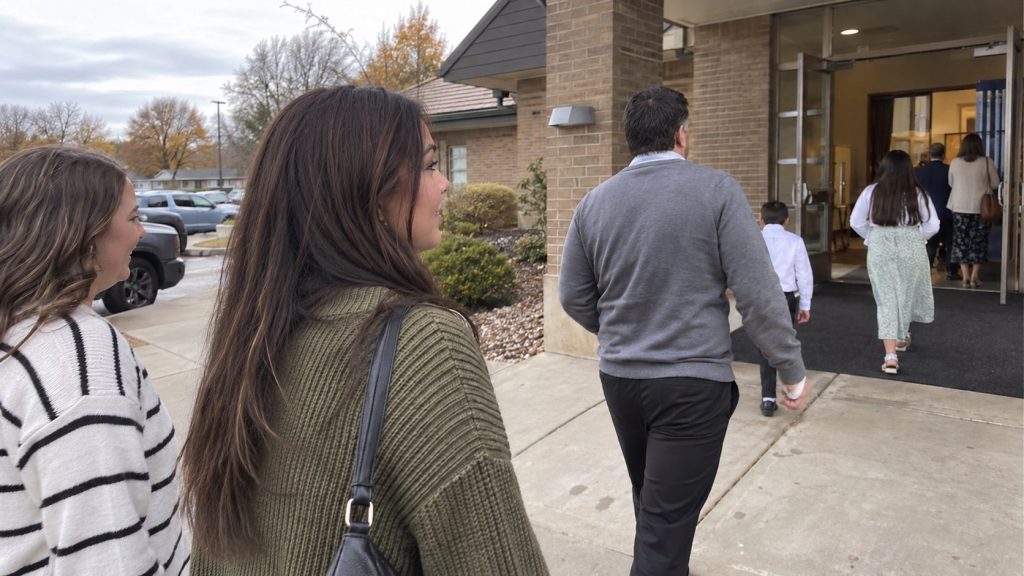
If you’ve been invited to a Latter-day Saint baptism for the first time, you do not need to wear white, know special prayers, or participate in the ordinance—the baptism itself.
People often search for this as a Mormon baptism, although the Church’s official name is The Church of Jesus Christ of Latter-day Saints. Nonmembers, friends, and relatives are welcome, and the baptismal service is intended to be simple and brief.
Here is what to expect—from what to wear and how much time to allow to what actually happens when the person enters the water.
Mormon Baptism at a Glance
| Question | Quick Answer |
|---|---|
| Can non-Mormons attend? | Yes |
| Do guests wear white? | No |
| What should I wear? | Clean, modest, normal church-appropriate clothing |
| How long does it last? | There is no fixed length; allowing roughly an hour is a practical estimate |
| Do I have to participate? | No |
| Is baptism by immersion? | Yes |
| Can I take photos? | Not of the baptismal service or ordinance |
| Should I bring a gift? | No gift is required |
| Is confirmation always the same day? | No; timing differs for children already on Church records and converts |
| Will missionaries talk to me? | They may, but attending creates no obligation |
The exact program varies. The Church does not prescribe a fixed length or require every baptismal service to include exactly the same talks, music, or other elements.
Can Non-Mormons Attend a Mormon Baptism?
Yes. Nonmembers are welcome at Latter-day Saint baptismal services.
Friends and relatives are often invited, particularly when an adult or young adult is joining the Church. You do not need to be a Latter-day Saint—or even a Christian—to attend.
You also do not need to understand everything that happens beforehand.
If someone you care about invited you, your presence can simply be a way of supporting that person.
What If I Don’t Agree With LDS Beliefs?
You can still attend.
Being present at someone’s baptism does not mean that you agree with every belief of The Church of Jesus Christ of Latter-day Saints.
It can simply mean:
“This matters to you, so I came to support you.”
You will not be expected to pretend that you believe something you do not. You can listen quietly, be respectful during the service, and congratulate the person afterward.
What Should You Wear to a Mormon Baptism?
Guests do not need to wear white.
A practical choice is clean, modest clothing similar to what you might wear to an ordinary church service or family event.
That might be a dress, skirt, trousers, blouse, dress shirt, polo, or other neat everyday clothing. Many Latter-day Saints may be dressed somewhat formally, but there is no reason to turn the invitation into a wardrobe emergency.
If your available option is clean jeans and a normal shirt, it is better to come support the person than to stay home because you think you are not dressed formally enough.
What Does the Person Being Baptized Wear?
The person being baptized wears white baptismal clothing that will not become transparent when wet.
The person performing the baptism also wears white. Current Church instructions specify white, nontransparent clothing for both participants.
This clothing is connected with the baptism itself. Guests are not expected to match it.
How Long Does a Mormon Baptism Last?
There is no official fixed length for an LDS baptismal service.
The Church’s handbook describes baptismal services as simple, brief, and spiritually uplifting. It does not specify 30 minutes, 45 minutes, or any other universal duration.
For practical planning, allowing roughly an hour is reasonable if the family has not given you a more specific schedule. That is a planning estimate, not a Church rule.
A small service for one person may be shorter. A shared baptismal service involving several people can take longer.
If you were given a starting time but no ending time, it is sensible not to schedule something immediately afterward that requires you to leave at an exact minute.
What Happens at a Mormon Baptism? Step by Step
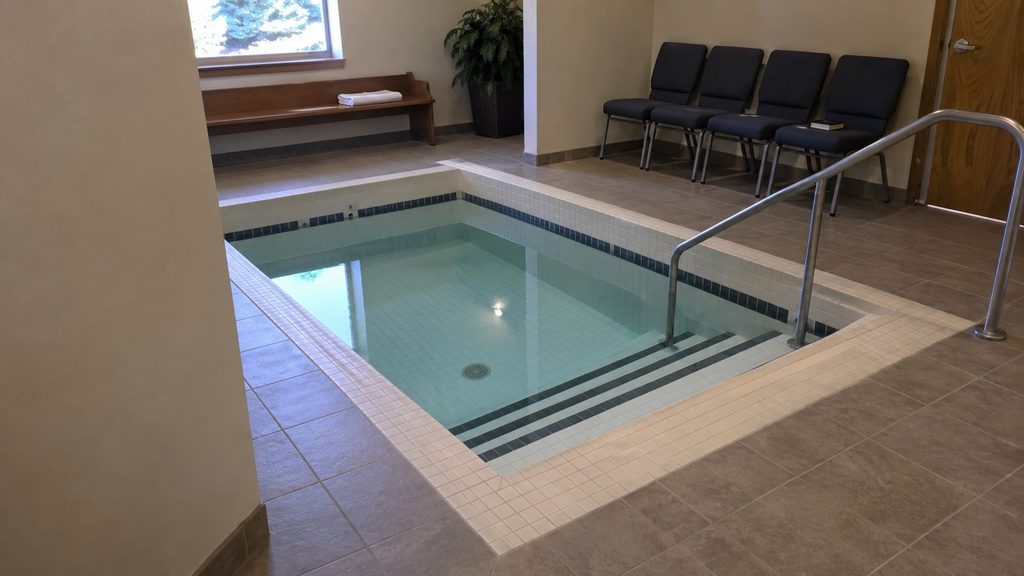
An LDS baptismal service—sometimes searched as a Mormon baptism ceremony—usually follows a simple sequence.
The Church’s handbook outlines a service that may include a welcome, hymn and prayer, short messages, music, the baptism, time for the participants to change clothes, confirmation when applicable, and a closing hymn and prayer.
1. Arrival and Seating
Most baptisms are held where a baptismal font is available, often in a Latter-day Saint meetinghouse.
Follow the location on the invitation. Once inside, ask someone to direct you to the room being used for the baptismal service if it is not obvious.
Arriving a little early can be helpful, particularly if you have never been inside the building before.
2. Opening Hymn and Prayer
The service normally begins with a brief welcome, hymn, and prayer.
If you do not know the hymn, you can simply listen. If lyrics are available and you want to sing, you can join in.
There are no special responses or memorized prayers that a guest needs to know.
3. Short Talks or Music
There may be one or two short messages about baptism, the Holy Ghost, or related subjects.
A musical number may also be part of the program.
These parts are often given by family members, missionaries, or local Church members rather than by a visiting minister.
The exact program varies from one baptism to another.
4. The Baptism by Immersion
Two approved witnesses observe the baptism to make sure it is performed correctly.
Depending on the building and how the local service is arranged, other guests may watch the immersion from the baptismal area, or they may remain in the main meeting room while the baptism takes place. Official Church instructions require two approved witnesses to observe the ordinance; they do not require every guest to have a view of the water.
The immersion itself lasts only a few moments.
One thing can surprise first-time guests: sometimes the baptism is performed again.
That does not mean anything dramatic or spiritually troubling happened. Complete immersion is required. If part of the person’s body, hair, or clothing does not go completely under the water—or if the prescribed words are not spoken correctly—the baptism is repeated.
5. Changing Into Dry Clothes
After leaving the font, the participants go to change into dry clothing.
The program naturally pauses during this time.
There may be quiet music, hymn singing, or simply a few minutes of reverent waiting. The Church’s suggested baptismal-service outline specifically includes this period while participants change.
So if nothing seems to be happening immediately after the baptism, the service has not stalled. The pause is normal.
6. Confirmation May Take Place
Depending on the person’s circumstances and how the service is planned, confirmation may happen here or at another Church meeting.
More on that below.
7. Closing Prayer and Conversation
The formal program normally ends with a closing hymn and prayer.
Afterward, the atmosphere becomes more informal. Family members and friends may congratulate the person who was baptized, talk together, or continue to another gathering if the family has planned one.
Will I Be Expected to Sing, Pray, or Participate?
No. You can attend simply as a guest.
Unless someone has spoken with you beforehand about participating in the program, you can sit with the other guests and observe.
Do I Have to Sing?
No.
You are welcome to sing during the hymns, but listening quietly is also fine.
Do I Have to Pray?
No.
The opening and closing prayers are normally offered by people who have already been asked to do so.
Will I Be Asked to Speak?
Not unless that has been arranged with you beforehand.
You should not expect to be unexpectedly called forward to give a religious message simply because you attended.
Do I Have to Make Any Religious Commitment?
No.
Guests do not make baptismal promises, recite a creed, or formally affirm Latter-day Saint beliefs.
The baptism belongs to the person being baptized.
Will Missionaries Talk to Me?
They may.
Missionaries are often present at convert baptisms. One may introduce himself or herself, ask how you know the person being baptized, or talk with you about the service.
That does not mean you have to give missionaries your phone number, schedule a lesson, or express interest in joining the Church.
If you are not interested, a simple:
“No, thank you.”
is enough.
Attending someone’s baptism is not an agreement to take missionary lessons.
Guest Etiquette: Photos, Gifts, and Children
Most guest etiquette is straightforward: be respectful during the religious service and follow the family’s lead before and afterward.
Can I Take Photos?
Do not photograph or record the baptismal service or the baptism itself.
This rule is broader than simply putting your phone away during the moment of immersion. The current General Handbook says no one should take photographs or make video recordings of ordinances, blessings, or baptismal services.
Posed photographs before or after the service may be fine if the family and local leaders are comfortable with it.
If you want a photograph with the person who was baptized, asking afterward is the safest approach.
Should I Bring a Gift?
No gift is required.
Your presence may be enough.
If you are a close friend or relative and want to bring something, a simple card or small personal gift is perfectly reasonable.
There is no standard LDS baptism gift that every guest is expected to purchase.
Can I Bring Children?
Generally, yes.
Latter-day Saint baptismal services are family-oriented events, and children commonly attend.
Use the same judgment you would at another quiet religious gathering. If a young child needs a break, stepping outside briefly is usually less disruptive than trying to force complete silence.
What Is Confirmation?
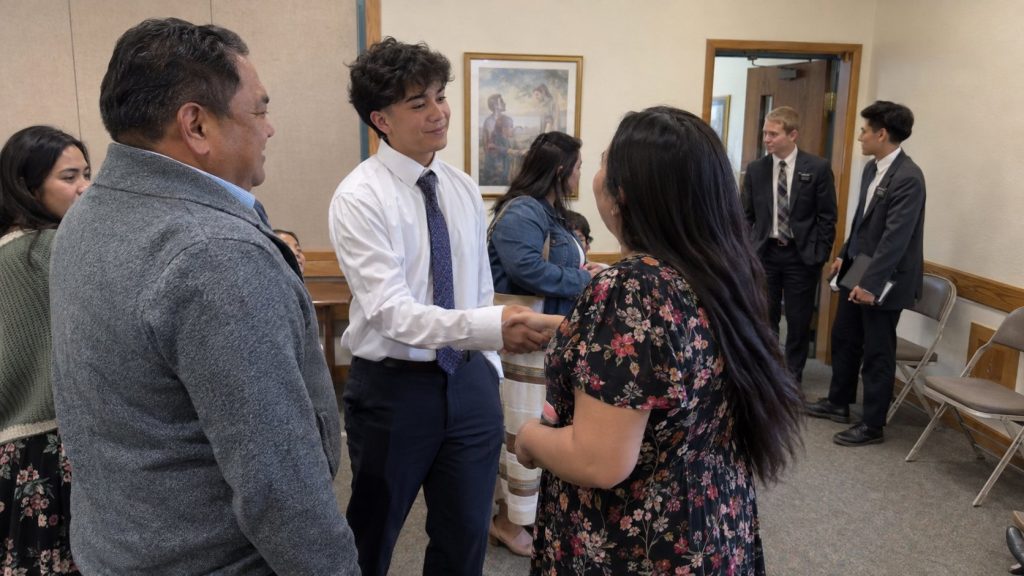
Confirmation is a separate ordinance that follows baptism.
During confirmation, authorized priesthood holders place their hands on the person’s head. The person is confirmed a member of The Church of Jesus Christ of Latter-day Saints and receives the gift of the Holy Ghost.
Is Confirmation Always on the Day of Baptism?
No.
For an 8-year-old already on Church records, confirmation typically happens on the same day as baptism.
For a convert—someone joining the Church—confirmation may happen at the baptismal service or later in sacrament meeting, the congregation’s main Sunday worship service, as soon as possible after baptism. The current Handbook explicitly allows both options for converts.
So if you attend a convert baptism and the service ends without a confirmation, nothing was necessarily forgotten.
Baptism and confirmation are both completed and recorded as part of becoming a Church member.
What Should I Say After Someone Is Baptized?
You do not need special Latter-day Saint vocabulary.
Simple, sincere comments work perfectly well:
- “Congratulations.”
- “Thank you for inviting me.”
- “I’m glad I could be here.”
- “I know this was important to you.”
If you are close to the person, you can also simply ask how they are feeling.
There is no need to turn the moment into a theological conversation unless they want to.
What If I’m the One Getting Baptized?
If you are preparing for your own baptism rather than attending as a guest, you need a different guide.
Questions about the preparation process, missionary lessons, Church attendance, baptismal interview, eligibility, and situations that can delay baptism are covered separately in LDS Baptism Requirements: A Practical Guide for Converts.
Read the LDS Baptism Requirements guide
This page is intentionally focused on what happens at the service and what a first-time guest should expect.
Mormon Baptism FAQ
Is There Food After a Mormon Baptism?
Sometimes.
A family may provide refreshments, desserts, or a small gathering afterward, but food is not part of the baptismal service and should not be assumed.
Do Mormons Have Godparents?
No.
The Church does not have a formal godparent role comparable to the one found in some other Christian traditions.
Relatives and friends can still play important spiritual roles in someone’s life, but no godparent is required for an LDS baptism.
Can a Mormon Baptism Take Place Outside a Church?
Yes.
A baptismal font is used when one is available. If there is no font, a safe body of water large enough for the person being baptized and the person performing the baptism may be used.
Is the Baptismal Water Blessed?
No.
The water itself is not blessed or dedicated for baptism. The Handbook explicitly states that water is not dedicated for baptisms.
Who Can Perform an LDS Baptism?
A baptism can be performed by a priest or a Melchizedek Priesthood holder, with the required approval.
For example, an appropriately authorized father may baptize his child, while a convert may be baptized by a missionary or another authorized priesthood holder.
Can Several People Be Baptized at the Same Service?
Yes.
Several people can share a baptismal service.
The current Handbook specifically allows multiple children to share a service and, in areas with many children, allows children from multiple congregations to participate in a shared baptismal service.
Do Mormon Baptisms Have to Be on Sunday?
No.
There is no rule requiring an LDS baptism to take place on Sunday.
Follow the date and time on the invitation rather than assuming the baptism will be part of a normal Sunday worship service.
Last reviewed: September 2026
“Mormon” and “LDS” remain common search terms used by people looking for information about The Church of Jesus Christ of Latter-day Saints. The Church’s official name is The Church of Jesus Christ of Latter-day Saints.
Official Church Sources
General Handbook 18.7 — Baptism and Baptismal Services
General Handbook 18.8 — Confirmation and Gift of the Holy Ghost
General Handbook 38.2.2 — Photographs, Recordings, and Transcriptions of Ordinances and Blessings